You're trying to study with lecture slides open, a paragraph half-written, and your phone lighting up beside the keyboard. You check one message to clear your head, then look up and realize you've spent the time replying, scrolling, and reopening the document without finishing the work that mattered.
That isn't a character flaw. It's a work-design problem. Deep work vs shallow work gives you a practical way to see why a day can feel full and still produce little, and what to change. Kohru, an app built for students, helps block distractions on your phone and laptop at the same time, so a focus plan doesn't depend on resisting every notification.
| Work type | What it asks of you | Common examples | Best place in your schedule |
|---|---|---|---|
| Deep work | Sustained attention, expertise, and judgment | Studying, research synthesis, original writing, complex analysis | Protected blocks when you're most alert |
| Shallow work | Routine coordination and low-context follow-through | Email, scheduling, basic admin, routine messages | Designated windows, away from deep blocks |
Shallow work isn't useless. It keeps classes, projects, and teams moving. The trouble starts when you let it arrive whenever it wants. Messages, scheduling, and quick checks fill the open spaces in your day, pushing aside the work that requires a continuous train of thought.

Table of Contents
- Why Your Day Feels Busy but Empty
- Defining Deep Work and Shallow Work Clearly
- What Research Says About Interruptions and Switching
- Real Use Cases for Students, Researchers, and Professionals
- The Hidden Role of Shallow Work in an AI World
- When to Schedule Deep Blocks and Shallow Windows
- How Kohru Helps You Actually Do the Work
- Practical Tips to Increase Deep Work This Week
Why Your Day Feels Busy but Empty
The first fix is to stop treating activity as evidence of progress. A full inbox, completed admin, and a calendar packed with calls can make you feel productive while your key deliverable stays untouched. Your day needs room for both coordination and concentration, but they shouldn't compete for the same minutes.
Deep work means applying sustained attention to a demanding task that builds skill or produces work that's hard to replicate. Shallow work means routine, lower-context activity that can tolerate more interruptions. Studying a difficult concept, drafting an argument, analyzing data, and writing code often need depth. Replying to routine messages, moving appointments, and updating a task list usually don't.
The distinction isn't a moral ranking. You need shallow tasks. A student must handle course logistics; a researcher must coordinate with colleagues; a professional must reply to clients. But those tasks can expand until they occupy every gap unless you deliberately give them boundaries.
Find the part of the day that keeps disappearing
Look at yesterday's calendar or task list. Identify the single piece of work that would have made the day feel meaningful if you'd completed it. Then note what interrupted it, including self-initiated checks. The point isn't to blame yourself. It's to see whether the problem was a task that lacked a clear next step, or a day designed around reactions rather than priorities.
Give the important task a specific outcome, not a vague label. “Study biology” is too broad. “Explain the cell-signaling process from memory and check gaps against the notes” gives your attention a target. “Work on paper” is vague. “Draft the section comparing the two methods” is workable.
Practical rule: Decide what you'll finish before you open email or chat. If you don't choose the day's priority, other people's requests will choose it for you.
A better day doesn't mean eliminating every small task. It means making sure shallow work has a place and deep work has protection. That's the shift from being busy to producing something you can point to.
Defining Deep Work and Shallow Work Clearly
A useful distinction has to guide decisions, not just sound inspiring. Ask: Does this task require my full attention to produce something only I can make? If the answer is yes, it likely belongs in a deep-work block. If the task is routine, logistical, and easy to resume after a pause, it's probably shallow work.
Deep work relies on sustained concentration. A literature-review section, a challenging problem set, a complex analysis, or an original design can demand knowledge, judgment, and connected thinking. Interruptions matter because you may need to rebuild the argument or remember why you took a particular path.
Shallow work handles coordination and maintenance. Examples include sorting routine email, arranging meetings, formatting notes, or sending a standard update. These tasks still need to be done, but they usually don't deserve your sharpest hours.
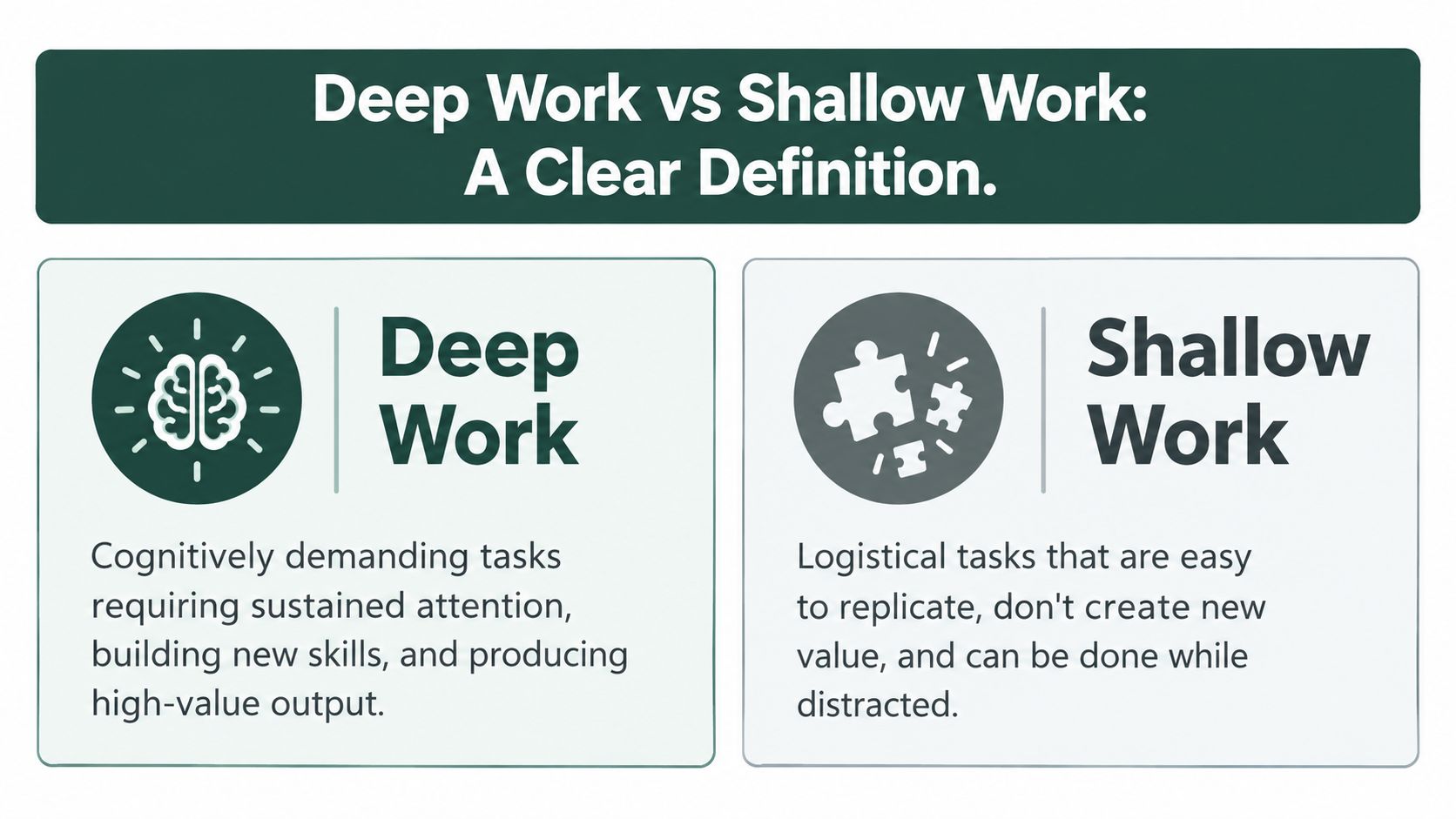
| Criterion | Deep Work | Shallow Work |
|---|---|---|
| Cognitive demand | High, requiring sustained thought and judgment | Lower, often routine and repeatable |
| Context cost | High, because the task depends on holding a complex problem in mind | Lower, because the next step is often easy to pick up |
| Typical examples | Research synthesis, studying, original writing, complex problem-solving | Email triage, scheduling, routine communication, basic administration |
| Best scheduling window | A protected period when you're alert | A planned window between or after focus blocks |
Here's a useful test for borderline tasks: Would splitting my attention make the result worse? If you're checking a complicated calculation or developing a thesis, interruptions can break the line of reasoning. If you're confirming a meeting time, you can usually pick up where you left off without reconstructing an argument.
Don't force every task into a fixed category forever. Reading a paper for an idea may be deep; skimming a message for a date may be shallow. Classify the work by the attention it needs, then schedule it accordingly.
What Research Says About Interruptions and Switching
Multitasking isn't a free way to squeeze more into a day. A controlled experiment with 30 participants compared uninterrupted single-task work, multitasking, and interruption conditions. Multitasking significantly reduced correctness, increased reaction time, and raised cognitive load. Interruptions also increased reaction time and cognitive load, while reducing correctness during monotasking (the controlled experiment).
That finding supports a simple operating rule: give each focus block one primary deliverable. Don't draft a section while monitoring chat and switching to small admin tasks. Finish the planned piece, then move to messages during a separate window.
Predictable switching still takes effort. Even when people know they'll alternate between tasks, they can perform more slowly on switch trials than on repeat trials. The cost tends to grow when tasks are more complex or unfamiliar (the American Psychological Association's overview of multitasking). A planned switch may be necessary, but it isn't costless.
Treat interruptions as a design problem
An interruption can leave you with a resumption lag: you need to reconstruct what you were doing, what the goal was, and what comes next. Interruption research also describes errors from repeated or omitted work, and finds that interruptions at natural breaks or that are short and task-relevant tend to be less disruptive. Batch routine messages, protect high-context tasks, and write a concise “ready to resume” note before switching: current objective, completed step, next action (review of interruption research).
Your phone doesn't have to buzz to affect the work. In two experiments published in the Journal of the Association for Consumer Research, having a smartphone nearby reduced available working-memory capacity and fluid intelligence even when participants didn't use it (research on smartphone presence and cognitive capacity). Put the phone out of reach during demanding work instead of asking yourself to ignore it repeatedly.
If background audio helps you settle into a study routine, choose it deliberately rather than adding another source of novelty. These LesFM study music recommendations offer an option to explore while setting up a consistent focus environment.
Real Use Cases for Students, Researchers, and Professionals
A college student has lectures, a problem set, and a part-time shift in the same week. The student's deep work might be a protected block to solve a specific set of problems, with the phone and social apps put away. Shallow work can include checking course announcements, arranging a shift swap, and replying to routine messages in a separate window. The important distinction is not whether the student is at a desk, but whether the task needs concentrated thinking.
That distinction matters for learning. An analysis of 27 experiments covering 2,245 participants, with an average age of 21, found a statistically significant, medium-sized negative effect of mobile-technology distractions on students' ability to recall lecture and reading content (analysis of mobile distractions and student recall). Time with a textbook open isn't necessarily focused learning if attention keeps getting diverted.
A graduate researcher faces a different mix. Reading a paper to synthesize its argument, comparing findings, or drafting a chapter calls for sustained attention. Booking a meeting, confirming a source, and updating a shared document are coordination tasks. Before leaving the chapter to answer a necessary request, the researcher can jot down the next sentence or question to tackle, making it easier to re-enter the work.
For someone preparing for instrument flight rules, a demanding study block could focus on understanding one topic and checking it against study materials. A structured IFR readiness checklist can help organize what to review without turning the study session into a stream of unrelated checks.
Match the schedule to the real environment
A young professional may need to balance client work, meetings, and inbox triage. They should protect a block for analysis or a client deliverable, batch routine replies, and leave a clear route for urgent matters. A remote worker or neurodivergent learner may also need a plan that tolerates an unpredictable environment rather than assuming every interruption can be prevented.
Don't copy someone else's ideal calendar. Choose one high-value task, reserve a realistic period for it, and name which interruptions can wait. That gives you a repeatable pattern without pretending your responsibilities are identical to anyone else's.
The Hidden Role of Shallow Work in an AI World
Treating every shallow task as waste is a mistake. Email, feedback, coordination, and preparation can be necessary inputs to deep work. The goal isn't to erase them. It's to stop routine coordination from consuming the time and attention needed for work that depends on your expertise.
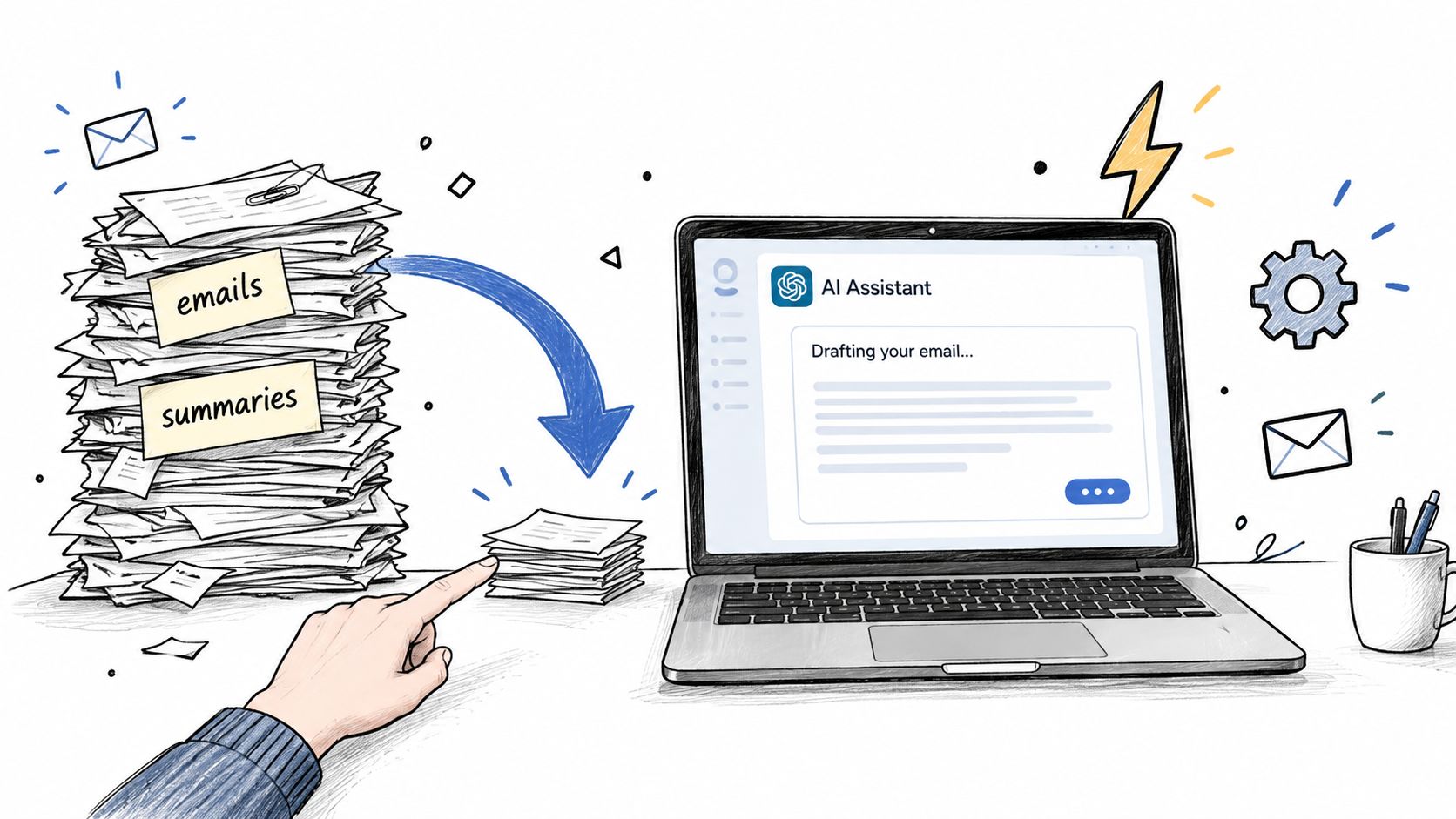
AI can speed up some routine tasks, but saved time doesn't automatically become focused time. In a randomized field experiment across 66 firms and 7,137 knowledge workers, workers given workplace AI access who used it spent about two fewer hours per week on email and worked less outside regular hours, with no meaningful change in overall task composition (the workplace AI field experiment). The finding points to an allocation problem: people may do familiar work faster without changing what they choose to do next.
Reinvest the time on purpose
Use a clear division of labor. Let AI help with draft-level work, such as producing a starting point for a routine message or organizing notes. Keep your judgment on the claims, decisions, and final wording. Then assign any time saved to a named deep-work deliverable before the day starts.
A student might use an assistant to organize rough notes, then spend the protected block checking the concepts and writing an explanation in their own words. A professional might use a draft to speed up a routine update, then reserve the recovered time for analysis or problem-solving. In both cases, the tool assists with preparation; the person still does the work that requires understanding.
Automation should shorten the shallow task, not give it permission to spread. Decide where the saved time goes before it appears.
The right target isn't zero shallow work. It's shallow work that's bounded, useful, and kept out of the best concentration windows. Use automation to reduce routine effort, then deliberately protect the human work that needs depth.
When to Schedule Deep Blocks and Shallow Windows
Put deep work on the calendar before routine tasks claim the day. An effective starting plan is a 90-to-120-minute morning block for one primary deliverable, followed by a shallow-work window. Add another brief shallow window in the late afternoon, then use a short evening review to choose tomorrow's focus task. Adjust the pattern to your class timetable, meetings, caring responsibilities, and energy.
Choose a task with a visible finish line. “Work on research” gives you no way to tell if the block worked. “Compare the methods in two papers and draft my synthesis notes” does. Keep the block focused on that outcome, and defer messages that don't meet your exception rule.
Decide which interruptions earn a response
Don't use a simplistic rule that every interruption is bad. Before breaking a block, assess four questions:
- Urgency: Will waiting create a real problem, or is someone merely expecting a quick reply?
- Irreversibility: Could delay cause harm or close an important option?
- Collaboration value: Does responding now unblock meaningful work for someone else?
- Cognitive reset: Can you return to the task quickly, or will the switch disrupt a complex line of thought?
Respond when an issue is urgent or delay would be costly. Batch ordinary requests for the next shallow window. For unpredictable settings, agree on an exception channel with colleagues, classmates, or family so important messages can get through without making every notification an emergency.
Before an intentional switch, write down the next action. “Resume analysis” isn't enough; “check whether the two studies use the same outcome measure” is specific. When the shift arrives, choose the next deep task and prepare the materials you'll need. That makes it easier to begin instead of spending your best attention deciding what to do.
How Kohru Helps You Actually Do the Work
A schedule only works if your devices don't keep pulling you out of it. Kohru is built for students and helps block distractions on your phone and laptop at the same time, supporting a focus session around one clearly defined task instead of leaving every app available to interrupt.
The case for cross-device boundaries is practical. In a study of 160 adolescents tracked for three weeks, researchers collected 733,359 smartphone-use observations and 12,723 experience-sampling reports. 77% of participants showed increased distraction when phone use was more fragmented, while 55% showed increased distraction when use was more continuous or sticky (the study of smartphone-use patterns and distraction).
Kohru's one-click Focus Sessions let you set a session around one task, while its Smart To-Do Lists separate Work and Personal items and turn tasks into focused sessions. Habit Tracking uses flexible weekly targets rather than relying only on an unbroken daily streak. Those features make the deep-work plan easier to carry out across devices. Kohru is a practical answer to the article's central problem: make focus a coordinated part of your environment, not a test of willpower.
Practical Tips to Increase Deep Work This Week
Use this checklist to make the next seven days more deliberate:
- Name one deliverable before each focus block. A clear outcome gives your attention a target.
- Write a ready-to-resume note before an intentional switch. It lowers the effort of rebuilding context.
- Move your phone out of reach. Silencing it still leaves it nearby as a distraction.
- Batch email and chat into planned windows so routine messages don't break up demanding work.
- Use AI for draft-level assistance, then assign the time saved to analysis, study, or original writing.
- Review your day briefly and ask what should get your first focused block tomorrow.
For additional study ideas that fit adult learners' schedules, see these focus tips for UK adult learners. At the end of the week, ask yourself: “What percentage of my prime hours went to deep work?” Use the answer to adjust the calendar, not to criticize yourself.
Kohru can block distractions across your phone and laptop while turning individual tasks into Focus Sessions. Visit Kohru to set up a focused work session and give your next important task the protected attention it needs.
