You sit down to study, open the assignment, and tell yourself you'll begin in a moment. Then the moment stretches. The deadline still feels distant, the task feels enormous, and suddenly the day has disappeared. You may care about the work and still feel unable to start.
An ADHD focus timer can help by making time visible, bounded, and easier to act on. It isn't a test of discipline or a cure for ADHD. It's an external support for a brain that may struggle to estimate duration, begin low-interest tasks, shift attention, or notice time passing.
Table of Contents
- Why Your Brain Struggles With Time
- The Science Behind Timed Work Blocks
- Choosing the Right Interval Length
- Essential Features to Look For
- Setting Up Your Focus Strategy
- Real-World Use Cases and Examples
- Integrating Timers with Kohru
Why Your Brain Struggles With Time
A graduate student opens a research paper due soon. The reading should fit into a manageable period, yet the task feels shapeless. Should they read the abstract, take notes, search for sources, or begin drafting? Without a clear boundary, each possible action competes for attention. They may wait until urgency becomes strong enough, then try to complete the work under intense pressure.
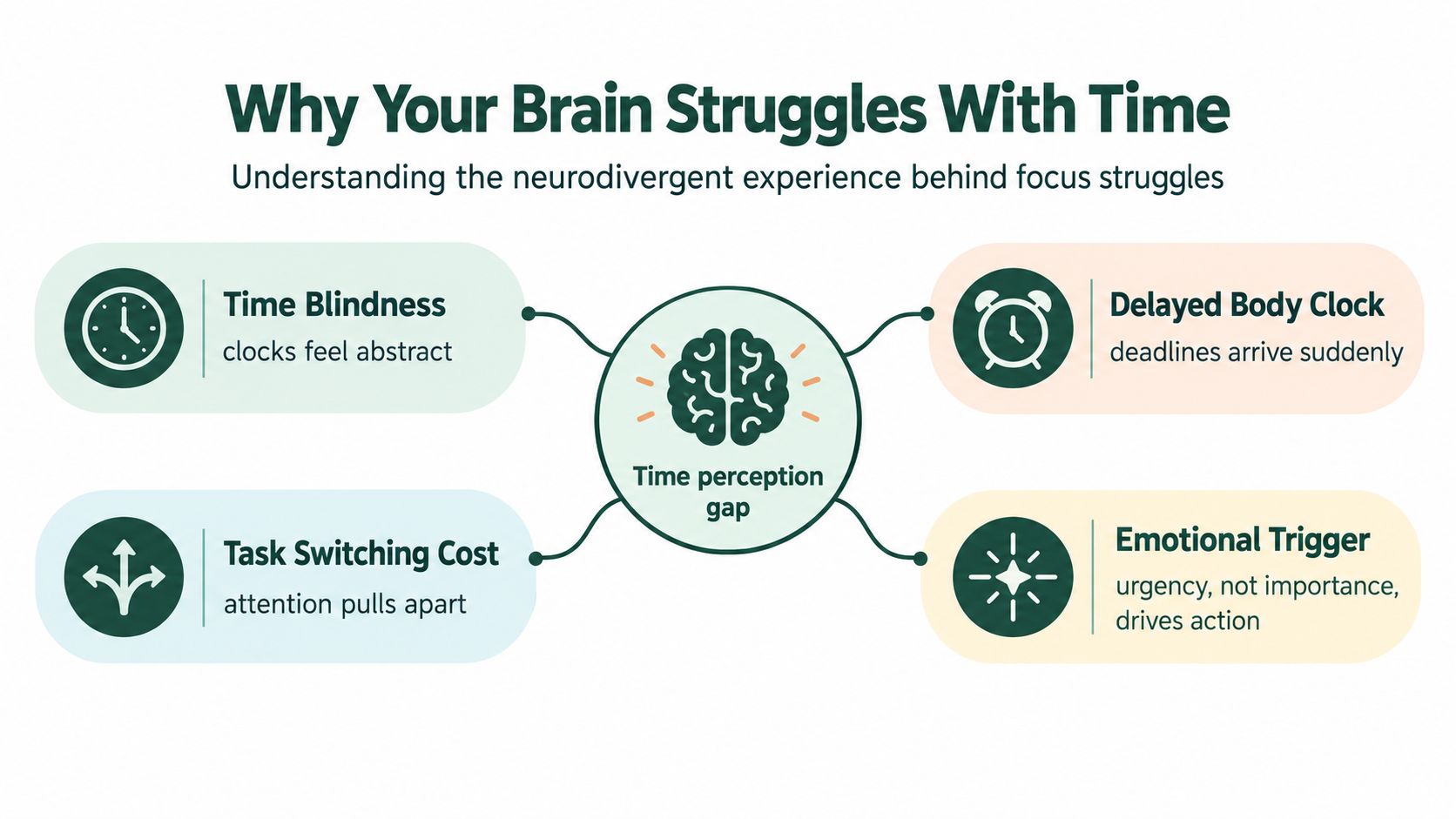
This experience is often called time blindness, though the problem involves more than failing to notice the clock. Reviews of ADHD research describe differences in time estimation, time reproduction, and time management. A deadline can feel far away when action is needed now, then suddenly feel immediate. Internal time tracking is not providing a dependable guide. That is a cognitive difficulty, not a character flaw. Reviews of ADHD time perception describe these differences across children, adolescents, and adults.
Why intention doesn't always become action
Many people with ADHD understand what they need to do. The difficulty sits between intending and starting. A large or unclear task requires the brain to estimate duration, select a first step, resist distractions, keep the goal in working memory, and tolerate discomfort before any reward appears.
Several executive-function demands arrive at once, so a simple task can feel inaccessible. A visible countdown removes part of that uncertainty. Instead of asking, “How long will this take, and can I finish it today?” you can ask, “What can I do during this defined work period?”
That change gives the task a beginning, a temporary boundary, and a stopping cue. The timer acts as an external scaffold for executive functions that may be difficult to access consistently. Its format should match the difficulty involved: a countdown can make duration visible, while a start and stop signal can reduce decisions around beginning and ending.
Self-compassionate rule: If your internal sense of time is unreliable, use an external signal instead of blaming yourself for not “trying harder.”
The Pomodoro Technique provides a familiar structure with 25-minute focus intervals, 5-minute breaks, and a longer 15 to 30-minute break after four cycles. It can turn abstract time into visible segments, but one standard format will not suit every ADHD-related need. A 2017 randomized controlled study involving 38 children aged 9 to 15 with ADHD found that a time-related multimodal intervention improved time perception ability more than standard care, with a statistically significant result of p = 0.019, as reported in the study record on time-related ADHD interventions.
A timer cannot make every task interesting or remove emotional resistance. It can bridge “I should begin” and one concrete action. If you are also exploring habits that may boost concentration naturally, treat them as possible complements rather than replacements for the external structure that supports starting.
The Science Behind Timed Work Blocks
A task can be clear, important, and still feel impossible to contain. You begin without knowing how long the effort will last, lose track of time while working, or continue until fatigue makes restarting harder. Timed work blocks address that uncertainty by giving effort a visible boundary.
The support works in two ways. It externalizes time management, which may be difficult to maintain internally, and limits uninterrupted effort before attention begins to deteriorate. A timed block works like a container: it holds one period of work without requiring you to predict the entire afternoon.
Adult ADHD research examines several forms of timing. Prospective timing means estimating how long an activity will take. Retrospective timing means judging its duration afterward. Interval reproduction means trying to repeat a period accurately. Reviews describe difficulties across these tasks and discuss findings in which children with ADHD estimated a 10-minute task as taking about 20 minutes. The adult ADHD time perception review provides that research context.
Those differences help explain why “just keep an eye on the clock” can be inadequate advice. A timer supplies the information at the point of need, rather than asking you to generate it continuously.
At the beginning, the timer marks the starting line. During the block, it shows that the work has a defined endpoint. At the end, it answers the question of whether you have worked long enough. These cues reduce timing decisions while your attention is already handling the task.
Why breaks are part of the method
A break creates room for recovery before fatigue, restlessness, or mental wandering makes the next interval harder. In a controlled study using four 20-minute attention tests, adults with ADHD showed medium-sized differences in alertness, selective attention, and divided attention compared with healthy controls. The controlled attention study supports using planned recovery as part of a timed-work design.
Recovery can be simple: stand up, drink water, look away from the screen, or change your physical setting briefly. Give the break a boundary too, so it does not turn into an open invitation to check every distracting app.
The structure separates activation, effort, and recovery. You do not need enough motivation for an entire afternoon. You need a cue to begin, a bounded period for one concrete task, and a planned pause before deciding what comes next.
What the evidence doesn't prove
This evidence supports external time cues and shorter periods of uninterrupted work. It does not establish the Pomodoro method as a clinical treatment for ADHD, nor does it show that one interval and break pattern suits everyone.
Use timed work as an experiment rather than a test of discipline. If the timer reduces uncertainty and helps you return to the task, keep that format. If it adds pressure, interrupts useful concentration, or becomes another object to manage, change the duration, cues, or recovery plan.
Choosing the Right Interval Length
The standard 25-minute focus period is a starting point, not a requirement. Some people need a smaller first step because the task feels emotionally or cognitively heavy. Others need a longer uninterrupted period because reading, coding, writing, or solving a complex problem requires time to build context.
Short intervals can lower the entry barrier. Independent guidance on ADHD timers notes that some people use 15- or 20-minute sessions when those periods better match their attention capacity, and that defined intervals can make task initiation feel less overwhelming. The discussion of timer formats for ADHD time perception also emphasizes that direct comparisons between visual, auditory, and haptic timers remain limited.
Match the interval to the task
| Task situation | A practical starting point | What to watch for |
|---|---|---|
| Strong resistance or unclear first step | A short session | Stop after the interval and define the next action |
| Routine reading or administration | A moderate session | Use the end cue to prevent drifting |
| Writing, research, coding, or design | A longer session | Avoid interrupting yourself just as concentration develops |
| Low energy or late-day work | A shorter session with recovery | Treat completion as useful, not as a reason to extend endlessly |
The key question isn't “Which timer length is correct?” Ask instead, “What kind of support does this task need?” A short session can help you open the document, write a rough heading, or sort the first group of notes. Once you're engaged, you may choose a longer interval for the next round.
Shorter isn't always better
Short work periods can become counterproductive when every alarm interrupts the thinking process. A researcher may spend the first part of each session remembering the argument, locating a source, and rebuilding concentration. Frequent breaks can then fragment the very work the timer was meant to protect.
For deep work, try allowing enough uninterrupted time to pass through setup and into sustained attention. You can still use a visible countdown and a planned stopping point without forcing yourself to stop at the first sign of progress.
Auditory, visual, and haptic cues may serve different needs. A visual timer helps when elapsed time needs to remain visible. An audio cue helps when looking away from the task would cause distraction. A vibration may support transitions without adding noise. There isn't strong head-to-head evidence showing that one format is universally best for adults with ADHD, so choose based on the problem you're solving.
Experiment, don't obey: Keep the interval that helps you start, stay engaged, and stop without resentment.
You may also vary the setting across the day. A shorter session can support task initiation when energy is low. A longer session can protect complex work when your attention is already engaged. The goal is a flexible rhythm that respects fluctuating attention rather than a rigid schedule that turns normal variation into failure.
Essential Features to Look For
A countdown alone does not address every way an ADHD workflow can break. Choose a timer according to the support you need most. Do you lose track of elapsed time, struggle to begin, get pulled toward notifications, or keep working after useful attention has faded? The right tool should reduce those decisions instead of becoming another dashboard to manage.
Start with custom durations, a clear display, and simple controls. Your needs may change with the task, your energy, and your level of engagement. If adjusting a session takes several menus, the tool creates friction at the moment executive function is already under pressure. Opening the timer, choosing a task, and starting should feel straightforward.
Prioritize the support you actually need
- Visible progress: A shrinking bar or clear countdown gives abstract time a visible shape. You can check your position without repeatedly calculating how long you have been working.
- Gentle transition cues: A sound, vibration, or spoken notification can mark the start and end of a session when switching tasks does not happen automatically.
- Automatic breaks: A break prompt creates a planned recovery point. It can interrupt the tendency to work until exhaustion or drift into an unplanned pause.
- Distraction blocking: Blocking selected apps and websites removes repeated choices during a session. This helps when notifications or habitual checking quickly redirect attention.
- One-task focus: Showing one selected task at a time can make the next action easier to identify, especially when a crowded list creates paralysis.
- Session history: Simple records can reveal which durations support your work. Treat the information as feedback, not a score that determines whether you used the timer correctly.
Adults with ADHD may find that sustained attention becomes harder as time-on-task continues. Controlled attention research linking shorter uninterrupted periods and more frequent breaks with reduced deterioration supports giving recovery features equal weight with the countdown display. The study of alertness and selective attention in ADHD provides the research background for that approach.
Use sensory cues carefully
More stimulation does not automatically create better focus. A bright animation may help one person remain engaged while distracting another. A loud alarm may make transitions clearer for one user and cause sensory overload for someone else.
Choose the least intrusive cue that solves the specific problem. If you forget that the timer is running, use a stronger end signal. If sound pulls you out of concentration, select a visual indicator or vibration. If transitions between tasks make time disappear, set reminders for both the end of work and the beginning of the break.
Test the tool on a difficult day. Can you open it, select the task, start the session, and return to work without negotiating with the interface? A useful ADHD support tool should remain workable when your attention and organization are already limited. A long feature list matters less than reliable access to the one feature you need.
Setting Up Your Focus Strategy
The timer works best when it has a job inside a larger workflow. Before starting, choose one task and define the smallest visible outcome for the session. “Work on thesis” is too broad. “Draft the opening paragraph” or “sort the notes under the literature heading” gives the interval a direction.
Separate work tasks from personal reminders when possible. A study session shouldn't compete on the same screen with shopping, messages, appointments, and household errands. Fewer competing choices make it easier to recognize what the current interval is for.
Build a low-friction routine
Use this setup when you're starting from scratch:
- Capture the task: Write the task in concrete language, such as “answer the first client email,” not “catch up.”
- Choose the entry interval: Pick a shorter period when starting feels difficult, or a longer period when the task needs uninterrupted context.
- Remove one distraction: Put the phone away, block a distracting site, or close unrelated tabs.
- Start with a visible action: Open the document, write the heading, read the first page, or place the materials on the desk.
- Stop at the cue: Record what you completed and what the next action will be before taking your break.
- Return deliberately: Decide whether to continue, change tasks, or finish for now.
This approach treats stopping as part of the work. A clear stopping point protects recovery and gives you useful information about how much effort the task requires.
Short intervals can be valuable when they reduce overwhelm, but they can also fragment demanding work. Independent guidance on study methods notes that people often adapt the standard structure to their attention capacity and task type, while emerging productivity tools increasingly combine timers with one-task flows, recovery breaks, and progress views. This overview of Pomodoro adaptations supports a flexible approach rather than strict loyalty to one format.
Measure consistency without creating pressure
Tracking can show which conditions help you start. Note the task type, interval length, time of day, and whether the break helped you return. You don't need a perfect record. A brief weekly review can reveal that reading works better with a longer session, while email works better with a short one and an immediate stopping cue.
Use progress data as feedback, not as a verdict. If you want more ideas for how environmental changes and routines can improve focus and concentration, compare those suggestions with what you observe in your own work. The most useful strategy is the one that reduces the gap between feeling stuck and taking the next action.
Real-World Use Cases and Examples
A university student preparing for an exam might begin by selecting one topic rather than opening every lecture file. A short session could be used to make a rough list of what they remember, followed by a break that includes standing up and getting water. The next session could focus on answering practice questions. The timer creates a boundary around study without demanding that the student predict the entire evening.
A graduate researcher faces a different challenge. Reading a dense paper involves setup, comprehension, and note organization, so a very short interval may interrupt the work before the argument becomes clear. A longer session can protect that context, while a separate transition cue reminds the researcher to stop, summarize the paper, and decide whether to continue or switch tasks.
For a remote professional, the timer can separate work from the rest of the home. One session might cover drafting a proposal with notifications blocked. The break can become a deliberate reset before a meeting, rather than an accidental slide into social media. Another session might be reserved for administrative tasks, with a clear end point that prevents low-value work from absorbing the whole day.
The common principle is simple: match the timer to the failure point. Use a visible cue when time disappears, a short entry interval when starting feels impossible, a stronger transition signal when switching is hard, and distraction blocking when the environment keeps winning.
Integrating Timers with Kohru
An ADHD focus timer becomes more useful when it connects the session to a task and protects the environment around it. Kohru combines one-click Focus Sessions, custom durations, distraction blocking across a phone and laptop, structured breaks, smart to-do lists, habit tracking, and a progress dashboard. That combination can turn an isolated countdown into a repeatable workflow for students and professionals.
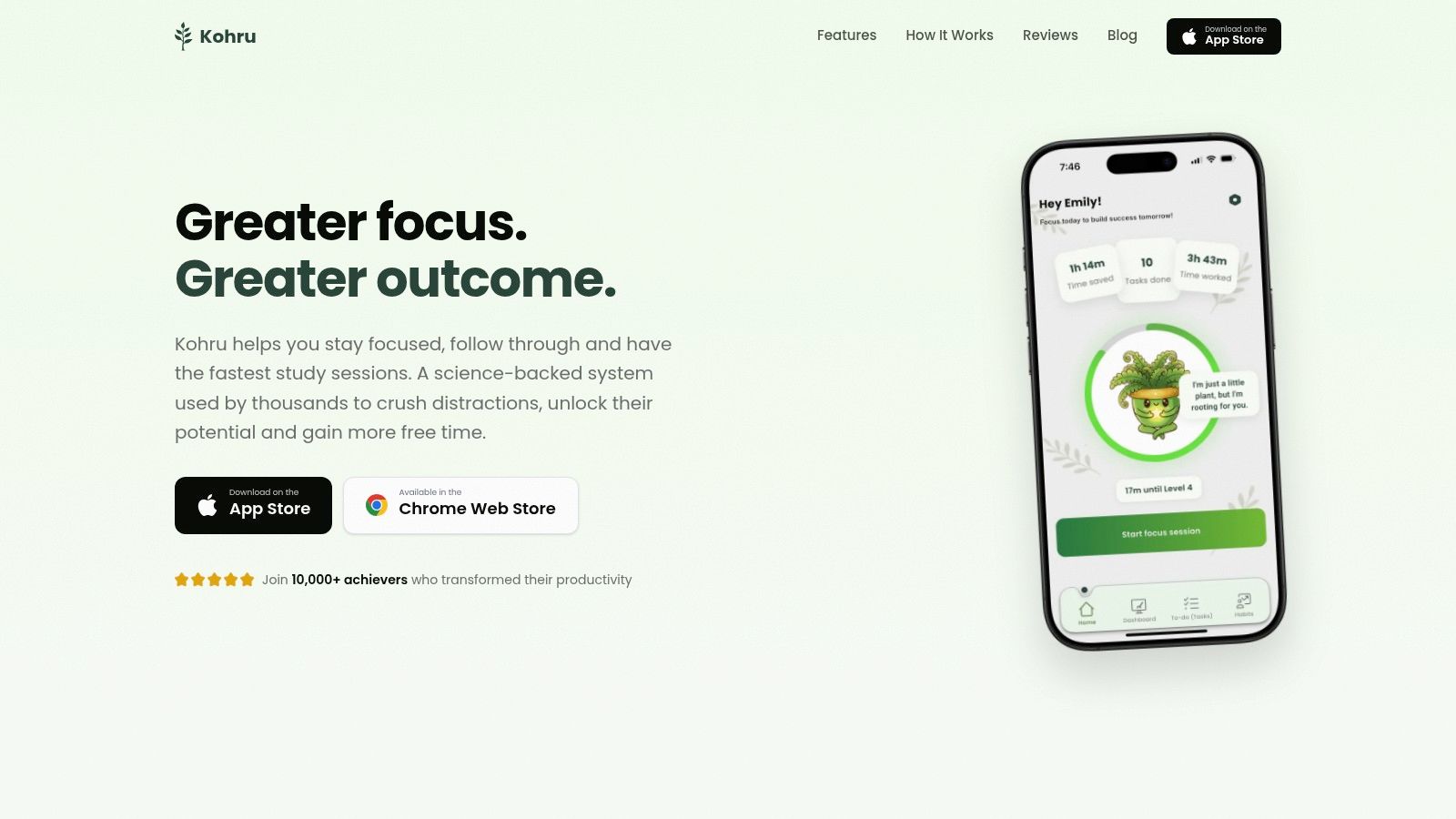
Choose one task, set a duration that fits its demands, and let the session define the next manageable action. The distraction block reduces the need to negotiate with tempting apps while the break system gives you a planned recovery point.
A short demonstration can help you see how a focus session fits into a broader routine:
The goal isn't to force your attention into a rigid pattern. It's to make time visible, make starting easier, and give your brain reliable cues for working and recovering.
Kohru offers custom Focus Sessions, task-based planning, distraction blocking across devices, structured breaks, and flexible progress tracking for people who want more than a standalone countdown. Visit Kohru to try a focused workflow that helps you turn the next manageable interval into completed work.
