Summary of the Article
The marshmallow test is not debunked, but the popular version of it is. Walter Mischel's original experiment showed that preschoolers who could wait for a bigger treat did better years later, but a large 2018 replication found that link was about half as strong and mostly explained by family background, and a 2024 follow-up found the test does not reliably predict adult outcomes.
- The original study: small, well-off Stanford preschool sample; waiting correlated with later achievement, but generalizing from it was always shaky.
- The 2018 replication: 918 children, and the wait-to-achievement link shrank by about two-thirds once family background and early ability were controlled.
- The 2024 follow-up: at age 26, marshmallow performance barely predicted education, BMI, or earnings after adjustments.
- What still holds: self-control is real, but it is situational. Kids and adults wait longer in environments that feel trustworthy and make waiting cheaper.
- Practical takeaway: change your study environment instead of blaming your willpower. That works better than gritting your teeth.
The Test, as Most People Tell It
Somewhere in the late 1960s and early 1970s, a psychologist at Stanford named Walter Mischel put a marshmallow in front of a preschooler and made a deal: eat it now, or wait and get two. The child sat alone with the treat. If they could not hold out, they could ring a bell and end the wait, but then they only got the single marshmallow.
In the 1990 follow-up by Yuichi Shoda, Mischel, and Philip Peake, the seconds kids managed to wait correlated with later measures like SAT scores and how well parents and teachers rated their competence. The pop-psychology version took off from there: wait for two marshmallows as a four-year-old and you are destined for success. Snack immediately and, well, the headline writes itself.
That story always had two problems. The sample came from Bing Nursery School at Stanford, so the children were mostly from educated, well-resourced families, and there were relatively few of them. And the test itself measured one behavior on one afternoon: delay of gratification, how long a child can pass on a small reward now for a bigger one later. It was never designed to be a fortune-telling device, and its findings were correlations, not proof that waiting causes success.
What the 2018 Replication Actually Found
In 2018, Tyler Watts, Greg Duncan, and Haonan Quan re-ran the study on much larger, more diverse data, using the NICHD Study of Early Child Care and Youth Development. They tested 918 children at age four and a half and followed their outcomes to age 15.
Key details matter here:
- The wait was capped at 7 minutes, shorter than the 15 to 20 minutes in Mischel's original studies. Because of that cap, many kids topped out.
- The sample was ten times larger than the original study, and the researchers focused especially on children whose mothers had not completed college, which is closer to how most American kids grow up.
- In the simplest comparison, every extra minute a child waited at age four predicted roughly a tenth of a standard deviation better achievement in grade 1, a few years later. And even before any statistical controls, the link between waiting and achievement at age 15 ran at about half the size of the original studies' correlations.
- Once they controlled for family background, early cognitive ability, and the home environment, the link fell by two-thirds and often lost statistical significance.
Also worth knowing: most of the difference came from a threshold. Children who waited at least about 20 seconds did almost as well as children who waited the full 7 minutes. Waiting a long time was not obviously better than waiting a little.
Is It Debunked?
Partly misread is more accurate than debunked, and that distinction matters for the marshmallow experiment's psychology.
Other researchers pushed back carefully. A 2020 reanalysis by Falk, Kosse, and Pinger argued the 2018 controls may have gone too far and soaked up real signal, and Doebel, Michaelson, and Munakata showed that the test is much less predictive in single measurements, but that children who could trust their environment waited longer. You can read the APS summary of that complex picture.
The strongest verdict came in 2024. Sperber, Vandell, Duncan, and Watts followed the same kind of dataset all the way to age 26 and ran a preregistered analysis. Their title says it plainly: the marshmallow test does not reliably predict adult functioning. There were small unadjusted links with education (r = .17) and BMI (r = −.17), but after accounting for family background and early ability, almost every link vanished.
So the honest summary: the correlation shrank and, with proper controls, mostly disappeared. It did not flip. Mischel was not wrong to think self-control matters. He was wrong, or rather the retellings were wrong, that a preschooler's wait time reads their future.
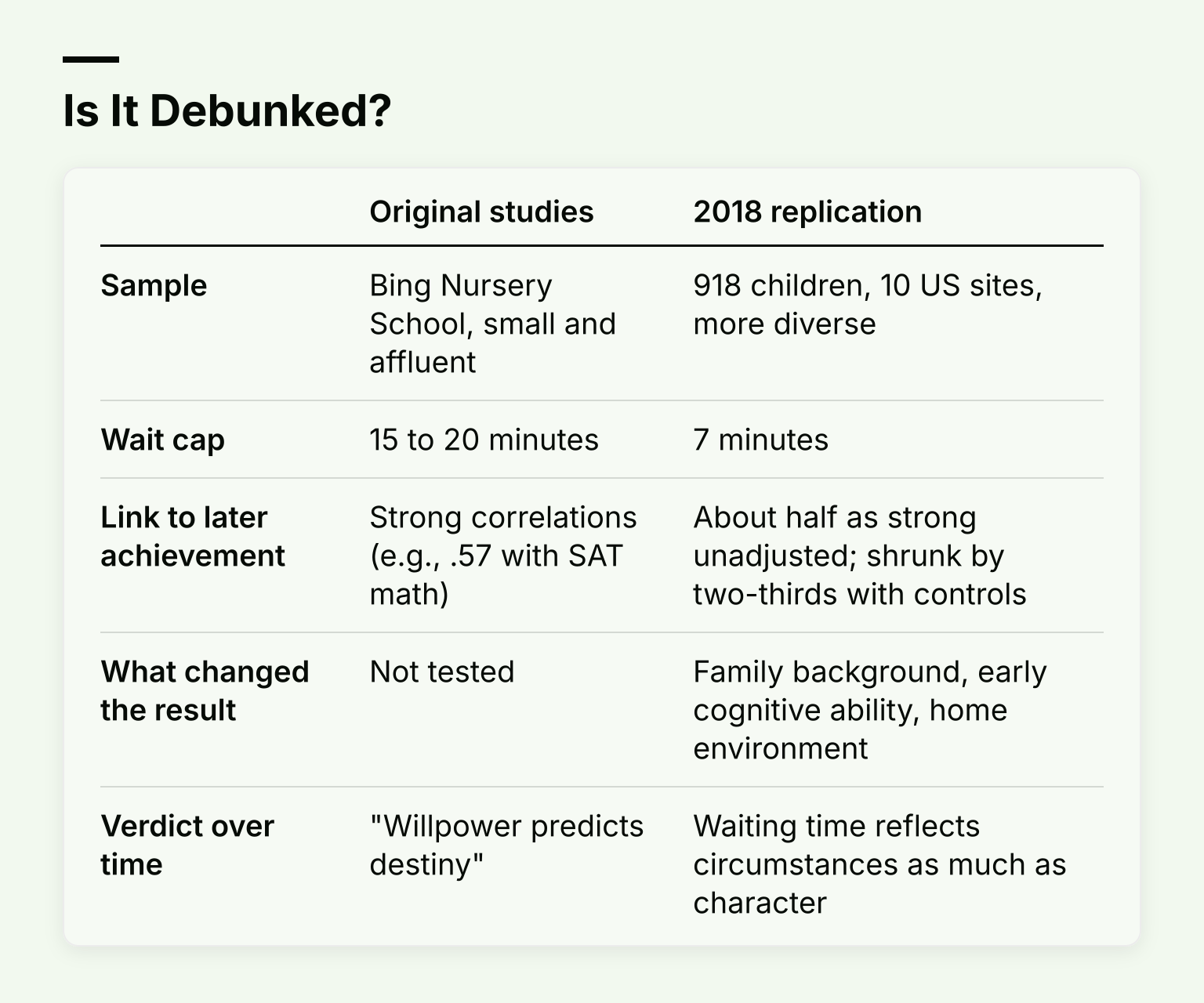
| Original studies | 2018 replication | |
|---|---|---|
| Sample | Bing Nursery School, small and affluent | 918 children, 10 US sites, more diverse |
| Wait cap | 15 to 20 minutes | 7 minutes |
| Link to later achievement | Strong correlations (e.g., .57 with SAT math) | About half as strong unadjusted; shrunk by two-thirds with controls |
| What changed the result | Not tested | Family background, early cognitive ability, home environment |
| Verdict over time | "Willpower predicts destiny" | Waiting time reflects circumstances as much as character |