Most advice about attention starts with the wrong diagnosis. You probably haven't developed a permanently ruined attention span, and you don't need to force yourself to “try harder” for hours at a time. The more useful question is this: how much does it cost you to return to a task after each interruption?
Attention is less like a battery that suddenly shrinks and more like a doorway that keeps getting blocked. Notifications, open tabs, background worries, messages, and unclear goals pull you away from the task. Every return requires you to remember where you were, reconstruct what mattered, and rebuild momentum. Improving attention span means reducing that re-entry cost, then gradually practicing longer periods of deliberate focus.
Table of Contents
- Why Your Attention Feels Broken And What the Science Actually Says
- Set Up a Focus-Friendly Environment
- Practice Focus With Progressive Sessions
- Sleep Nutrition and Movement That Directly Fuel Attention
- Tailoring Your Approach to Students Professionals and Neurodivergent Users
- Habits Cues and Tracking Systems That Actually Stick
- Your 30-Day Attention Reset Plan and Common Questions
Why Your Attention Feels Broken And What the Science Actually Says
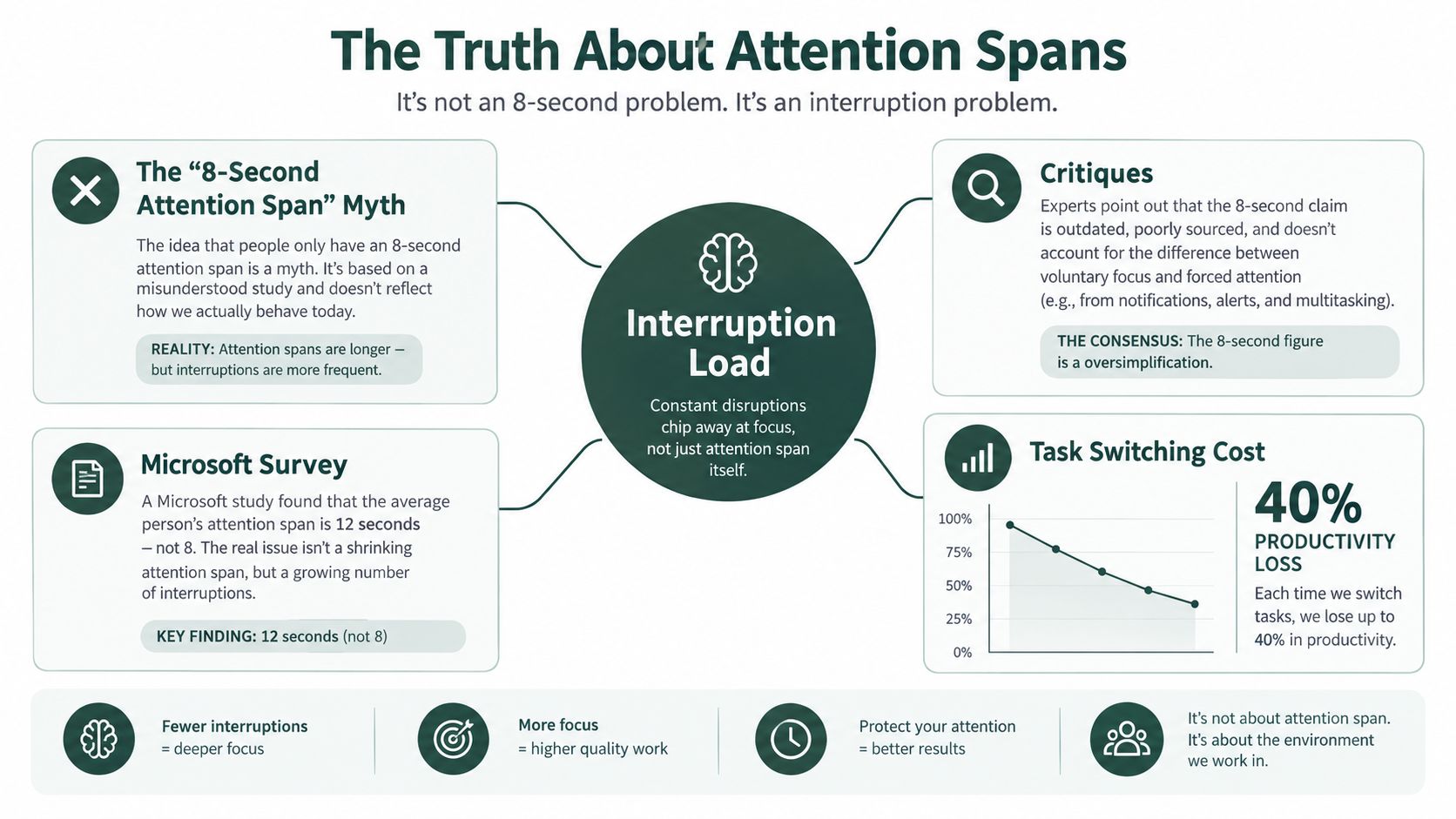
The popular claim that human attention has collapsed to a few seconds is too simplistic to guide your behavior. Controlled evidence doesn't clearly show a general, permanent decline in concentration. A 2024 meta-analysis of more than 21,000 people across 32 countries found no decline on d2 attention tests, while adult performance improved slightly, according to Scientific American's review of the evidence on shrinking attention spans.
That doesn't mean distraction is imaginary. It means your ability to concentrate depends heavily on the conditions around the task. Recent digital-behavior reporting says U.S. adults check their phones about 186 times per day, spend about five hours a day on smartphones, and may switch focus on a screen every 47 seconds. Those figures come from a Nature summary of recent attention and digital-behavior findings. A person can have a healthy capacity for deep concentration and still spend a day repeatedly paying the mental cost of returning to unfinished work.
Separate attention from interruption
Voluntary attention is the focus you choose, such as reading a chapter or debugging code. Involuntary attention is what grabs you without permission, such as a vibration, a new email, or a worry about an overdue task. You can train voluntary attention, but you must also reduce unnecessary involuntary pulls. Meditation won't compensate for a phone that interrupts every few minutes.
Sustained attention has always been vulnerable to fatigue. Historical vigilance research, including classic radar-operator experiments from 1948, remains foundational evidence that performance declines during continuous monitoring tasks, as summarized in this review of attention and vigilance research. More recent lab findings summarized there also report that performance on many attention tasks declines in about ten minutes, even without mobile distractions.
The practical diagnosis: Your attention may not be broken. Your task environment may be demanding too many expensive re-entries.
If you regularly lose focus, notice whether the problem is a brief lapse, constant interruption, exhaustion, anxiety, or a task with no clear next action. A useful overview of poor concentration causes can help you distinguish ordinary overload from concerns worth discussing with a qualified professional.
Set Up a Focus-Friendly Environment
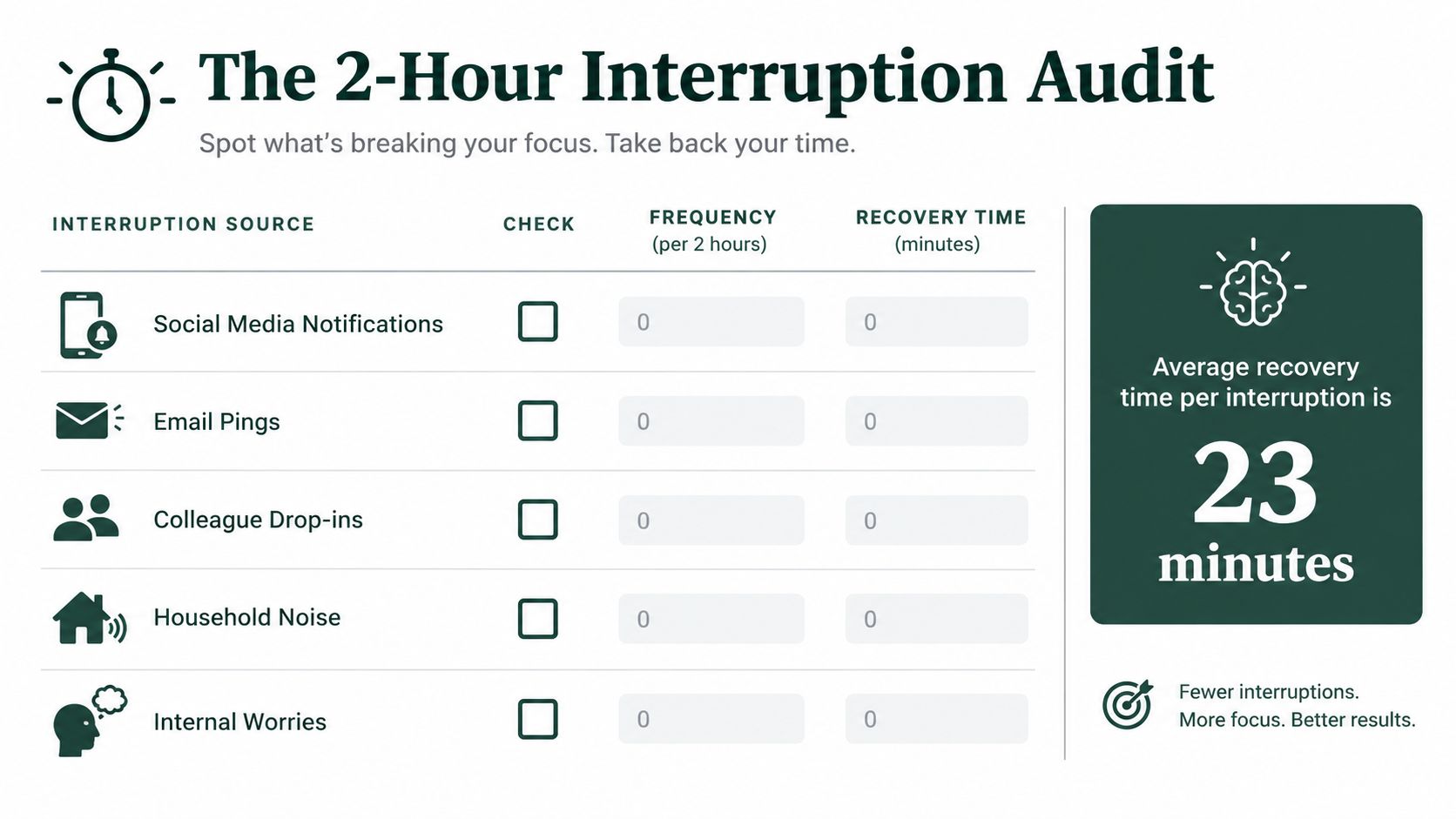
Your first intervention should be environmental, not motivational. For the next two hours, write down every event that breaks your focus. Include obvious interruptions such as messages and people, but also internal ones such as checking a browser tab, remembering an errand, or searching for information unrelated to the task.
Record two qualities for each interruption:
- Frequency: How often does it appear?
- Recovery cost: What must you reconstruct before work resumes?
Don't redesign your entire life after one distracted morning. Start with the highest-frequency source and add friction to it. Put your phone in another room, enable a separate work profile, group noncritical notifications, and remove social apps from the first screen. During a focus session, grayscale mode can make a phone less visually tempting. Website blockers such as Cold Turkey or Focus can prevent an automatic visit to sites you already know will derail you.
Build the room around starting
Your workspace should answer three questions without requiring thought:
- What am I doing? Keep one primary document, book, or application visible.
- What do I need? Place water, notes, headphones, and reference material within reach.
- What happens if I get distracted? Keep a capture sheet nearby so you can write down a worry or unrelated idea without pursuing it.
A single monitor often reduces visual competition. If you need two, assign each a role, such as writing on one screen and a source document on the other. Use a door sign or a visible status message when people around you need a clear signal. Noise-canceling headphones, brown noise, or quiet may work, but choose the sound profile that disappears into the background rather than becoming another object of attention.
The most effective setup takes only a short sequence: silence alerts, close unrelated tabs, define one deliverable, put the phone away, and open the exact file you need. A deeper setup can include separate browser profiles, recurring notification windows, cable management, and a prewritten response for nonurgent interruptions. For a broader treatment of cognitive load and executive mental bandwidth guide, see the resource from Acheloa Wellness, Inc.
Use the environment to make focus easier to start and distraction harder to begin. A short demonstration of focus setup can help you turn that principle into a repeatable workspace routine.
Practice Focus With Progressive Sessions
Short sessions aren't a consolation prize. They're the correct starting point when your current attention is fragmented. The mistake is treating a timer as a productivity trick while leaving the task undefined. Before every session, write one observable result, such as “outline the introduction” or “solve exercises one through three,” rather than “study.”
Use this four-week progression as a training plan, not a rigid test. If a level leaves you agitated, repeatedly checking the clock, or unable to complete the block, stay there until it feels demanding but manageable.
The four-week progression
| Week | Work Block | Break | Blocks Per Session | Goal |
|---|---|---|---|---|
| 1 | 15 minutes | 5 minutes | 2 | Stay with one defined task |
| 2 | 25 minutes | 5 minutes | 2 | Complete two blocks without switching |
| 3 | 50 minutes | 10 minutes | 1 to 2 | Sustain deeper work with a clear outcome |
| 4 | 90 minutes | Extended recovery | 1 | Test a demanding uninterrupted session |
Breaks have rules. Stand up, drink water, look into the distance, stretch, or walk briefly. Don't open social media, news, or email, because a break that introduces fresh stimulation can turn into a new interruption cycle. If your eyes feel strained, look at something far away rather than replacing one screen with another.
Increase difficulty without exhausting yourself
Single-tasking is a skill. Keep one task active, and store every unrelated thought on a capture list. You can return to the list after the block, but you don't get to negotiate with it during the block.
Unexpected interruptions need a recovery protocol. Write down the interruption, mark the exact line or step where you stopped, handle only what is genuinely urgent, and restart with a smaller block. A bad session isn't evidence that the plan failed. The real failure is turning one interruption into permission to abandon the entire day.
Students can use the progression for reading, problem sets, and active recall. Professionals can reserve the longer blocks for writing, analysis, design, or coding. Neurodivergent users may need shorter minimums, movement, body doubling, or sensory adjustments at every level. The structure stays useful when the delivery is customized.
Sleep Nutrition and Movement That Directly Fuel Attention
Your environment determines how much of your capacity you can access, but biology sets the ceiling. If you're chronically tired, underfed, dehydrated, or physically stagnant, a clever focus system will produce inconsistent results.
Sleep deserves priority because it affects alertness, emotional regulation, and executive control at the same time. Keep your wake time stable, reduce stimulating screen use before bed, and give yourself a realistic sleep opportunity. For adults, UChicago Medicine AdventHealth's guidance on concentration and rest recommends aiming for 7 to 9 hours of sleep. Don't treat sleep as time stolen from work. It determines how much useful work you can do once you're awake.
Make attention easier to access
Build meals around foods that keep you satisfied, include protein and fiber, and avoid relying on highly sweetened snacks to carry demanding work. Keep water available rather than waiting until thirst becomes another distraction. Caffeine can help alertness, but use it strategically and pay attention to whether it interferes with sleep. L-theanine and magnesium may appeal to some people, but they aren't substitutes for rest, a suitable environment, or clinical care.
Movement works as a reset and as a baseline investment. Stand, walk, or stretch between demanding blocks. Add regular aerobic activity and resistance training if they're safe for you, because a body that rarely changes state often makes sitting still feel harder.
| Lever | What to Do | Effect on Focus |
|---|---|---|
| Sleep | Keep a consistent wake time and protect adequate sleep opportunity | Supports alertness, emotional control, and mental endurance |
| Meals | Choose filling meals with protein, fiber, and minimally processed ingredients | Reduces attention swings caused by hunger or abrupt energy changes |
| Hydration | Keep water within reach during work | Removes a preventable source of discomfort and task interruption |
| Caffeine | Use it earlier and monitor its effect on sleep | Can support alertness when it doesn't create a later crash |
| Movement | Stand, walk, stretch, and train regularly | Helps you return to work with more physical and mental readiness |
If attention collapses every afternoon, don't immediately buy a supplement. Check sleep timing, meal composition, workload, and movement first. Biology isn't a moral test. It is the operating context your focus plan has to respect.
Tailoring Your Approach to Students Professionals and Neurodivergent Users
A student, a project manager, and a person with ADHD may all say, “I can't focus,” but they may need different interventions. The student often needs protection from a phone during passive listening. The professional may need fewer meetings and clearer communication boundaries. The neurodivergent user may need external scaffolding that makes initiation possible.
Choose the stack that matches the problem
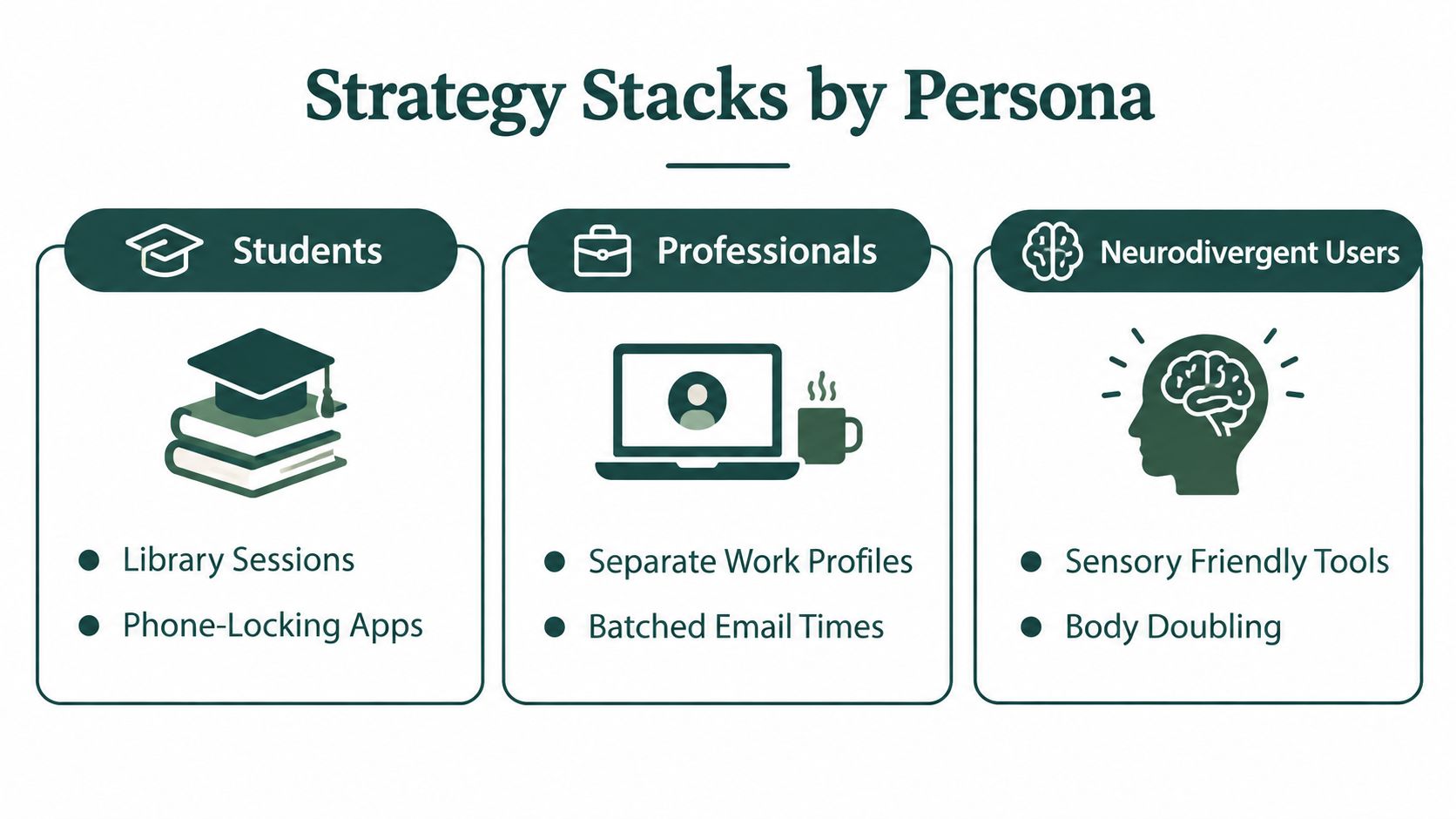
Students should anchor focus to a place and a visible outcome. A library session with the phone locked away, a short reading target, and active recall at the end is stronger than rereading notes beside an active social feed. During lectures, use a phone-locking app or physical distance from the device, then write questions rather than trying to transcribe everything.
Professionals need calendar protection. Reserve a recurring meeting-free window for the work that requires reasoning, batch email and chat, and tell colleagues when you'll respond. Separate personal and work profiles so one environment doesn't constantly invite the other. If your day is meeting-heavy, use small protected blocks for preparation and follow-up instead of waiting for an imaginary empty afternoon.
Neurodivergent users shouldn't be forced into a single conventional productivity style. Lower the minimum session until starting is realistic. Try body doubling, sensory-friendly headphones, a fidget tool that doesn't compete for attention, or pairing an unpleasant task with a preferred sound or beverage. Someone with ADHD may need a visible timer and immediate task rewards. Someone with autism may need predictable sensory conditions. Someone with dyslexia may benefit from text-to-speech, larger type, and reduced visual clutter.
The overlap is clear: define the next action, reduce interruptions, and use external cues. The difference is how much structure, sensory control, novelty, or accountability each person requires. Treat these tools as accessibility supports, not evidence that you lack discipline. Mix the stacks until they fit your brain and your setting.
Habits Cues and Tracking Systems That Actually Stick
A focus habit survives bad weeks when the starting instruction is specific. “I'll focus more” is a wish. “After I pour coffee at my desk, I'll open my research file and work on one defined task” is an implementation intention.
Attach the behavior to something already stable. Your cue might be coffee, arriving at the library, closing your last meeting, or putting on a particular pair of headphones. Keep the ritual short. The point isn't to create an elaborate morning routine. It's to make the transition into focus familiar.
Track behavior, not self-judgment
A paper log or single spreadsheet is enough. Record:
- Session count: How many deliberate sessions did you complete?
- Average duration: How long did you stay before an intentional break?
- Focus rating: Give the session a simple rating from 1 to 10.
- Interruption note: Identify the main reason you left the task.
Review totals weekly instead of demanding a perfect daily streak. Weekly measurement shows whether your capacity is growing while allowing for travel, illness, deadlines, and difficult personal circumstances. A missed day is normal. The recovery rule is to resume at the next reasonable opportunity instead of waiting for a new week or month.
Build for return: A sustainable system doesn't prevent every bad session. It makes the next session obvious.
Don't change five variables at once. If your sessions improve after moving the phone, keep that change. If a complicated dashboard makes tracking feel like another job, delete it. Consistency across months matters more than an intense burst that collapses after several days.
Your 30-Day Attention Reset Plan and Common Questions
Use the first week to remove avoidable friction. Audit interruptions, silence noncritical notifications, create a clear work profile, and prepare one reliable focus location. Each morning, write the day's most important task before opening messages.
In the second week, practice the shorter blocks from the progression plan and fix the biological basics that are easiest to control. Set a consistent wake time, prepare water and a satisfying meal, and take a brief movement break after demanding work. In the third week, test longer sessions and attach them to a cue such as coffee, arriving at the library, or beginning your first deep-work block. In the fourth week, review your log, identify your strongest time and biggest interruption, and personalize the system rather than adding more rules.
Common questions
How long will it take to notice improvement?
You may notice that starting feels easier before you can sustain long sessions. Judge progress by fewer unnecessary checks, faster recovery, and more completed work, not by a fantasy of never getting distracted.
Can attention medication help?
Medication can be appropriate for some diagnosed conditions, but it requires an individual assessment by a qualified clinician. Don't self-medicate with supplements or someone else's prescription.
What should I do when focus collapses mid-task?
Stop trying to rescue the original perfect session. Write down where you stopped, remove the immediate distraction, reduce the next block, and complete a small defined action. Re-entry is the skill you're practicing.
The essential plan is simple: design the environment, train with graduated sessions, and protect sleep, food, and movement. Attention improves when you stop treating every lapse as a character flaw and start managing the conditions that create expensive re-entry.
Kohru gives you one-click Focus Sessions that block distracting apps across your phone and laptop, along with custom durations, structured breaks, task-focused lists, and progress tracking. If you want a practical system for applying this reset and measuring your sessions, visit Kohru and start with one protected focus block today.
