Summary of the Article
A dopamine loop is the habit cycle your brain runs when a cue triggers a craving, you take an action like opening an app, and the reward you get is weaker than the wanting that drove you there. Dopamine drives the anticipation, not the pleasure, which is why you keep scrolling even when it stops feeling good. Apps keep the loop running with notifications, badges, infinite scroll, and unpredictable rewards. The practical fix is changing your cues and environment, not trying harder to resist in the moment.
- The loop: cue → anticipation → action → weak reward → repeat.
- The key insight: dopamine makes you seek; it does not make you enjoy.
- Why apps win: variable rewards and engineered cues beat willpower.
- What works: remove cues, add friction, and block distractions on schedule rather than fighting cravings one at a time.
What Is a Dopamine Loop? Why You Keep Opening Apps You Don't Even Enjoy
You pick up your phone to check one thing. Twenty minutes later, you put it down and feel worse than before, and you can't really say what you got out of it. Then, an hour later, you do it again.
That pattern has a name: a dopamine loop. It explains why you keep opening apps you don't even enjoy. Understanding the loop is more useful than blaming yourself, because once you see how it works, the fixes become obvious and mostly have nothing to do with willpower.
What a Dopamine Loop Is
A dopamine loop is a simple cycle with four steps:
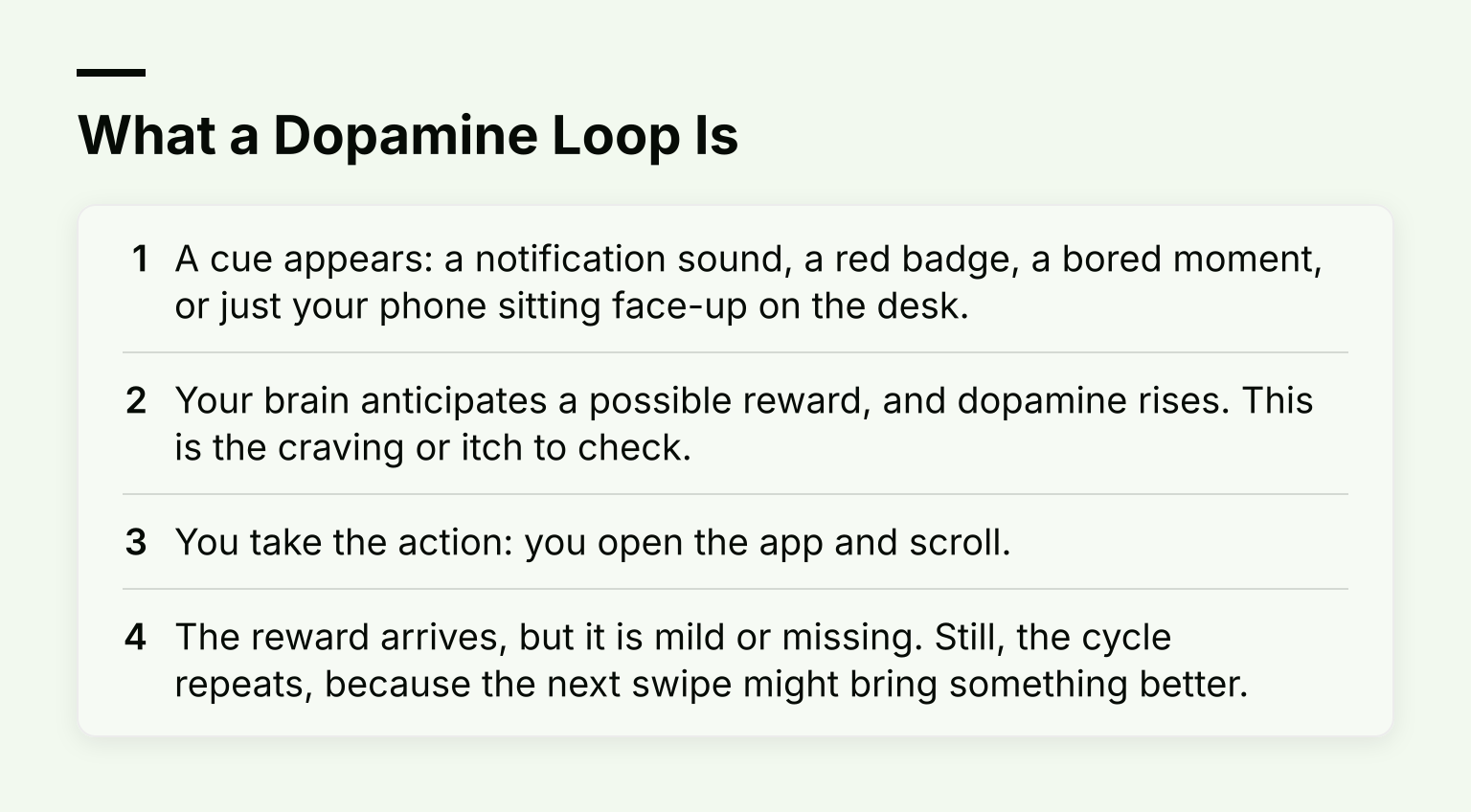
- A cue appears: a notification sound, a red badge, a bored moment, or just your phone sitting face-up on the desk.
- Your brain anticipates a possible reward, and dopamine rises. This is the craving or itch to check.
- You take the action: you open the app and scroll.
- The reward arrives, but it is mild or missing. Still, the cycle repeats, because the next swipe might bring something better.
That's the loop: cue → anticipation → action → weak reward → repeat. Each pass strengthens the connection between the cue and the action, so checking becomes more automatic over time. It's the same reward loop that shapes all habits, just supercharged by software built to keep it spinning.
Dopamine Makes You Want, Not Enjoy
The most important thing to know about dopamine is that it isn't the pleasure chemical. That's a popular myth. Neuroscientist Kent Berridge's research split reward into two separate systems: "wanting" and "liking". Dopamine runs the wanting system. It drives seeking, curiosity, and the pull toward something. A different system, using endorphins and other brain chemicals, handles liking: the actual feeling of satisfaction.
As Berridge's lab explains, dopamine mediates "wanting" for reward, not the pleasure itself. The wanting system is also stronger than the liking system. As Psychology Today's explainer on the dopamine seeking-reward loop puts it, you seek more than you are satisfied.
This solves the mystery of why scrolling doesn't feel good but you keep doing it. The dopamine spike happens before the reward, during anticipation. It fires hardest when a reward is possible but not guaranteed. Once you're actually looking at the feed, the liking system barely registers anything. So the chase keeps going, and the payoff never justifies it.
There's a second problem: the wanting system has no built-in off switch. Eating fills you up. Scrolling doesn't. The dopamine system doesn't reach satiety the way hunger does, so unless something interrupts you, the loop just continues. If you relate to this especially with negative news, that's a close cousin called doomscrolling; see our explainer on doomscrolling for how that version differs.
Cues Are Manufactured Triggers
Step one of the loop, the cue, is where app design comes in. Pavlov showed that a signal paired with a reward eventually triggers the response on its own. App makers use this deliberately:
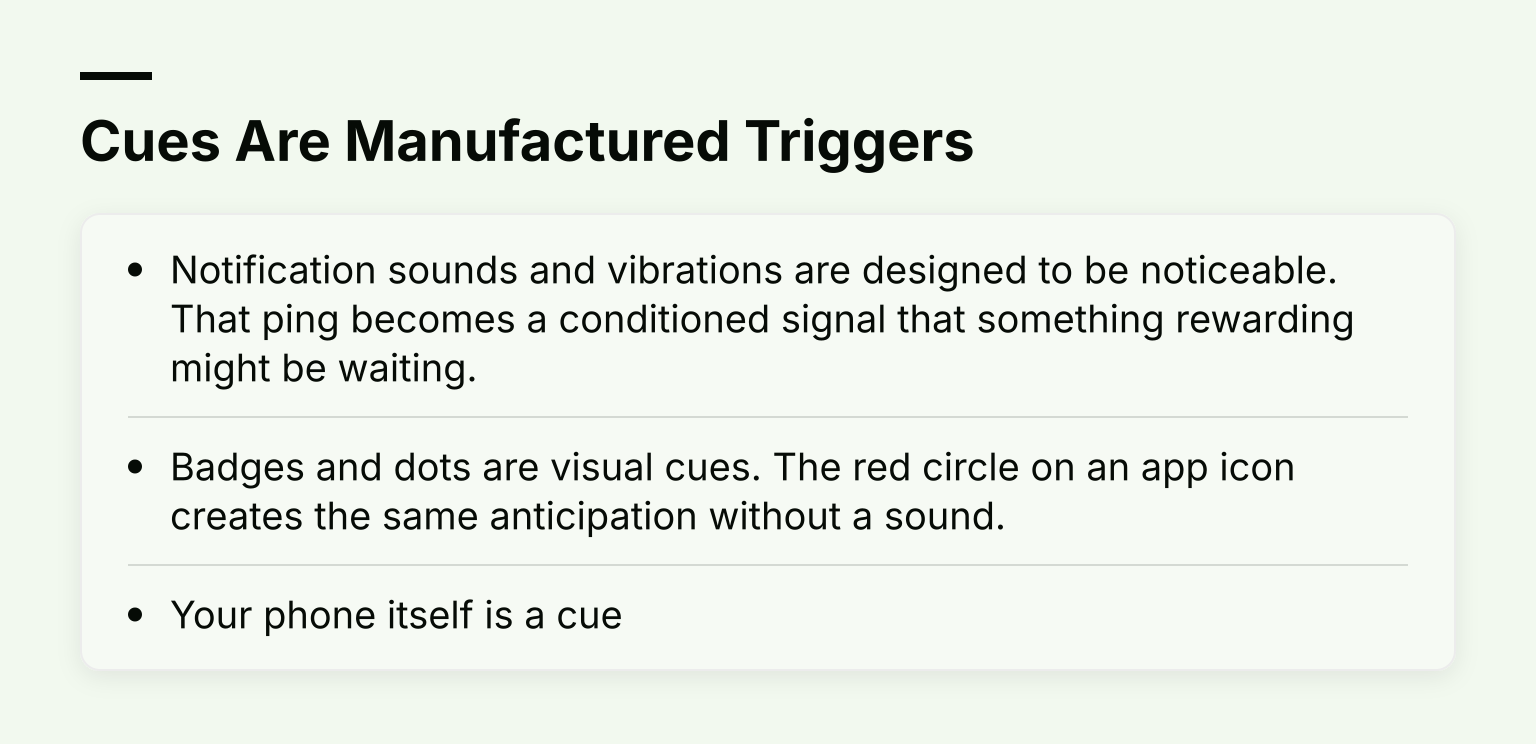
- Notification sounds and vibrations are designed to be noticeable. That ping becomes a conditioned signal that something rewarding might be waiting.
- Badges and dots are visual cues. The red circle on an app icon creates the same anticipation without a sound.
- Your phone itself is a cue. In a well-known study from the University of Texas, students who kept their phone on the desk performed worse on tests of attention and working memory than students who left it in another room, even with the phone silent and face-down. The researchers call it "brain drain": the mere presence of your own smartphone reduces available cognitive capacity, and the effect is strongest for people most dependent on their phone.
Every one of these is a trigger you didn't choose. When you "randomly" reach for your phone, it's usually not random. A cue fired, the wanting system lit up, and the action followed before you made a real decision.
Variable Rewards: Why Feeds Beat Predictability
Here's the part that makes feeds so sticky. Rewards that arrive unpredictably produce far more persistent behavior than predictable ones. Behavioral researchers have documented this for decades: in lab comparisons, behavior maintained by a variable reward schedule persists longer and responds less to losing rewards than behavior under a fixed schedule, where you know exactly when the payoff comes. This is the principle behind slot machines, called variable-ratio reinforcement. You keep pulling the lever because the next pull might be the big one. A review of the research on fixed versus unpredictable reward schedules describes how unpredictability makes the same reward hold behavior more strongly.
A feed is a slot machine in your pocket. Most posts are forgettable. Every so often, something is genuinely interesting, funny, or important. Your brain learns that checking sometimes pays off big, and the unpredictability keeps dopamine and checking behavior high in a way a predictable reward never would.
Compare that to, say, a book chapter. You know roughly what you'll get and when you'll get it. Predictable. Calm. Not engineered to keep you hooked. If you want to go deeper into how reward schedules drive motivation and habit, we cover that in our guide to motivation and reward systems.
Apps stack several exploit mechanisms on top of this:
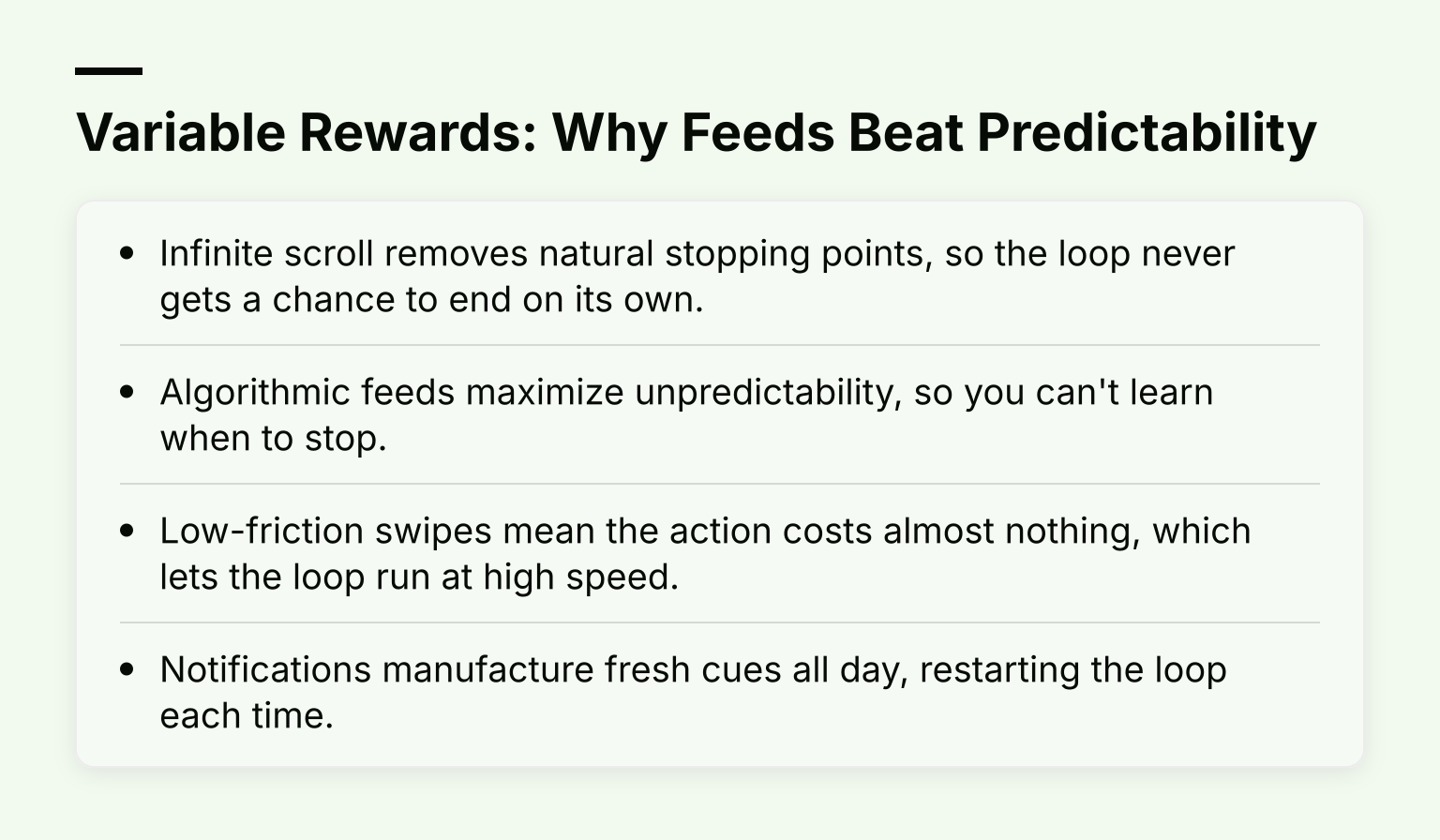
- Infinite scroll removes natural stopping points, so the loop never gets a chance to end on its own.
- Algorithmic feeds maximize unpredictability, so you can't learn when to stop.
- Low-friction swipes mean the action costs almost nothing, which lets the loop run at high speed.
- Notifications manufacture fresh cues all day, restarting the loop each time.
None of this requires you to be weak. The software is optimized by teams of people to close this loop around you.
