You open your laptop to answer one email. Forty minutes later, the message is still unsent, your browser has accumulated new tabs, and the task you intended to start now feels harder than it did this morning. You know what needs to happen. The problem is crossing the gap between knowing, starting, switching, and finishing.
Learning how to manage ADHD symptoms in daily life requires more than a planner and good intentions. It means designing surroundings that reduce friction, building routines that can survive interruptions, practicing attention redirection, and using clinical support when symptoms continue to impair work, study, relationships, or self-care.
Table of Contents
- Understanding the ADHD Execution Gap
- Designing a Distraction-Free Environment
- Building Flexible Routines and Smart Task Lists
- Training Attention and Tracking Habits
- Navigating Therapy and Medication Options
- Creating a Sustainable Daily Workflow
Understanding the ADHD Execution Gap
Most productivity advice assumes that a person can convert an intention into action without much resistance. “Get organized,” “prioritize your tasks,” and “follow your schedule” sound reasonable, but they skip the moments where ADHD creates the most trouble: opening the document, deciding which step comes first, returning after an interruption, and stopping one activity long enough to begin another.
That's the execution gap. You may understand the assignment and still be unable to initiate it. You may create a detailed plan and abandon it after one delayed meeting. You may work intensely on an interesting task while routine responsibilities remain untouched. These experiences aren't proof that you're careless or unmotivated. They show that the environment and the task structure aren't supplying enough usable cues at the point of action.
The scale of ADHD also matters. The National Institute of Mental Health ADHD statistics estimates current ADHD prevalence among U.S. adults at 4.4%. U.S. data also show that 9.4% of children ages 2 to 17 have ever received an ADHD diagnosis, and 10.5% of youth had current ADHD in 2022. In the prior year, 44.4% received behavioral treatment and 53.6% received medication, which indicates that many people still don't receive care that fully matches guideline recommendations.
Why ordinary systems break down
A conventional task list often stores outcomes instead of actions. “Finish the report” may represent research, outlining, drafting, editing, formatting, and submitting. When all of that appears as one line, your brain has to perform several planning operations before work can begin.
Context-switching creates a second problem. Each switch requires you to reconstruct what you were doing, locate the relevant materials, and resist the pull of the new stimulus. A notification, an open chat window, or a visible household task can turn a simple transition into a fresh decision.
A more useful management model has three connected parts:
- Environmental design: Put distractions farther away and make the next action visible.
- Flexible routines: Use sequences and recovery points rather than brittle schedules.
- Clinical support: Track symptoms and functioning with a qualified professional when impairment remains substantial.
Families looking for accessible explanations and practical guidance can also use ADHD resources for families as a starting point for conversations about support at home, school, and in everyday routines.
Practical rule: If a system depends on you remembering to use it at the exact moment you're already distracted, the system is too fragile.
Designing a Distraction-Free Environment
Willpower is a poor first line of defense against a phone that vibrates beside your keyboard. The more reliable approach is to change the environment so the distracting action takes effort and the intended action takes less effort.

Start with the physical workspace. Keep only the materials required for the current task in view. Put chargers, snacks, notebooks, and frequently used reference items in consistent locations, so retrieving them doesn't become a search project. If visual noise pulls your attention, use a clear desk surface, a single monitor window, or noise-cancelling headphones. The right setup isn't minimalist for its own sake. It's a way to remove competing prompts.
The digital environment needs the same treatment. Turn off nonessential notifications, sign out of social platforms, and use separate browser profiles for work and personal activity. A work profile can contain only the documents, calendar, and communication tools you need. A personal profile can hold everything else. This separation gives your brain a contextual cue instead of asking it to make a fresh choice every few minutes.
Add friction to the tempting option
Use app-blocking tools and scheduled focus sessions to make impulsive switching less convenient. A useful session might block social media and entertainment sites while leaving access to a reference page or an urgent work channel. Avoid blocking everything if that forces you to bypass the system. The purpose is controlled friction, not punishment.
A practical setup looks like this:
- Choose one clearly defined task.
- Open only the files and applications required for the next action.
- Start a focus session with a realistic duration.
- Place your phone outside arm's reach, or use a separate device mode.
- Write down unrelated thoughts instead of acting on them immediately.
- End by recording the next step before taking a break.
A tool such as Kohru can fit this workflow by combining one-click Focus Sessions, distraction blocking across phone and laptop, Smart To-Do Lists, and flexible habit targets. It's one option among many, but the useful design principle is consistent: the task, the timer, and the distraction controls should work together rather than live in separate systems.
A 2026 study found that adults with ADHD can struggle with task management when their cognitive needs clash with ordinary systems and environments, while a 2026 scoping review described digital health tools for adults with ADHD as expanding but fragmented. The implication is practical, not fashionable. A symptom tracker alone won't help much if it doesn't support the moment you need to begin, switch, or follow through. See the research on ADHD task management and digital health for that broader context.
This short video can help you think through the relationship between focus and environmental control before you build your own setup.
Don't aim for a perfect distraction-free life. Aim for a workspace where the default path leads back to the task.
Building Flexible Routines and Smart Task Lists
A rigid timetable often fails at the first point of friction. If a meeting runs over, a child needs help, or your energy drops, every later item becomes late. Many people then treat the whole day as lost. A flexible routine protects momentum by defining the order and conditions of work without pretending that every transition will happen on time.
Use anchors instead of minute-by-minute commands. An anchor might be “after breakfast, review today's first task” or “after the final meeting, process the open-loop list.” The cue remains stable even when the clock changes.
Your task list should also distinguish between an outcome and an executable action. Replace “work on dissertation” with “open the methods document,” “write three rough bullet points,” or “label the sources for the next paragraph.” A micro-action isn't trivial. It reduces the amount of working memory required to enter the task.
Build lists that support initiation
Separate work, study, household, and personal tasks when those categories carry different contexts. A single giant list makes every item compete for attention. A context-specific list lets you answer a narrower question, such as “What can I do at my desk?” or “What can I finish while waiting?”
A useful daily list contains:
- One primary task: The activity that would make the day meaningful if nothing else went well.
- A few maintenance tasks: Small responsibilities that prevent avoidable buildup.
- A low-energy option: Something useful that requires less concentration.
- A recovery action: The next step after an interruption, such as reopening the document and rereading the last sentence.
Estimate effort in plain language, such as “short,” “moderate,” or “deep,” rather than pretending you know the exact duration. If you use a timer, choose a session length that makes starting less intimidating. The first session can be devoted only to setup and a rough beginning. Momentum often arrives after action, not before it.
The CDC summarizes behavioral strategies that can reduce symptom-related impairment, including keeping a consistent daily schedule, reducing distractions, and organizing belongings. For children younger than 6 with ADHD, the American Academy of Pediatrics recommends parent training in behavior management as first-line treatment before medication. For children 6 and older, guidance recommends medication together with behavior therapy. The CDC guidance on ADHD treatment provides the clinical context, while the same environmental principles can inform adult routines.
When a plan breaks, use a restart protocol instead of self-criticism. Identify what interrupted you, remove one obstacle, and choose the smallest visible action. “Resume report” is vague. “Open report and place the cursor under the last heading” gives your brain somewhere to go.
Motivation also needs practical support. Pair an effortful task with an immediate, harmless reward, use body doubling when available, or work beside someone who understands that presence can help with initiation. The system should make starting easier on ordinary days, not only on days when urgency supplies artificial energy.
Training Attention and Tracking Habits
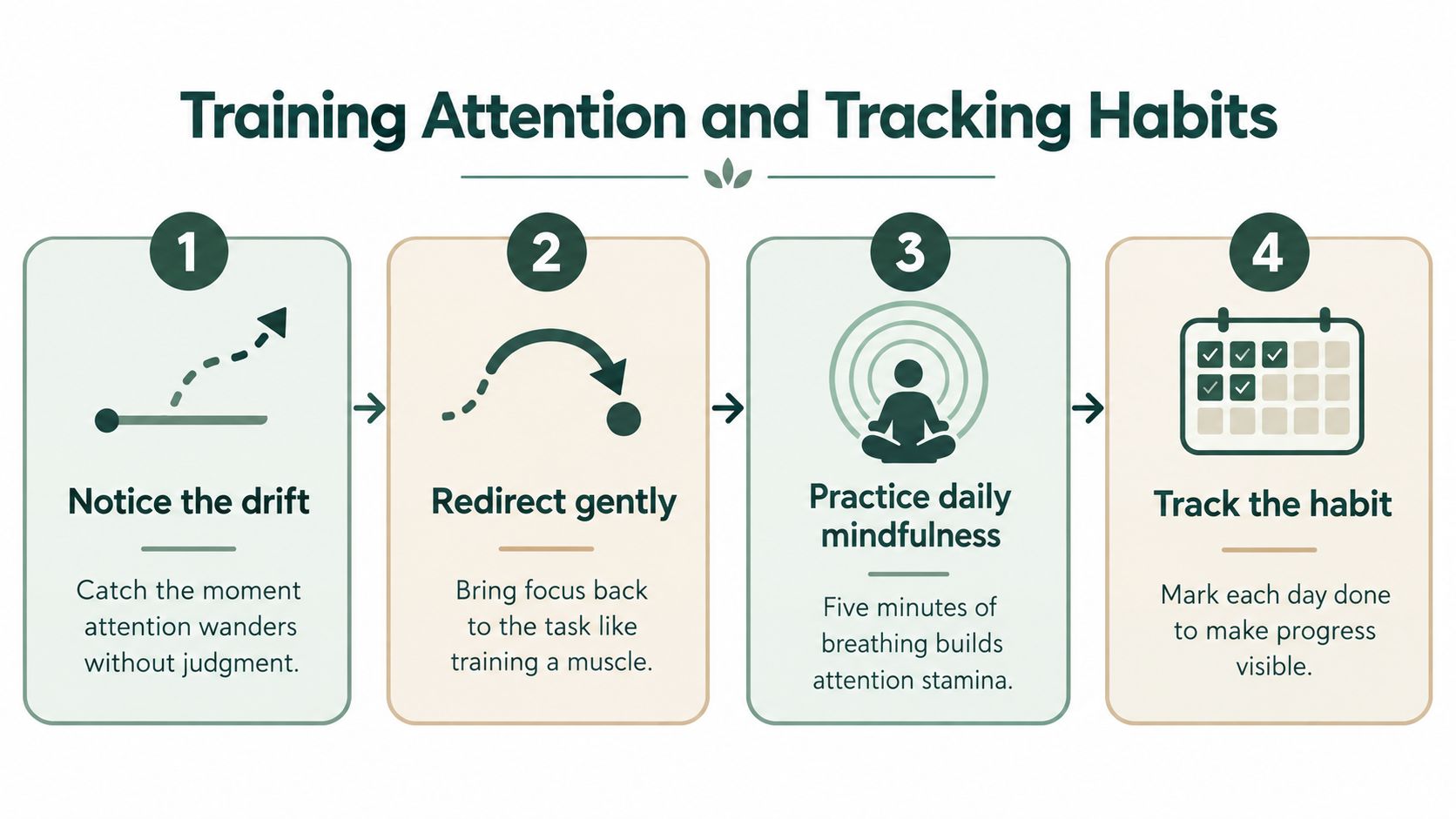
Blocking interruptions protects attention, but it doesn't eliminate mind-wandering. Effective attention training teaches you to notice the drift and return without turning the lapse into a verdict about your character.
Mindfulness-based interventions are among the better-supported non-pharmacological options for managing ADHD symptoms in adults, but they work best as a structured adjunct, not a standalone replacement for appropriate care. A recent adult meta-analysis found significant improvements in self-rated symptoms, observer-rated symptoms, and overall functioning, with the reported outcomes and statistical details available in the adult mindfulness meta-analysis.
Use a repeatable practice
Keep the method simple enough to repeat:
- Sit or stand in a stable position.
- Choose the sensation of breathing as an attention anchor.
- Notice when the mind moves to a thought, sound, urge, or plan.
- Label the drift briefly, without arguing with it.
- Return attention to the breath, task, or next physical action.
The return is the training. You don't need to achieve an empty mind, and you don't need to feel calm for the practice to count. The same sequence applies during work: notice that you're reading unrelated material, close the tab, and return to the sentence or action you selected.
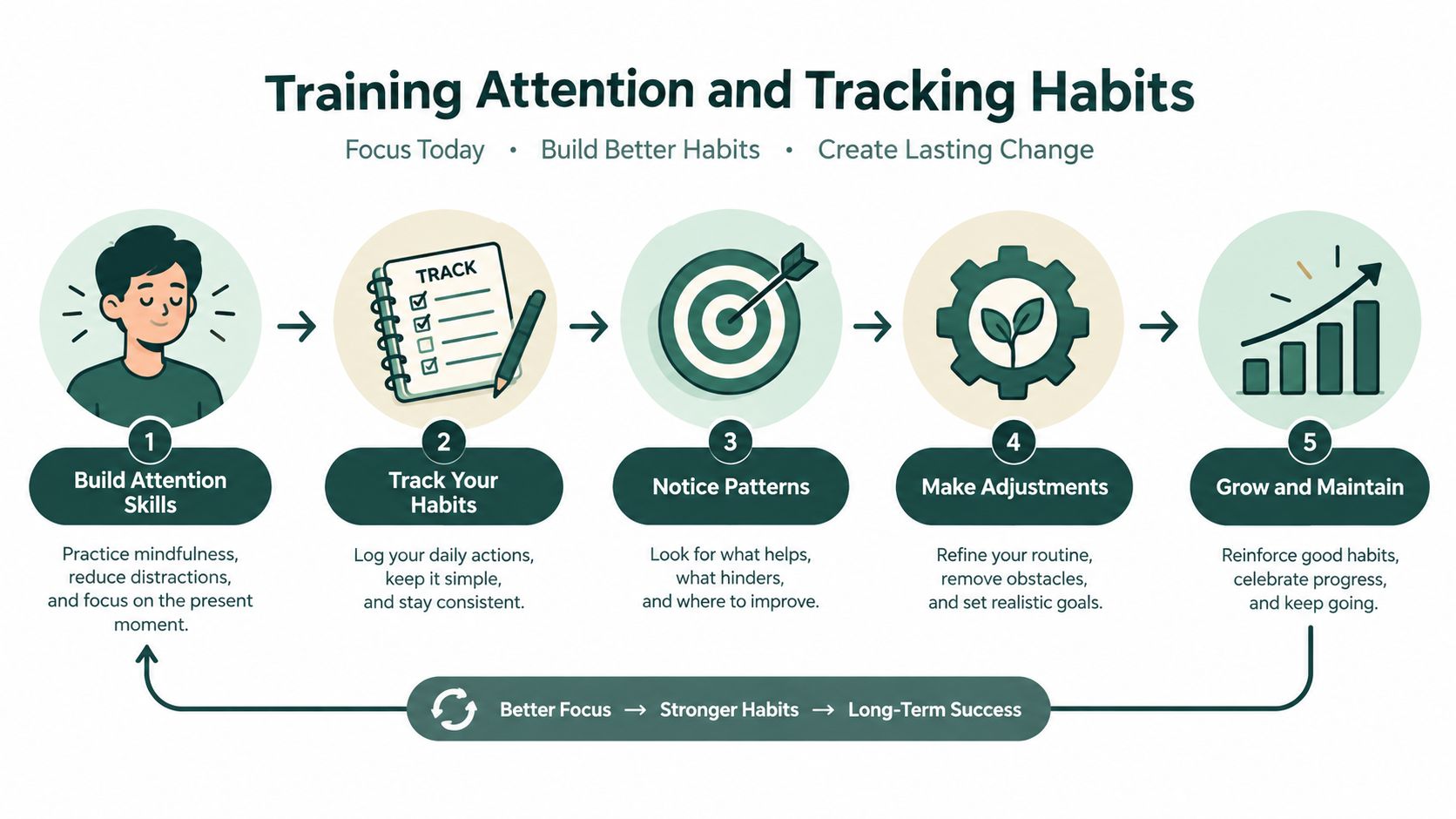
Habit tracking works better when it measures behavior you control. Track whether you started a focus session, completed the planned micro-action, or performed the attention practice. Don't use the tracker as a daily test of moral worth. A missed entry is information about timing, energy, task size, or environmental friction.
Track function, not just streaks
A flexible weekly target can be more resilient than a fragile daily streak. Record the outcomes that matter to your life:
- Did you begin the priority task?
- Did you return after an interruption?
- Did you complete the next defined action?
- Did the routine reduce forgotten commitments?
- Did the task feel more manageable after environmental changes?
A clean dashboard can show focus time, completed tasks, and habit activity without forcing you to interpret a dense collection of data. Review the pattern periodically and adjust one variable at a time. If evening practice repeatedly fails, move it to an existing morning anchor. If long sessions lead to avoidance, shorten the entry session and define a clear stopping point.
Mindfulness won't make every task interesting, and tracking won't compensate for untreated impairment. The value comes from repetition, measurement, and compassionate adjustment. You're building a return path, not trying to eliminate every lapse.
Navigating Therapy and Medication Options
Behavioral systems can make daily execution easier, but they shouldn't carry the entire burden when ADHD symptoms remain disruptive. Clinical treatment helps you assess whether the problem is ADHD, another condition, a combination of conditions, or a treatment plan that needs adjustment.
Adult ADHD guidance describes a stepwise model. Certain amphetamine and methylphenidate stimulants are typically used as first-line pharmacotherapy, while atomoxetine, viloxazine, and bupropion may be considered when stimulants aren't suitable or when anxiety or depression also occur. Medication decisions belong with a qualified prescriber, particularly when there are concerns about side effects, interactions, misuse, or diversion. The AAFP adult ADHD guideline outlines this treatment-stratification approach.
Measure the life impact
Before an appointment, define target symptoms in observable terms. “I need better focus” is difficult to evaluate. “I miss assignment deadlines,” “I lose the thread during meetings,” or “I can't start household tasks without a crisis” gives you and your clinician a clearer basis for decisions.
Track function alongside symptom intensity:
| Area to monitor | Useful observation |
|---|---|
| Task initiation | How often you begin the planned first step |
| Follow-through | Whether tasks reach a defined completion point |
| Switching | How easily you leave one task and start another |
| Adherence | Whether the agreed treatment plan is followed |
| Side effects | Changes that affect sleep, appetite, mood, or daily functioning |
Independent primary-care guidance recommends reassessment within 30 days of diagnosis or a medication change, then monthly until symptoms stabilize, and every 3 to 6 months once improvement is established, as described in the AAFP source above. Don't change dosage, stop medication, or share medication without professional guidance.
Therapy can address planning, emotional responses, avoidance, and the shame that often builds around repeated unfinished tasks. If emotional reactivity is a major barrier, ADHD emotional regulation help can offer a focused starting point for understanding that part of the experience and finding appropriate support.
Care can also be delayed. A 2026 randomized trial reported clinical improvement among 337 adults using a digital CBT-based intervention, and the authors described the tool as a bridge while participants waited for therapy. The same source reports that medication continuation across countries was 15% to 44% at one year and 8% to 30% at two years, highlighting why follow-up, tolerability, and workable routines matter in long-term management. Read the 2026 digital CBT and medication-continuation report for the reported findings.
Creating a Sustainable Daily Workflow
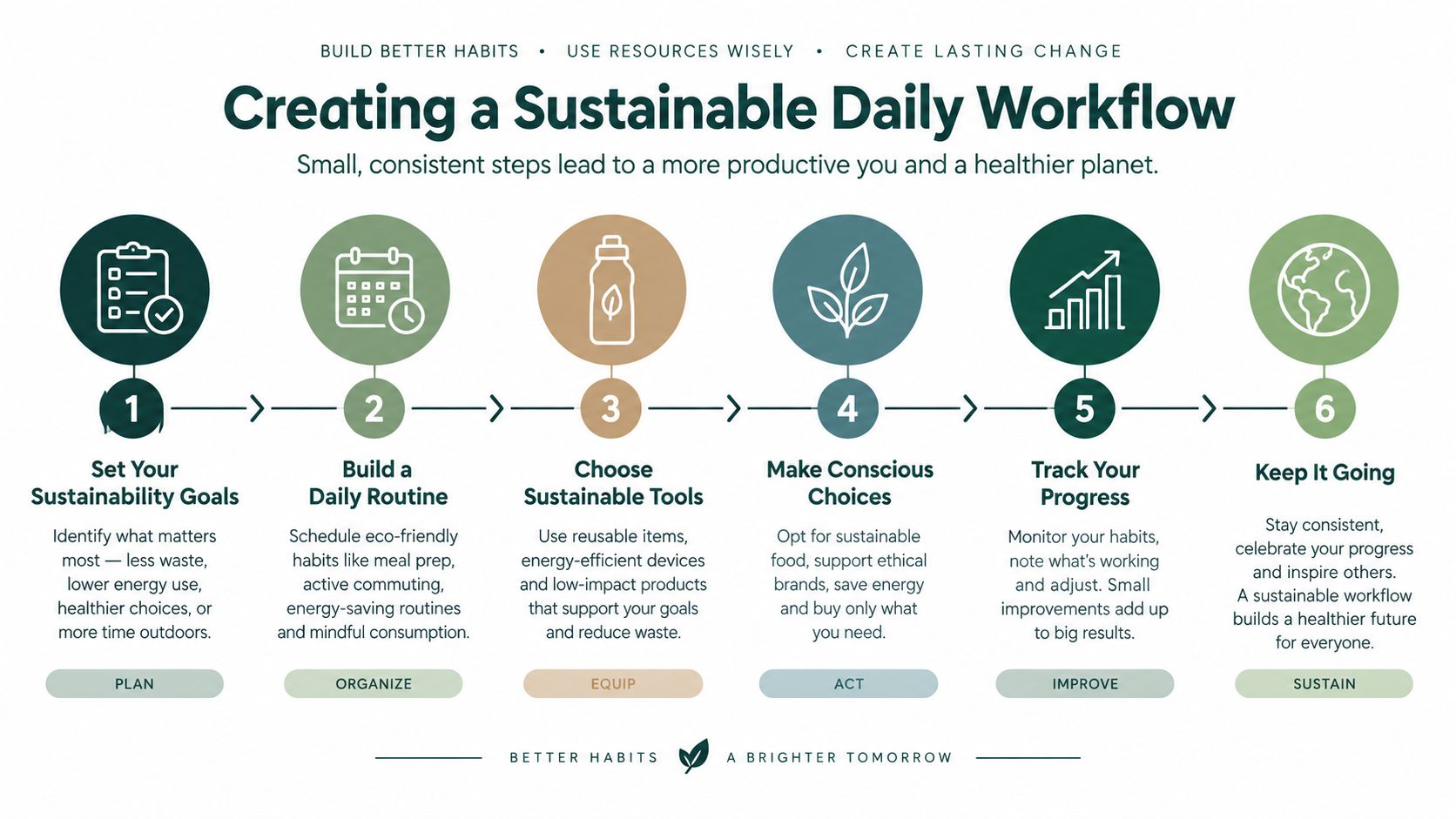
A sustainable workflow should feel like a sequence of handoffs, not a military timetable. Each stage prepares the next one and leaves a visible restart point for the moment your attention moves elsewhere.
Start the morning with a low-friction launch. Keep the first task selected the previous evening, place the required materials where you'll see them, and begin with a short setup action rather than an abstract goal. After that, use a focus session for the primary task, with distracting apps blocked and your phone outside immediate reach.
A workable day sequence
- Morning setup: Review the priority, identify the first physical action, and remove one predictable obstacle.
- First work block: Complete a defined focus session, stopping at a planned boundary rather than waiting until exhaustion.
- Transition reset: Write down where you stopped, stand up, and choose the next activity before checking messages.
- Afternoon maintenance: Process communication and smaller tasks in a contained window, instead of allowing notifications to fragment the day.
- Food and household support: Reduce decisions around meals and errands. An ADHD meal-planning tool can help turn another recurring decision into a prepared list of options.
- Evening close: Record completed actions, move unfinished work to a realistic next step, and prepare the first cue for tomorrow.
Breaks deserve design too. A break that opens an unrestricted social feed can become an unplanned context switch, while water, movement, a brief snack, or looking outside can restore capacity without creating a new attention trap. Keep a written “return cue” beside you, such as “next, edit the second paragraph,” so restarting doesn't require reconstructing the whole task.
The 2026 digital CBT findings point to a practical reality: accessible tools can support people while they wait for therapy, but digital support works best when it helps execute real tasks rather than merely collect symptom data. Your workflow should therefore connect planning, environmental controls, attention practice, and clinical monitoring. If one piece repeatedly fails, adjust that piece instead of blaming the entire system.
Kohru brings Focus Sessions, cross-device distraction blocking, Smart To-Do Lists, flexible habit targets, and progress tracking into one workflow for studying and professional work. Use Kohru to turn tomorrow's priority into a defined session, reduce switching at the point of initiation, and review what you completed.
