
Studying longer isn't the same as learning more. A student can spend an evening rereading lecture slides and still struggle to explain the material the next morning. The stronger approach is to build a connected system that makes each study block purposeful: plan the work, protect attention, encode information actively, test understanding, and maintain a routine that can survive real college life.
That matters because college often gives students more control over their schedules, but also more responsibility for deciding when and how to work. A 2022 U.S. student survey found that 50.5% of respondents studied less than two hours per day, while 34.4% studied three to four hours daily and 15% studied more than five hours a day, according to this analysis of student study habits. Short, intentional sessions can be a realistic starting point, especially when they replace passive time with active learning.
The ten habits below work as parts of one flexible system. You can adjust session length, breaks, sensory conditions, study location, technology, and accountability to fit your needs. A student with ADHD might use shorter blocks and visible cues. Another student might prefer longer quiet sessions, handwritten notes, or an audio explanation. You'll find subject-specific examples, practical implementation steps, and a sample weekly approach, plus guidance on choosing a best refurbished laptops UK option that supports study without adding unnecessary cost or distraction.
Table of Contents
- 1. The Pomodoro Technique
- 2. Active Recall and Spaced Repetition
- 3. Deep Work and Distraction Blocking
- 4. The Feynman Technique
- 5. Structured Note-Taking Systems
- 6. Interleaving and Mixed Practice
- 7. Teaching Others and Peer Study Groups
- 8. Strategic Time Management and Schedule Blocking
- 9. Practice Testing and Self-Assessment
- 10. Elaboration and Connecting to Prior Knowledge
- 10-Strategy Study Habits Comparison
- Turn the List Into Your Weekly Study Routine
1. The Pomodoro Technique
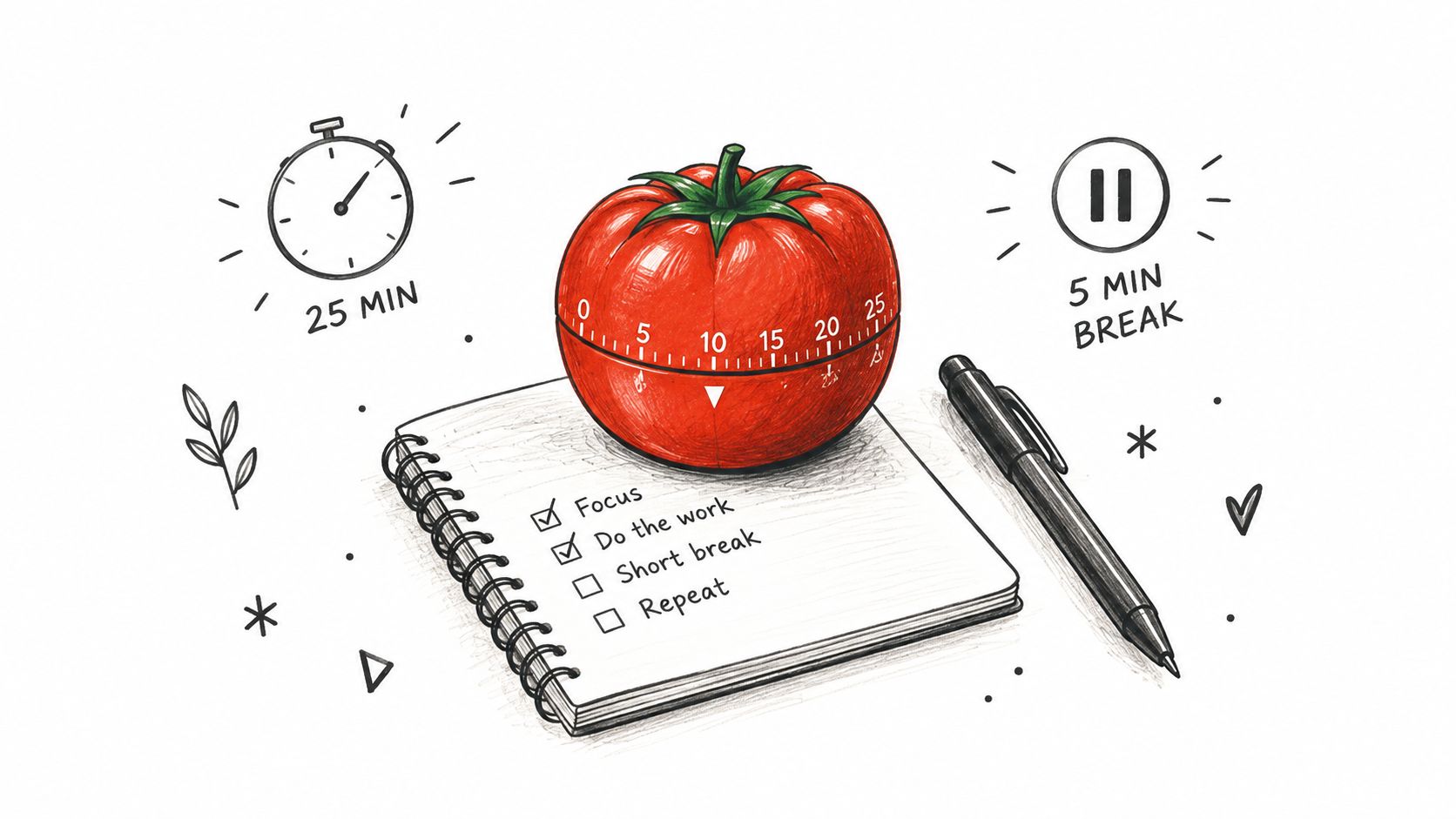
The Pomodoro Technique gives study time a visible shape. Instead of telling yourself to “study biology,” you define a short focus interval, work on one task, then pause before fatigue turns into avoidance. The classic format uses 25 minutes of focused work followed by a five-minute break, with a longer break after several completed intervals. Those timings are a starting point, not a rule.
The method works because it reduces the psychological weight of beginning. A medical student may use one interval to label an anatomy diagram, another to retrieve the function of each structure, and a later interval to answer practice questions. A computer science student might dedicate a block to reading a function, another to writing code, and another to debugging. A law student could use separate blocks for extracting facts, identifying the legal issue, and comparing cases.
Make the interval serve a clear task
Write the outcome before starting. “Complete questions on cellular respiration” is more useful than “study chemistry.” Turn off notifications, place your phone outside reach, and use a timer or a focus tool such as Kohru's Focus Sessions if you want one-click activation and app blocking.
Use the break to stand, drink water, stretch, or look away from the screen. Avoid replacing a focused task with a highly absorbing social feed, because a short break can easily become a long interruption.
Practical rule: If 25 minutes feels too short for your attention pattern, change the interval. The useful habit is deliberate focus followed by recovery, not loyalty to a particular number.
Students who find transitions difficult can prepare the next task before taking a break. Students who need movement or sensory regulation can use the break for walking, fidgeting, or a quiet reset. Track completed intervals as evidence of follow-through, but don't treat missed blocks as failure. The system should help you return to work, not punish you for having variable energy.
2. Active Recall and Spaced Repetition
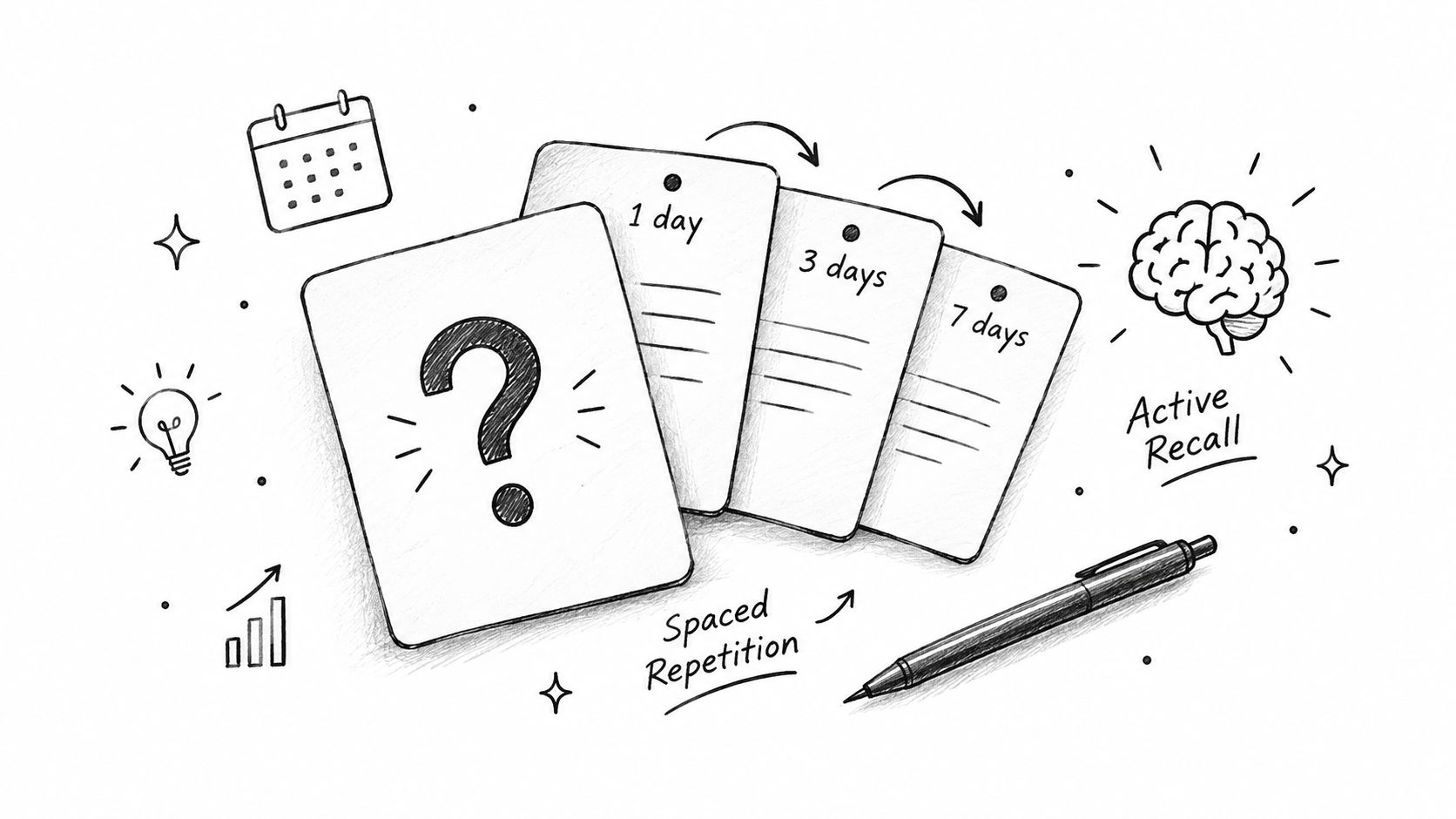
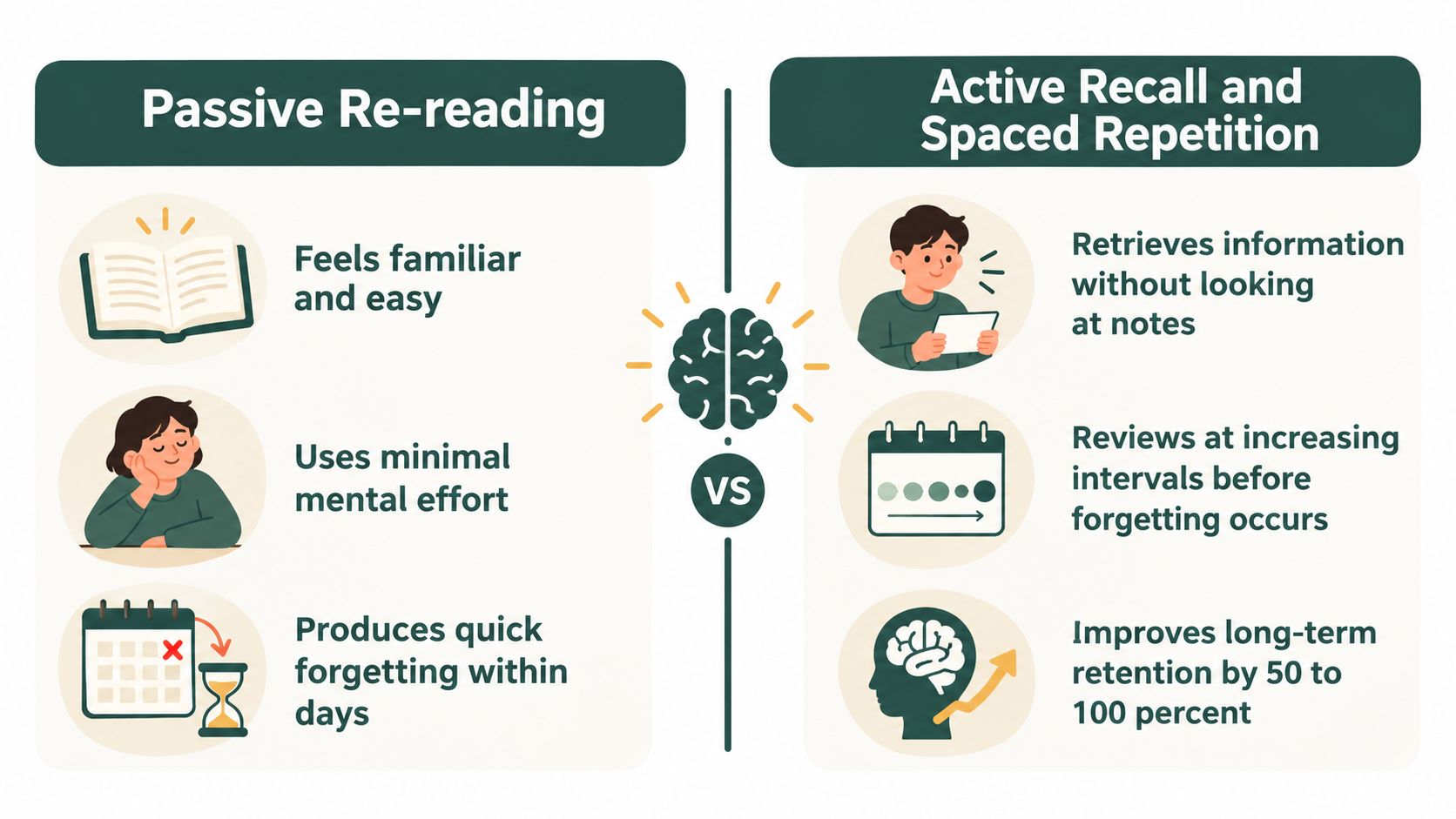
Rereading creates familiarity, but familiarity can hide gaps. Active recall asks you to retrieve information without looking at the answer. Spaced repetition then brings that information back at planned intervals, giving you repeated opportunities to notice what you know and what you've forgotten.
This combination is especially useful when a course has many details that must remain available over time. A medical student can turn pharmacology notes into questions about mechanisms, side effects, or contraindications. A language learner can review vocabulary by producing a word from a definition rather than merely recognizing it on a page. An engineering student can solve a problem without first checking which formula the textbook expects.
Build questions from your own material
After a lecture, close your notes and write questions such as:
- Define the concept: What does opportunity cost mean?
- Explain the process: How does an action potential move along a neuron?
- Choose the method: Which equation or approach fits this mechanics problem?
- Compare ideas: How does one constitutional argument differ from another?
- Apply the principle: What would happen if one condition changed?
Use flashcards in Anki, Quizlet, or another system, but don't let card creation become a substitute for studying. A strong card usually tests one meaningful idea. If a card contains an entire paragraph, split it into smaller prompts or replace it with a short-answer problem.
Research published in CBE Life Sciences Education found that students used about four active study strategies on average and spent roughly half of their study time on active strategies. The same study reported that students began exam preparation about six days before an exam. You can read the study in CBE Life Sciences Education. These findings support a practical conclusion: active methods need to appear throughout preparation, not only during the final review.
Set a weekly target for retrieval sessions rather than demanding a perfect daily streak. If you're neurodivergent, use visual cards, audio prompts, color coding, or a choice between speaking and writing an answer. The best format is the one that makes retrieval clear and repeatable.
3. Deep Work and Distraction Blocking
Some tasks need more than a timer. Reading a difficult theory, debugging a program, interpreting research, or drafting an argument requires sustained attention. Deep work means protecting a defined period for one cognitively demanding task while removing the interruptions that trigger context switching.
Start with a narrow goal. “Work on my essay” leaves too many decisions open. “Draft the introduction and identify two supporting passages” gives the session a finish line. A physics student might choose a set of related derivations. A business student might analyze a case and list the assumptions behind the recommendation. A data science student might debug one section of a notebook with messages and social platforms blocked.
Design the environment before the timer starts
Put the phone in another room or enable an app blocker. Close unrelated browser tabs. Use headphones, a library desk, a quiet room, or a low-stimulation space according to your needs. Some students concentrate better with steady background sound, while others need silence. Neither preference is a character trait or a measure of effort.
Schedule demanding work when your concentration is usually strongest, but don't assume that morning is best for everyone. A student who works late because of employment, caregiving, or medication timing can protect an evening block instead. The important decision is to match task difficulty to available attention.
Recent evidence shows why this deserves more nuance than “just use willpower.” A 2019 and 2020 cross-sectional survey of students found that 91% said COVID-19 made studying more difficult, 92% said the loss of structure or routine harmed their study habits, and 75% reported increased stress. The study on university students and study habits also reported that many students used environmental and routine-based supports. A protected session recreates some of that structure without requiring perfect motivation.
End by recording what you completed and what should happen next. That small note lowers the restart cost when you return.
4. The Feynman Technique
You can recognize a definition without understanding it. The Feynman Technique exposes that difference by asking you to explain a concept in plain language, as if your listener has no specialist background. When the explanation becomes vague, overly dependent on jargon, or stuck at a list of terms, you've found a gap worth studying.
Try it after a lecture or a problem set. An organic chemistry student might explain why a reaction proceeds through a particular mechanism, not just name the mechanism. An economics student could describe inflation using an everyday example before connecting it to formal theory. A biology student might explain protein synthesis as a sequence of events and identify where the explanation becomes uncertain.
Use a four-step explanation loop
- Name the idea: Write the concept at the top of a page.
- Explain it clearly: Use ordinary words, a concrete example, or a diagram.
- Mark the gap: Circle any step you can't justify or any term you used without explaining.
- Repair and repeat: Return to the lecture, textbook, office hours, or a reliable reference, then explain it again.
Speaking aloud helps because it makes missing links easier to hear. If speaking is uncomfortable or impractical, write the explanation, record a private audio note, or use a visual flowchart. A study partner can interrupt with questions, but working alone is also valid.
If you can only repeat the lecturer's wording, you may remember the language without owning the idea.
The technique works well with spaced review. Keep your short explanations and revisit them later, but don't assume a polished paragraph proves mastery. Ask yourself to produce the explanation again without looking. For philosophy, history, and law, include the reasoning behind a position. For mathematics and science, include why each step is valid. For languages, explain the rule and then create a new example.
A dedicated focus block can make this habit easier to start. Keep the first explanation short, then expand only where your understanding requires more detail.
5. Structured Note-Taking Systems
Good notes don't attempt to preserve every word. They create a usable map of the lecture, reading, or problem-solving process. A structured system helps you separate main ideas from examples, mark questions while they're fresh, and turn notes into review prompts later.
The best system depends on the subject and your access needs. Cornell Notes divide a page into notes, cues, and a summary. An outline suits a history lecture organized around causes and consequences. A mind map can show how algorithms, data structures, and programming decisions relate to one another. A language learner might combine short examples, pronunciation notes, and color coding, provided the colors remain consistent and accessible.
Capture, process, and retrieve
During class, write concepts, relationships, examples, and questions rather than transcribing every sentence. Use abbreviations, symbols, or speech-to-text if handwriting speed or motor demands make traditional notes difficult. Digital tools such as OneNote, Notion, and Apple Notes can help you search and sync, while paper may reduce screen distractions.
Within a day, process the notes. Fill in missing steps, identify unclear terms, and write a short summary without copying the lecture. Then turn key points into questions. That last step changes notes from an archive into a study tool.
For practical guidance on adapting systems to lectures, compare these proven note-taking methods. Don't choose a format because it looks attractive online. Choose one you can use during a real lecture and review when you're tired.
A short review session might ask you to cover the notes column and answer the cue questions. For a neurodivergent student, a template can reduce the number of decisions required. For a student with visual processing needs, plain layouts, larger text, and clear headings may work better than dense color coding.
6. Interleaving and Mixed Practice
Blocked practice feels smooth because you repeat the same type of task. That smoothness can be misleading. Interleaving mixes related problem types or concepts so you must identify the right approach before you begin. It makes practice less predictable, but exams and real decisions rarely announce which method to use.
A mathematics student might alternate algebra, geometry, and calculus problems. A chemistry student could mix reaction types instead of solving ten examples with the same visible pattern. A language learner might move among vocabulary retrieval, grammar production, reading, and speaking. In physics, a mixed set can require you to decide whether a mechanics, optics, or thermodynamics principle applies.
Ask the diagnostic question first
Before solving, pause and ask, “What kind of problem is this, and what evidence tells me which strategy fits?” Cover the worked solution until you've committed to an approach. If you choose incorrectly, record the clue you missed. That error analysis is more valuable than checking whether the final answer matches.
Interleaving works best after you understand the basic methods. Begin with a small mixed set, then increase variety as the foundations become more secure. Keep a simple record of the problem type, chosen strategy, error, and correction. This prevents “I got it wrong” from becoming an unhelpful conclusion.
Use mixed practice to diagnose decisions, not to make every study session feel difficult.
Students who find unpredictable tasks overwhelming can preview the categories before shuffling the order. You might use symbols, labels, or a written decision tree without revealing the solution. Students who prefer structure can interleave within a predictable framework, such as alternating two known topics before adding a third.
The point isn't to make work harder for its own sake. It's to practise selecting, adapting, and transferring knowledge instead of following a memorized sequence.
7. Teaching Others and Peer Study Groups
Explaining a concept to another person changes the task. You must organize the idea, choose relevant examples, respond to questions, and notice where your reasoning breaks. A peer group can also reveal interpretations you hadn't considered, particularly in subjects where evidence and argument matter.
A medical student might lead a discussion of a research paper and defend an interpretation. Engineering students can solve a problem together, but each person should explain a step rather than copy the group's answer. Business students can take turns presenting a case recommendation. Law students can question one another about facts, rules, counterarguments, and conclusions.
Give the meeting an academic job
A productive group doesn't begin with “What should we study?” It begins with an agenda:
- Choose an outcome: Finish a problem set, explain three theories, or mark essay plans.
- Rotate the teacher: Each person explains one concept and answers questions.
- Use individual attempts first: Try the problem before comparing approaches.
- Finish with a check: Ask each member to state what remains unclear.
Groups of three to five people may be easier to coordinate than a large gathering, but the right size depends on the course, accessibility needs, and relationships. Some students benefit from body doubling, where others work nearby in silence. Others do better in a one-to-one session or an asynchronous exchange of recorded explanations.
Set expectations about start times, breaks, preparation, and communication. Use a shared document for questions and assign someone to keep the session on task. Distraction blocking can apply to group study too, especially if the meeting happens online. Keep the focus on learning rather than social performance, and offer alternatives for students who process more slowly or need time to formulate answers.
Ask a tutor, teaching assistant, or professor for clarification when the group reaches a disagreement. Peer discussion supports learning, but it shouldn't turn an uncertain explanation into a shared misconception.
8. Strategic Time Management and Schedule Blocking
A calendar does more than record intentions. It turns a broad goal into a sequence of actions, so attention, practice, and review can support one another. “Study statistics this week” has no clear starting point. “Tuesday after class, solve practice questions and review errors” gives the session a purpose.
Start with one calendar containing exams, papers, labs, presentations, work shifts, appointments, and other fixed commitments. Work backward from each major deadline. Schedule early blocks for learning and guided practice, then reserve later blocks for retrieval, correction, and assessment-style work. Spacing these steps helps prevent a final rush in which every task competes for the same limited time.
Build a schedule that can adapt
A study block should name three things: the course, the action, and the result. For example:
- Organic chemistry: Study reaction mechanisms, then reproduce them without notes.
- Modern history: Compare two arguments and draft a thesis.
- Statistics: Solve mixed problems and classify each error.
- Spanish: Retrieve vocabulary, practise listening, and record a short speaking response.
Schedule demanding work during your most alert period, whether that is morning, afternoon, or evening. Leave room for travel, meals, transitions, questions, and recovery. Students with ADHD or other access needs may benefit from shorter blocks, visual timers, body doubling, or a flexible task menu. A paper planner, digital calendar, or tutoring scheduling software can work well if it makes the next action easy to see.
Use weekly targets rather than treating a missed block as a failed plan. At the end of the week, compare intended actions with completed ones. If a block repeatedly disappears, adjust its time, length, location, or first step. Starting with one problem, one paragraph, or a brief recall session may provide a more workable entry point than demanding a long study period.
The goal is a schedule that protects attention while leaving enough flexibility to maintain the system through an unpredictable college week.
9. Practice Testing and Self-Assessment
A practice test is part of studying, not merely a final check. Retrieving an answer without notes shows what you can produce, while an incorrect or uncertain response identifies the next task. Use testing after you have learned the material, then connect the results to the rest of your study system: repair gaps, adjust your weekly targets, and test again.
Match the practice to the course. A pre-med student might complete timed multiple-choice questions and explain the reasoning behind each choice. A language student can divide practice among listening, writing, and speaking. A history student could answer an essay prompt, then compare the argument with the marking criteria. An engineering student may solve an old problem set without first selecting the formula, since choosing the method is part of the skill.
A useful test creates evidence, not just a score. Mark responses as correct, incorrect, or uncertain, and review the uncertain answers even when they happen to be right.
Let each mistake choose the next task
Sort errors by cause:
- Knowledge gap: You did not know the relevant fact or concept.
- Retrieval gap: A cue helped you recognize it, but you could not produce it independently.
- Application gap: You understood the idea but selected the wrong method.
- Process error: You misread, rushed, or lost a step.
Each category points to a different repair. Relearn a knowledge gap with a short explanation and retrieval prompts. Use mixed problems for an application gap. For a process error, slow the reading, show each step, or change the testing conditions. Students with ADHD or test anxiety can begin with untimed questions, spoken answers, or a smaller set, then add time limits as confidence and accuracy improve.
Begin before the final review period. Short cumulative tests leave time to ask a professor, attend tutoring, or compare solutions with a study partner. A quiet space and timer can resemble exam conditions, but every session does not need high pressure. Record the diagnosis and schedule its repair in the next study block. The score is useful. The explanation behind it is more useful.
10. Elaboration and Connecting to Prior Knowledge
Elaboration makes a new concept easier to retrieve because it gives the idea several routes back into memory. Instead of storing a definition alone, connect it to what you know, why it works, and the limits of the comparison. The result is a study system in which planning, active practice, and review reinforce one another.
Start with the course's sequence. A biology student can link protein synthesis to earlier work on DNA replication and transcription. An economics student might connect supply and demand to a purchasing decision, then identify where that everyday example breaks down. A psychology student can relate neurotransmitter functions to behavior while keeping complex conditions from being reduced to one cause. In physics, a push or pull can introduce a principle, but the formal definition must determine the final explanation.
Use this short connection check after a lesson:
- What do I already know that resembles this?
- What changed from the earlier idea?
- Why does this process produce that result?
- Where does the analogy stop being accurate?
- Can I create an example without copying the textbook?
Then choose an output that suits the material and your attention. Draw a concept map, write a comparison, explain the link aloud, or arrange ideas on a whiteboard. A plain notebook may reduce sensory load. A voice recording can suit verbal thinkers, while a wall-sized map can support students who learn through movement. These options change the format, not the reasoning.
Check every analogy against the course definition. Similarity can open the door to understanding, while an unchecked comparison can create a false rule.
For courses that build across units, keep one running page of links between old and new material. During a weekly review, retrieve the connection rather than rereading only the definition. Ask whether one concept supports, contradicts, or depends on another, then add the result to the next study target. This turns prior knowledge into a working map that guides attention, practice, and later testing.
10-Strategy Study Habits Comparison
| Technique | Implementation complexity | Resource requirements | Expected outcomes | Ideal use cases | Key advantages |
|---|---|---|---|---|---|
| The Pomodoro Technique | Low, simple timer routine | Minimal, timer or app | Improved focus, reduced fatigue, sustained study rhythm | Short focused tasks, review sessions, coding sprints | Easy to adopt; prevents burnout; boosts time awareness |
| Active Recall & Spaced Repetition | Medium, needs scheduling and card creation | Moderate, flashcards/apps (Anki), question sets | Large gains in long-term retention and reduced study time | Memorization-heavy subjects: languages, medicine, facts | Strongest evidence for retention efficiency; personalized spacing |
| Deep Work & Distraction Blocking | Medium–High, requires discipline and setup | Moderate, blocking tools, quiet environment | Higher-quality work, faster progress on complex tasks | Research, writing, complex problem-solving (math, CS) | Enables flow states; minimizes context-switching costs |
| The Feynman Technique (Concept Simplification) | Medium, iterative explanation and refinement | Minimal, notebook or study partner | Deeper conceptual understanding; reveals knowledge gaps | Concept-heavy topics, exam explanations, teaching prep | Forces true understanding; improves communication skills |
| Structured Note-Taking Systems | Medium, learn and apply a formal system | Minimal–Moderate, notebooks or digital apps (Notion) | Organized reference materials and better lecture retention | Lectures, long courses, subjects needing review materials | Produces usable study artifacts; aids later review |
| Interleaving & Mixed Practice | Medium, requires designing mixed problem sets | Moderate, diverse problem resources | Better transfer, discrimination between problem types | Math, physics, chemistry, applied problem solving | Improves ability to apply strategies to new problems |
| Teaching Others & Peer Study Groups | Medium, coordination and facilitation needed | Moderate, peers, meeting space or online tools | Stronger retention, accountability, clearer explanations | Journal clubs, group problem sets, exam prep groups | Social motivation; protégé effect enhances learning |
| Strategic Time Management & Schedule Blocking | Medium, planning and regular review required | Minimal, calendar or scheduling tools | Reduced procrastination; balanced, consistent preparation | Semester planning, multi-course workloads, exam timelines | Turns intentions into commitments; reduces decision fatigue |
| Practice Testing & Self-Assessment | Medium, create/find realistic tests | Moderate, practice exams, feedback sources | Improved exam performance; better metacognition; reduced anxiety | High-stakes exams, cumulative courses, timed tests | High-impact retrieval practice; objective progress metrics |
| Elaboration & Connecting to Prior Knowledge | Medium, reflective effort and mapping | Minimal, time, concept maps or notes | Deeper, more retrievable memories and better transfer | Theory-heavy subjects, interdisciplinary learning | Makes learning meaningful; strengthens retrieval pathways |
Turn the List Into Your Weekly Study Routine
Ten habits can become another source of overwhelm if you try to adopt them all at once. Treat them as parts of a workflow. Planning decides what deserves attention, focus protection creates the conditions, active encoding makes the material meaningful, retrieval and testing reveal what you can produce, and review keeps important ideas available.
Start with the calendar. Add fixed classes, work, commuting, meals, appointments, and recovery time. Then assign each course a few specific study actions. Don't write only “biology.” Write “retrieve the lecture concepts,” “explain the cell process aloud,” or “complete and correct a mixed problem set.” A schedule should tell you what to do when you sit down.
Choose one focus structure for the first week. Use Pomodoro intervals if starting and sustaining attention are difficult. Use a longer protected block if your work requires extended reading or coding. Block notifications, prepare the materials before beginning, and choose an environment that fits your sensory needs. If background sound helps, use it consistently. If screens create too much temptation, print the reading or move to a library desk.
Convert passive reading into an output. Close the book and answer questions. Create flashcards from the concepts you repeatedly miss. Explain a difficult idea in plain language. Take a short practice test and classify your errors. Use interleaving when you need to decide which method applies, not merely repeat a familiar sequence. Add elaboration when the course depends on connecting new material to earlier units.
A 2021 study found that students spent roughly half of their study time on active strategies, while newer research reported that students were distracted 26% of the time and that greater distraction was linked to worse performance. You can review that evidence in this research on active strategies and distraction during exam preparation. The practical lesson is not to chase a perfect number of hours. Protect the time you have, and make more of it active.
Review your actual week before planning the next one. Which sessions happened? Which tasks took longer? Did the location help? Were breaks long enough? Did you need written prompts, body doubling, movement, or a different time of day? Adjust the system instead of abandoning it after an imperfect day.
Technology can support that process when it reduces decisions rather than adding them. Kohru offers Focus Sessions for distraction blocking, Smart To-Do Lists for turning tasks into study actions, flexible weekly Habit Tracking, and a dashboard that makes progress visible. You can use those tools alongside paper planning, campus resources, tutoring, office hours, or a peer group.
One final principle matters: study habits should support your life, not consume it. Sleep, meals, movement, relationships, accessibility accommodations, and recovery affect whether you can return to the material tomorrow. A sustainable system leaves room for variation. Your goal isn't to study in one supposedly ideal way. It's to create a repeatable path from intention to focused work, active understanding, useful feedback, and steady progress.
Kohru combines distraction-blocking Focus Sessions, Smart To-Do Lists, flexible weekly Habit Tracking, and progress visibility to help you turn study plans into focused actions. Visit Kohru to build a study workflow that fits your schedule, attention needs, and weekly targets.
