You open your laptop with a clear plan: review one chapter, answer a few practice questions, then start the report due next week. At first, the goal feels important. Later, the notes blur, notifications win, and the promise of a future grade or finished project no longer feels powerful enough to keep you moving. You still care. Your motivation system just isn't receiving useful feedback.
A well-designed reward system isn't a bribe jar. It's an information system that tells your brain what happened, why it matters, and what action is worth repeating. That distinction helps students, professionals, remote workers, and neurodivergent people build follow-through without relying on heroic willpower.
Table of Contents
- Why Motivation Fades Even When Goals Matter
- How Motivation Works in the Brain
- Types of Reward Systems and When to Use Each
- What Makes Rewards Feel Meaningful Instead of Noisy
- How to Design a Reward System That Sticks
- Common Pitfalls That Undermine Motivation
- Sustaining Motivation for the Long Term
Why Motivation Fades Even When Goals Matter
A university student might begin exam preparation with genuine urgency. The exam matters, the material matters, and the student wants to do well. Yet “study for the exam” is a distant instruction, while the effort required is immediate. Reading a difficult page produces no visible sign of progress, and the reward, a stronger grade, remains far away.
A similar pattern appears at work. A project lead wants to improve documentation, a freelancer wants to send proposals, and a remote employee wants to record time accurately. Each goal has value, but value alone doesn't tell the brain whether today's small action is working. Practical guidance on employee time tracking makes an important point for workplace systems: people need a clear connection between the behavior and the feedback that follows it.

Motivation is a feedback problem
Motivation is often described as a personal supply of discipline. That explanation can make a tired learner feel defective. A more useful view treats motivation as a loop:
- You choose a behavior.
- You perform it.
- You receive information about the result.
- You update whether, when, and how strongly you'll repeat it.
If the loop is vague, delayed, or unrelated to the behavior, the brain has little evidence that continuing is worthwhile. “Become healthier,” “write a thesis,” and “finish the quarter well” are meaningful aims, but they're poor moment-to-moment signals.
A reward system translates a distant outcome into nearer checkpoints. Completing a focused study session can create a visible progress marker. Sending a finished draft can trigger a meaningful break. Logging work can show where time was spent. The reward doesn't need to be expensive or dramatic. It needs to arrive at the right moment and communicate useful information.
Practical rule: Reward the action you can repeat, not only the outcome you hope to achieve.
This approach also respects different starting points. A student with attention difficulties may need a shorter entry point and more immediate feedback. A professional may need progress visibility across a long project. Someone working from home may need a system that separates work completion from the emotional pressure of being constantly available. The design changes, but the principle remains: motivation grows when effort produces understandable evidence of progress.
How Motivation Works in the Brain
The brain doesn't respond only to the size of a reward. It also compares what happened with what it expected to happen. This comparison is called reward prediction error.
Think of the process as a prediction thermostat. Before an action, your brain makes a forecast. If the result is better than expected, the system sends a stronger learning signal. If the result is disappointing or missing, the signal weakens. When the outcome is fully predictable, the response returns close to baseline. Research on dopamine and reward prediction error describes dopamine neurons as carrying this teaching signal, which updates the future value of actions and responds especially strongly to cues that provide new information about an upcoming reward.
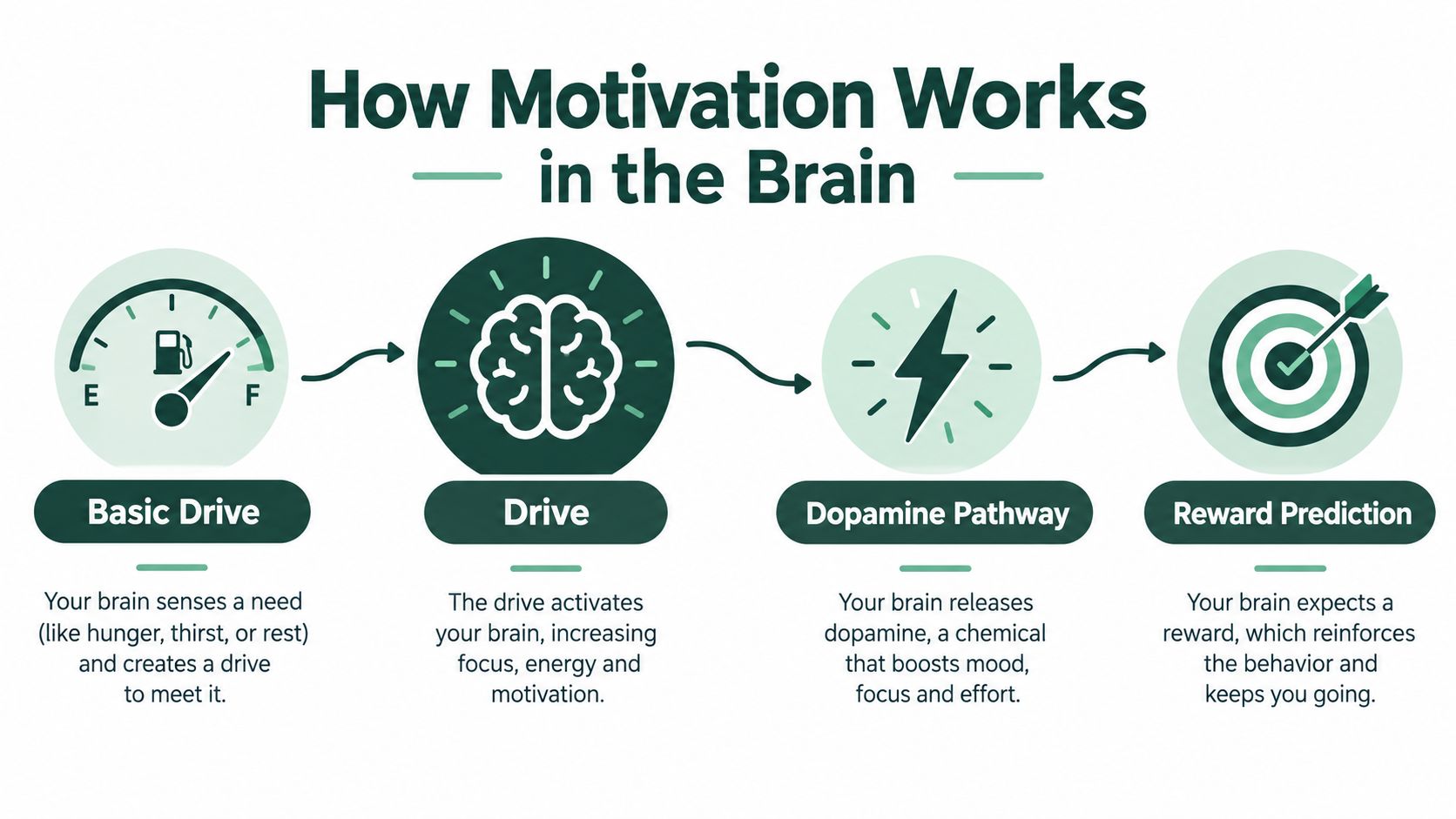
The four parts of a useful loop
First, identify the cue. A calendar reminder, a particular desk, or opening a task list can signal that a behavior is about to begin. A cue works better when it carries information, such as “this is a focused writing session,” rather than repeating an alarm with no clear next action.
Second, make the behavior concrete. “Study biology” is too broad for reliable feedback. “Complete a focused review of the cell-signaling notes” gives you an observable action. Professionals can use “draft the introduction” instead of “work on the proposal.”
Third, keep feedback close to the action. Immediate feedback helps the brain connect effort with consequence. A progress marker after a completed focus block is more informative than a vague promise that success will eventually feel good.
Fourth, preserve some information value. If the same reward appears automatically regardless of effort, it stops teaching much. The system should show what was completed, how it contributes to the larger goal, and what the next useful step is.
A reward, then, has two jobs. It can make an action pleasant, but it can also explain the action's value. A completed checklist item, a visible progress bar, or a planned break can all function as information when they accurately reflect effort.
Watch this short visual explanation alongside the reading:
Predictable rewards aren't always useless. Fixed feedback can help someone establish a routine, especially when the behavior is new. But once the pattern becomes automatic, a reward that adds no new information may turn into background noise. The strongest systems therefore combine consistency at the beginning with feedback that remains relevant to progress.
For a complementary explanation of intrinsic versus extrinsic motivation, keep one question in view: does the reward help the learner feel capable and in control, or does it communicate that someone else is controlling the behavior? That distinction determines whether an external reward supports learning or gradually replaces the learner's own reasons for acting.
Types of Reward Systems and When to Use Each
Different behaviors need different reward structures. A reward that helps someone start a dull administrative task may be inappropriate for creative work that depends on curiosity. The useful choice isn't between “rewards” and “no rewards.” It's between architectures that support the behavior and architectures that distort it.
Intrinsic motivation comes from the activity itself, such as the satisfaction of understanding a difficult concept, improving a skill, or solving an interesting problem. Extrinsic motivation comes from an external consequence, such as a grade, payment, privilege, badge, or break.
Self-determination theory separates these forms, but modern reviews show that external reinforcers can sometimes strengthen intrinsic motivation when they support autonomy, competence, or expectancy rather than controlling behavior. The review of self-determination theory and extrinsic rewards helps explain why “you choose your reward” can feel different from “you only get approval if you obey.”
A practical comparison
| Reward Type | Best For | Watch Out For |
|---|---|---|
| Intrinsic reward | Skill building, exploration, creative work, and long-term learning | The task may still need an accessible starting cue |
| Informational extrinsic reward | Showing progress, confirming completion, and clarifying competence | Avoid turning every signal into a judgment |
| Fixed reward | Establishing a dependable routine or reinforcing a repeated input | The pattern can become predictable and lose information value |
| Variable reward | Maintaining curiosity in suitable low-stakes tasks | Uncertainty can distract or feel unfair |
| Choice-based reward | Supporting autonomy across different people and contexts | Too many options can create decision fatigue |
| Social recognition | Collaborative work and visible contribution | Public comparison may embarrass or pressure some users |
Fixed schedules are easier to understand. A student might take a planned break after completing a defined study block. A manager might recognize completed documentation during a regular team review. These arrangements build consistency because the person knows what action leads to what response.
Variable rewards can add novelty, but they need careful boundaries. Random points or surprise privileges may keep a routine interesting, yet unpredictable access can also make the system feel arbitrary. Use variation in the experience, not confusion about the rules.
The safest design question is simple: What should the person learn from this reward? If the answer is “that their effort produced progress,” the system is probably informational. If the answer is “that they must satisfy the person administering the reward,” autonomy may be shrinking.
What Makes Rewards Feel Meaningful Instead of Noisy
More rewards don't automatically create more motivation. People interpret rewards through their own needs, preferences, culture, working conditions, and sense of fairness. A gift that feels useful to one employee may feel irrelevant to another. A public leaderboard that energizes one student may make another avoid the task.
Choice is one part of the solution. A student might choose music, a walk, or a favorite snack after completing a planned work block. A remote employee might prefer flexible time, learning access, or private recognition. Personalization turns a generic consequence into feedback that fits the person receiving it.
What the evidence says about fit
A 2025 multi-country Workhuman study found that rewards with real monetary value were associated with a 28% rise in belonging and a 21% rise in engagement. Employees whose reward options reflected their culture and interests were 3× more likely to love the program, while a positive rewards experience was associated with being 19× more likely to recommend the organization. These figures come from Workhuman's employee motivation coverage.
The lesson isn't that every organization should increase reward spending. The stronger lesson is that perceived usefulness and fit matter. A reward can carry monetary value and still fail if people can't use it easily, don't trust the selection process, or feel that the options ignore their lives.
Audit a reward system with these questions:
- Choice: Can people select from meaningful options, or does one reward fit everyone?
- Personalization: Do the options reflect different interests, cultures, access needs, and schedules?
- Redemption: Is claiming the reward simple, clear, and respectful of privacy?
- Fairness: Do people understand what behavior earns recognition?
- Signal quality: Does the reward explain progress, or does it merely create more notifications?
For students, personalization may mean choosing between a social break and quiet recovery time. For neurodivergent users, it may mean reducing sensory pressure, using clear cues, and avoiding public comparison. For remote workers, it may mean recognizing invisible coordination work rather than rewarding only highly visible output.
Practical employee reward ideas can help generate options, but the selection process matters more than copying a list. Ask the people using the system what feels useful, then remove rewards that create friction or obligation.
How to Design a Reward System That Sticks
A sustainable system begins with a behavior, not a prize. If the target is vague, every later choice becomes unstable. “Be more productive” can't tell you when to act or when you've succeeded. “Complete one uninterrupted literature-review block before lunch” can.
Start with the smallest observable action
Write the behavior in a way another person could verify without guessing:
- Student: Open the assigned article, annotate the key argument, and write a short summary.
- Researcher: Clean and label one defined portion of the dataset.
- Professional: Complete the client follow-up draft and place it in the review folder.
- Remote worker: Record the work completed during the planned session.
Keep the reward tied to the input you control. A grade, promotion, or project outcome depends on many factors. A completed session, submitted draft, or reviewed section gives your system a fairer and more immediate signal.
Choose feedback that supports agency
A reward should feel like useful confirmation, not payment for obedience. Let the person choose among options where possible. A student might select a break activity, while a professional might choose whether to end the day, take a walk, or spend time on a preferred task.
Make the reward proportional to the effort without turning the system into a constant transaction. A small completed action can earn a small acknowledgment. A meaningful milestone can lead to a larger choice. The exact reward matters less than the clear relationship between action and feedback.
Set timing and milestones
Place feedback close to completion. Then divide a distant goal into milestones that show movement. A thesis can have milestones for outlining, source evaluation, drafting, revision, and submission. A work project can use milestones for scope, first draft, review, and delivery.
Flexible weekly targets often work better than fragile daily streaks. A missed day should prompt adjustment, not erase the learner's identity as someone who can follow through. Build recovery into the design before a disruption occurs.
Design principle: A missed session is data about the system's fit, not proof that the person lacks motivation.
Tools can automate parts of this loop. Kohru combines Focus Sessions, Smart To-Do Lists, habit tracking with flexible weekly targets, distraction blocking, and a dashboard that makes focus time, completed tasks, and progress visible. Used thoughtfully, an app like this can supply the cue, record the behavior, and return immediate information without requiring you to maintain the system manually.
Review the loop
After using the system for a short period, ask:
- Did the reward arrive soon enough to connect with the behavior?
- Did it feel chosen and useful?
- Did the target describe an action rather than an outcome?
- Did the system make progress clearer?
- Did the reward help you return, or did it become another obligation?
Change one element at a time. You might shorten the work block, replace a public badge with private progress, or offer fewer but more relevant reward choices. Good motivation design is iterative because people and tasks change.
Common Pitfalls That Undermine Motivation
Reward systems fail when designers treat the reward as the intervention. A student receives points for completing worksheets, but the worksheets are confusing. An employee earns recognition for speed, but the system encourages rushed work. A freelancer gets a badge for logging hours, but the logging process takes so long that it becomes an extra burden.
The first pitfall is controlling language. “Do this or lose your privilege” can produce short-term compliance, but it may weaken the person's sense of choice. Reframe the reward as information about progress whenever possible. “You completed the planned milestone, so you can choose how to use this break” preserves more agency than “You earned permission to rest.”
The second is rewarding the wrong level of behavior. Outcomes such as grades, sales, or approval are often delayed and influenced by factors outside the learner's control. Inputs such as reading, attending, drafting, practicing, or submitting work provide clearer targets.
Boundary conditions matter
The research doesn't support a simple rule that rewards always help or always harm. A 2025 academic review reports that findings on rewards and intrinsic motivation remain divided. It also describes classroom research with weak or non-significant links between reward systems and observed pupil engagement in one 2026 sample, while another study found that grade-point rewards outperformed monetary rewards for collaborative-learning motivation. The findings are summarized in the academic review on rewards and intrinsic motivation.
That uncertainty is useful. It asks you to match the reward to the goal:
- For task initiation: use an immediate, low-friction cue and a small meaningful reward.
- For skill development: emphasize competence feedback and visible improvement.
- For collaboration: recognize contribution, shared progress, and group success.
- For creative work: protect choice and avoid rewards that make experimentation feel judged.
- For long-term habits: reduce dependence on external rewards as the behavior becomes more self-sustaining.
Avoid excessive notifications, rigid streaks, public rankings, and reward catalogs that ignore personal fit. If engagement doesn't improve, don't automatically increase the reward. First check whether the task is clear, achievable, accessible, and worth doing from the learner's perspective.
Sustaining Motivation for the Long Term
Long-term motivation depends on keeping progress visible while allowing the system to evolve. Start with immediate, informative feedback, then gradually let competence, identity, and genuine interest carry more of the load. The reward should become a bridge to the behavior, not a permanent toll charged every time you act.
Use this maintenance checklist:
- Review the target: Is the behavior still specific and within your control?
- Check the timing: Does feedback arrive close enough to teach the connection?
- Protect autonomy: Can the person choose, adapt, or recover after disruption?
- Refresh the signal: Has the reward become predictable noise?
- Watch the experience: Does the system reduce friction or add another obligation?
Motivation isn't mysterious, and it isn't a fixed personality trait. It's partly a design problem involving cues, actions, feedback, choice, and time. Build one small loop this week, observe what it teaches you, and adjust it without judgment.
Kohru combines distraction-blocking Focus Sessions, Smart To-Do Lists, flexible weekly habit targets, and progress dashboards that make completed work visible. Use it to connect focused action with immediate feedback, then visit Kohru to create a reward system that supports your attention and fits your real routine.
