
You open your laptop intending to work on one assignment. Instead, you check messages, search for a missing file, remember an upcoming exam, and move between course pages without finishing anything. By evening, you've spent hours “studying” but still can't explain what you completed or whether you're on track.
That pattern rarely reflects a lack of ambition. More often, the student has goals but no operating system for turning those goals into scheduled actions, repeatable habits, and early course corrections. An academic success plan should do more than list assignments. It should show what matters, when you'll act, how you'll handle predictable obstacles, and which signals will tell you that support is needed.
Table of Contents
- What an Academic Success Plan Really Does
- Turn Goals Into Action With If-Then Planning
- Build a Weekly Study Schedule That Fits Real Life
- Make Habits Stick and Distractions Disappear
- Track Progress and Fix What Is Not Working
- Your Ready to Use Templates and Kohru Workflow
What an Academic Success Plan Really Does
A useful academic success plan connects daily behavior to larger outcomes. It links a course deadline to a study block, a difficult topic to a support request, and a missed session to a recovery action. Without those connections, a planner can become a crowded list that creates awareness without producing movement.
Consider a student taking several demanding courses while working part-time. Their original goal might be “improve my grades.” That sounds reasonable, but it doesn't identify which course needs attention, what behavior will change, or how progress will be checked. A working plan might instead identify unfinished problem sets, missed review sessions, and delayed communication with an instructor as the behaviors most likely to affect progress.
Practical rule: A plan is useful only when it tells you what to do next, not merely what you hope will happen.
The five parts of a working plan
A strong plan usually contains five connected elements:
- Goals: Define the academic result or milestone you're pursuing, such as completing a course requirement or remaining eligible to continue in your program.
- Priorities: Rank tasks by consequence and timing. A major project that supports a core course outcome may deserve attention before a low-impact task due sooner.
- Schedule: Put actions on a calendar instead of relying on available time appearing by itself.
- Habits: Establish repeatable cues for attending class, beginning work, reviewing material, and asking for help.
- Tracking: Record enough evidence to see whether the system is working, including completed tasks, study sessions, registration progress, or attempted credits.
This structure serves more than first-year undergraduates. Graduate researchers can use it to separate reading, experiments, writing, and supervisor communication. Working students can plan around shifts rather than pretending every afternoon is available. Students with ADHD or other attention regulation challenges can use smaller starting actions, environmental cues, and flexible targets instead of depending on sustained motivation.
Find the missing piece
Before building the plan, answer these questions:
- Can you name the next action for each important course?
- Are those actions assigned to specific times?
- Do you have a response prepared for common distractions or missed sessions?
- Do you review progress before a problem becomes a crisis?
- Do you know which person or campus service you'll contact when you're stuck?
Your answers reveal the plan's weakest layer. If you know what to do but never start, focus on implementation intentions and environment design. If you work hard but miss deadlines, improve prioritization and calendar visibility. If you're unsure whether your courses support your degree path, contact an adviser before registration decisions become urgent.
The broader purpose is retention. A plan helps you keep making the next academic decision when the semester becomes crowded, rather than letting one missed task turn into withdrawal from an entire course or term.
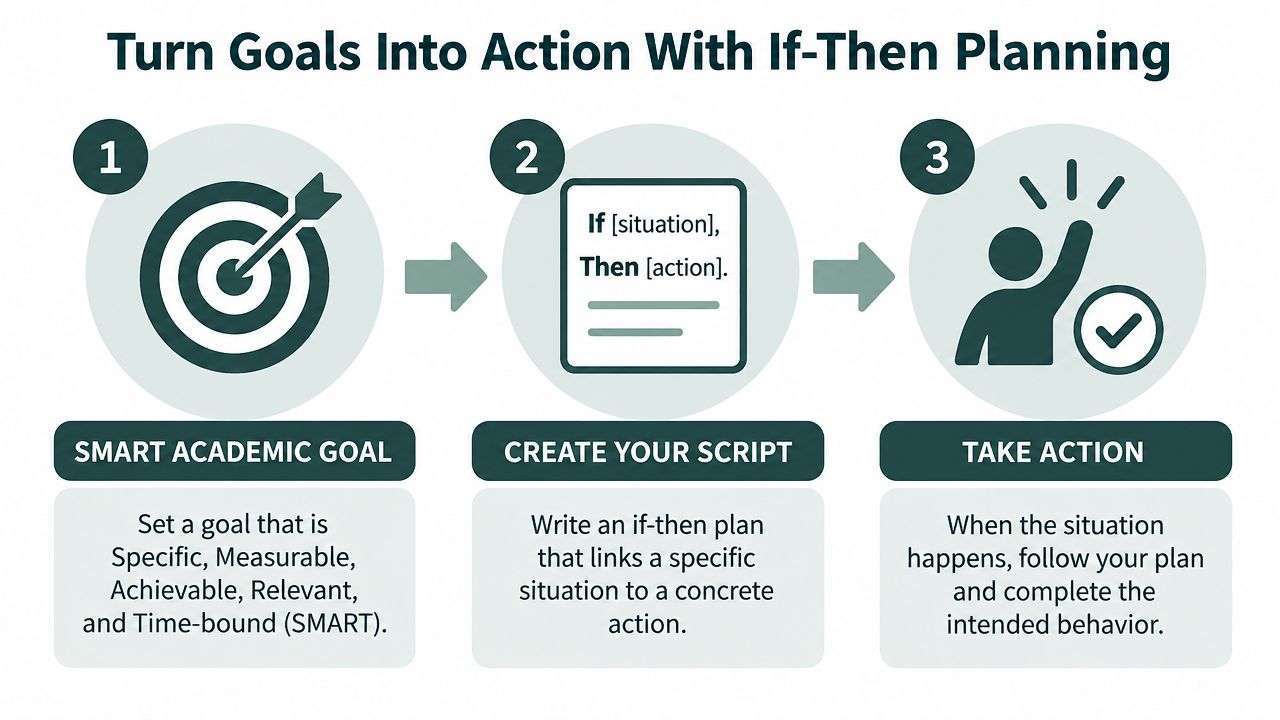
Turn Goals Into Action With If-Then Planning
Broad goals fail when they leave the moment of action undefined. “Study more” doesn't answer when you'll start, where you'll work, what material you'll use, or what you'll do when your phone interrupts you.
Implementation intentions solve that problem by converting a goal into an if-then script. The method asks you to specify the situation that will trigger an action and the behavior that follows. Education research has linked this approach with measurable gains in attendance, on-time submission of written work, and time spent on self-study. A school-based intervention also improved report-card grades, attendance, and conduct compared with a positive-thinking control group, with small-to-moderate effects reported for grades, attendance, and conduct (e-mentor discussion of implementation intentions).
Start with a concrete target
Write a goal that identifies an outcome and a behavior. You can use a SMART structure, but don't let the acronym become an excuse to write a complicated sentence.
- Vague: “Do better in biology.”
- More useful: “Complete the assigned biology problem set before the submission deadline and review errors afterward.”
- Action-ready: “On my scheduled biology workdays, I'll complete the assigned problems, mark uncertain answers, and bring those questions to office hours or tutoring.”
The final version makes quality visible. You aren't just spending time near a textbook. You're completing work, identifying confusion, and creating a route to clarification.
Add the script
Use this formula:
If [specific situation happens], then I will [specific action].
Examples:
- If it's 7 p.m. and I'm at my desk, then I'll open the problem set and work on it for a focused session.
- If class attendance feels optional, then I'll remember that attending and engaging gives me the earliest chance to notice confusion.
- If I reach a question I can't solve, then I'll mark it, attempt the next item, and add the question to my support list.
- If I pick up my phone during a study session, then I'll place it outside the study area and return to the next written step.
- If I miss a planned session, then I'll choose the next available recovery block rather than abandoning the week.
The trigger should be observable. “When I feel motivated” is unreliable because motivation changes. “After my Tuesday seminar, while I'm already on campus” gives you a clear cue and reduces the number of decisions required.
Rank the week before scheduling it
List every meaningful academic outcome for the coming week, then evaluate each item using two questions:
- How much does this affect academic progress?
- How soon does action become necessary?
High-impact and urgent work goes first. High-impact work without an immediate deadline still needs protected time, or it will eventually become urgent. Low-impact maintenance tasks can fill shorter gaps, but they shouldn't crowd out work that affects course completion.
Keep academic and personal responsibilities visible without mixing them into one undifferentiated list. Separate categories such as Coursework, Administration, Work, and Personal. That separation makes it easier to see the total load and prevents an important personal appointment or work shift from disappearing inside a course checklist.
A formal academic plan can also relate to persistence and degree progress. In a multi-institution analysis, students who completed a formal plan attempted an average of 2.68 more credit hours per term than peers without a plan, with the difference varying by school from 0.79 to 4.59 credits. Across an eight-semester bachelor's pathway, the accumulated difference exceeded 21 credits, and planners registered for the next semester at a 27.77 percentage-point higher rate (EAB analysis of academic planning). Those figures don't prove that a document alone causes progress, but they show why planning deserves to be treated as more than a productivity exercise.
Use the result as a one-page map: goals at the top, priorities beneath them, and if-then scripts beside the actions you're most likely to delay.
Build a Weekly Study Schedule That Fits Real Life
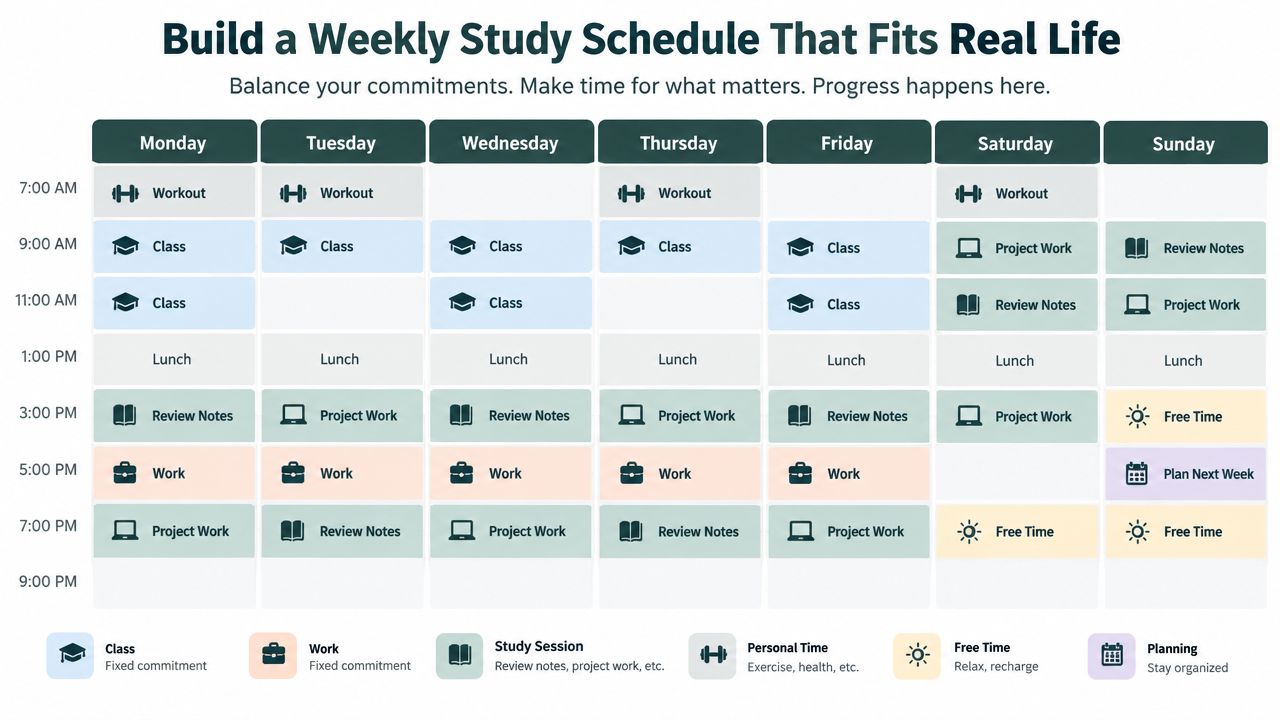
A realistic schedule begins with constraints, not wishes. Put classes, work shifts, commuting, appointments, family responsibilities, and recovery time on the calendar first. Then place study blocks into the remaining space, protecting enough flexibility for ordinary disruption.
An ideal timetable might assign every open hour to coursework. That approach looks disciplined but often collapses after one delayed bus, difficult reading, or unexpected shift. A sustainable academic success plan treats buffer time as part of the schedule, not as evidence that you're failing to maximize every minute.
Use a layered calendar
Build the week in this order:
- Fixed commitments: Add classes, work, appointments, and essential responsibilities.
- High-focus blocks: Reserve your clearest periods for problem solving, writing, coding, or research.
- Shorter sessions: Use lower-energy periods for flashcards, reading, note organization, or checking feedback.
- Buffers: Leave space between demanding tasks and around deadlines.
- Recovery: Protect sleep, meals, movement, and time away from academic work.
Focus sessions can be relatively short. Many student-focused routines use 25 to 45 minute blocks alongside planned breaks, but the right duration depends on the task and your attention profile. A reading review may fit a shorter block, while a complex proof or draft may need a longer uninterrupted period. Start with a duration you can repeat, then adjust based on evidence rather than pride.
Assign work to the right kind of time
Don't schedule every course in identical blocks. Match task difficulty to your available energy.
A student with classes and part-time work might reserve early daytime periods for a difficult quantitative course, use a gap between commitments for reading, and keep one evening block for drafting. The schedule should also include a weekly review slot where they inspect upcoming deadlines and move unfinished work into recovery space. If every block is occupied, the first missed session has nowhere to go.
Estimate workload by looking at the actual assignment, not by labeling it “study.” “Work on history” is too broad. “Read the assigned chapter, write three questions, and outline the response” gives the block a finish line. For a large project, divide the work into research, outline, first draft, revision, and submission checks.
For reliable background reading and course support, keep a short list of useful resources. A curated collection of study materials for undergraduates can help you find supplementary material without losing a scheduled block to aimless searching.
Protect the block
Before beginning, define the task, close irrelevant tabs, silence notifications, and put the phone outside immediate reach if possible. App blocking across a phone and laptop can reduce the number of decisions required during a session, especially when the task itself feels uncomfortable.
Your schedule should also state what happens when reality interrupts it. If work runs late, move the session to a named buffer rather than rewriting the entire week. If you miss a block because of illness, reduce the next action to the essential submission step and contact the relevant instructor or adviser when the issue affects a deadline.
A schedule works when it gives you a dependable next move while leaving enough room to remain human.
Make Habits Stick and Distractions Disappear
Scheduling tells you when to work. Behavior design determines whether starting feels possible. Students often build a detailed timetable and then blame themselves when they can't maintain it, even though the schedule depends on perfect energy, uninterrupted devices, and no unexpected responsibilities.
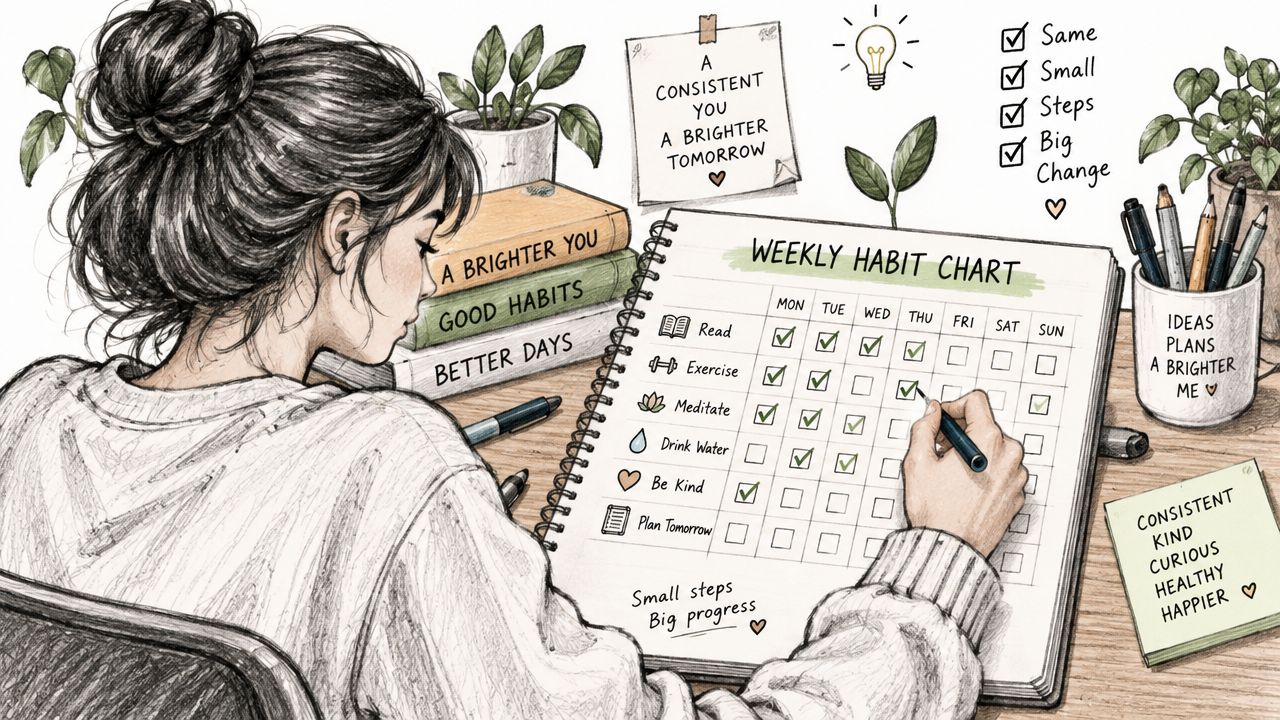
Replace perfect streaks with flexible weekly targets. If your target is to complete several meaningful study starts during the week, one disrupted day doesn't erase the progress already made. This approach preserves accountability while allowing for illness, work changes, family needs, fluctuating attention, and difficult tasks.
Build around cues, not willpower
Choose a stable cue for each habit:
- After a class ends: Record the next assignment action before leaving the room.
- When you sit at the study desk: Open the exact document or problem set named in the plan.
- After finishing a focus block: Log the completed action and choose the next step.
- When confusion persists: Add a question to an office-hours, tutoring, or adviser list.
The cue should lead directly to a small, visible behavior. “Prepare for the exam” creates resistance because it contains too many possible actions. “Answer the next practice question without notes” gives attention somewhere to land.
Device boundaries need the same precision. Notification blocking is useful, but it isn't a complete strategy if the phone remains beside your hand and every task requires online research. Prepare the materials first, block distracting apps during the session, and create a written parking lot for unrelated thoughts. That way, remembering an errand doesn't require opening another app.
Adapt the system to your attention
Students with ADHD or other neurodivergent learning needs may benefit from reducing initiation friction, using external visual cues, and making the first action unusually clear. A routine that depends on long, uninterrupted concentration may not fit. Try shorter starts, body doubling, visible timers, audio support, or a study location with fewer competing signals.
Remote students face a different problem. Home may contain entertainment, family interruptions, and no clear transition into academic mode. Create a start ritual, such as putting on headphones, opening one course workspace, and placing a written task beside the keyboard. End by recording where you'll resume, so the next session doesn't begin with reconstruction.
Busy professionals need a recovery rule more than an elaborate habit chart. If a meeting consumes a planned block, choose a reduced version of the task, such as outlining instead of drafting or sorting sources instead of writing. The aim is to preserve contact with the work without pretending that every day has the same capacity.
A flexible target protects the habit from one difficult day. It doesn't remove standards. It makes standards achievable under changing conditions.
The most effective distraction system combines a clear cue, a small starting action, a protected environment, and a recovery path. Remove any one of those and the plan becomes more dependent on mood.
Track Progress and Fix What Is Not Working
An academic success plan becomes a retention system when it tracks movement toward continuation and completion, not only hours at a desk. Time matters, but time can hide ineffective studying, repeated avoidance, or work on tasks that don't affect the most important outcomes.
Track a small set of signals each week. Useful measures include credit hours attempted, registration for the next term, completed tasks, focus time saved, submitted work, and habit completion against your flexible target. Formal academic plans have been associated with stronger credit-hour attempts and registration persistence, as described in the earlier planning analysis, so those institutional signals deserve attention alongside personal productivity.
Weekly Academic Success Plan Review Metrics
| Metric to Track | What Good Looks Like | Action If Off Track |
|---|---|---|
| Credit hours attempted | Your enrolled work still aligns with your academic pathway | Ask an adviser to review course load, prerequisites, and recovery options |
| Next-term registration | You know what you need to register for and when | Contact advising or the registrar before an administrative delay grows |
| Tasks completed | Priority assignments move forward before deadlines | Reduce task size, reorder the week, and schedule the next concrete action |
| Focus time saved | Protected sessions reduce avoidable device interruptions | Tighten app boundaries and prepare materials before starting |
| Weekly habit completion | You meet your flexible target without relying on perfect daily performance | Lower friction, revise the cue, or reduce the target temporarily |
| Support requests | Questions reach instructors, tutors, coaches, or advisers early | Send a specific question and include the relevant course context |
Run a short review
Set aside a consistent weekly review. First, compare planned actions with completed actions. Next, identify the reason for each miss without turning it into a character judgment. Was the block too long, the task unclear, the deadline hidden, the environment distracting, or the workload unrealistic?
Then make one or two changes. Move a difficult course to a higher-energy period. Split a project into smaller deliverables. Add a buffer before a deadline. Replace a vague task with an if-then script. A complete rewrite often creates temporary enthusiasm but doesn't solve the underlying constraint.
Review question: What made the planned behavior difficult, and what can be changed before the next attempt?
Escalate when the problem exceeds personal organization. Repeated missed work, uncertainty about degree requirements, financial pressure, health concerns, or persistent attention barriers can require academic advising, accessibility support, tutoring, coaching, or counseling. Higher-education guidance increasingly frames academic roadmaps as part of proactive outreach, registration recovery, retention, and completion systems rather than time management alone (ERIC guidance on student success planning).
A missed week is information. Use it to adjust the system while there's still time to recover.
Your Ready to Use Templates and Kohru Workflow
A plan becomes useful when you can fill it out without designing a new productivity system every Monday. Keep the first version to one page and write actions that another person could understand.
One-page academic success plan
Copy this structure:
- Term outcome: What academic milestone must remain visible?
- Course priorities: Which courses or requirements need the most attention?
- Weekly outcomes: What must be completed before the week ends?
- If-then scripts: If a known trigger occurs, what action follows?
- Support contacts: Which instructor, tutor, coach, adviser, or accessibility service can help?
- Review signals: Which tasks, registration steps, attempted credits, or habits will you check?
For the weekly schedule, list fixed commitments first, then assign high-focus work, shorter review sessions, buffers, and recovery. For the habit tracker, choose flexible weekly targets for behaviors such as attending class, starting planned sessions, reviewing feedback, or asking for help. Record completion without treating one missed day as a failed identity.
A practical workflow
Collect assignments, exams, projects, and maintenance tasks in one place. Separate large work into milestones, attach each milestone to a scheduled session, and write the first action in plain language. At the end of each session, record what moved forward and define the next starting point.
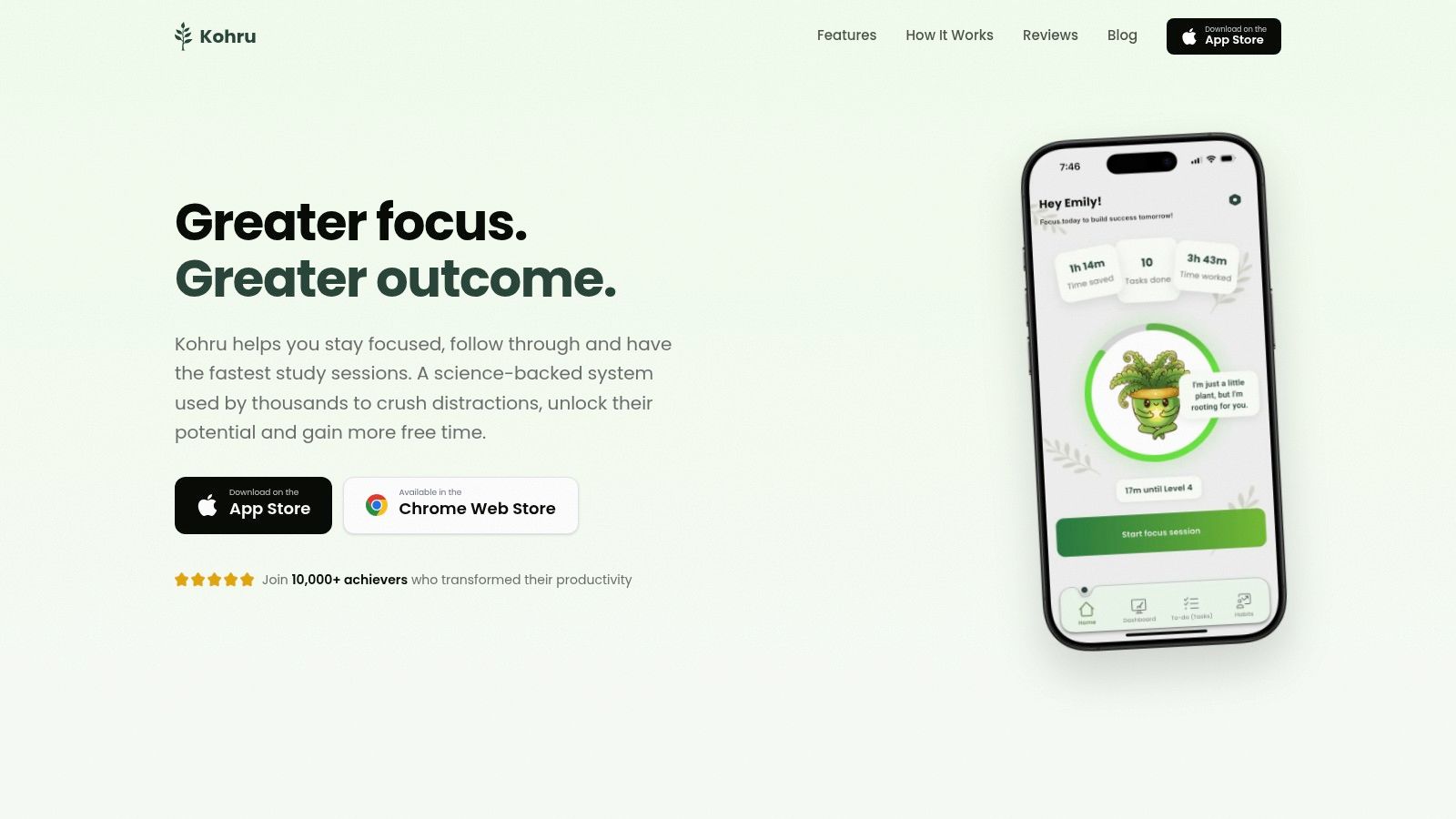
Kohru can support this workflow with Focus Sessions, task-linked work periods, app blocking across devices, Smart To-Do Lists that separate Work and Personal items, flexible habit targets, and a dashboard for reviewing completed tasks and focus progress. Use it as the execution layer, not as a substitute for deciding which academic outcome matters.
If you use AI for brainstorming or study support, review privacy practices before entering personal, academic, or identifiable information. A privacy-first ChatGPT alternative blog can help you think through those considerations while you design a responsible study workflow.
Seven-day launch checklist
- Day one: Gather syllabi, deadlines, work commitments, and support contacts.
- Day two: Choose course priorities and write the week's outcomes.
- Day three: Convert delayed actions into if-then scripts.
- Day four: Place study blocks, buffers, and recovery time on the calendar.
- Day five: Complete one protected session and log the result.
- Day six: Check whether the environment or task size created friction.
- Day seven: Review progress and make a small adjustment for the next week.
Start with one course, one weekly target, and one protected session if the full system feels overwhelming. Consistency grows when the plan can survive ordinary disruption, and measurable reviews help you improve it without waiting for a perfect semester.
Kohru gives you one place to turn academic tasks into protected Focus Sessions, manage distractions, and track flexible habits without depending on perfect streaks. Visit Kohru to build your academic success plan into a weekly system you can start using today.
