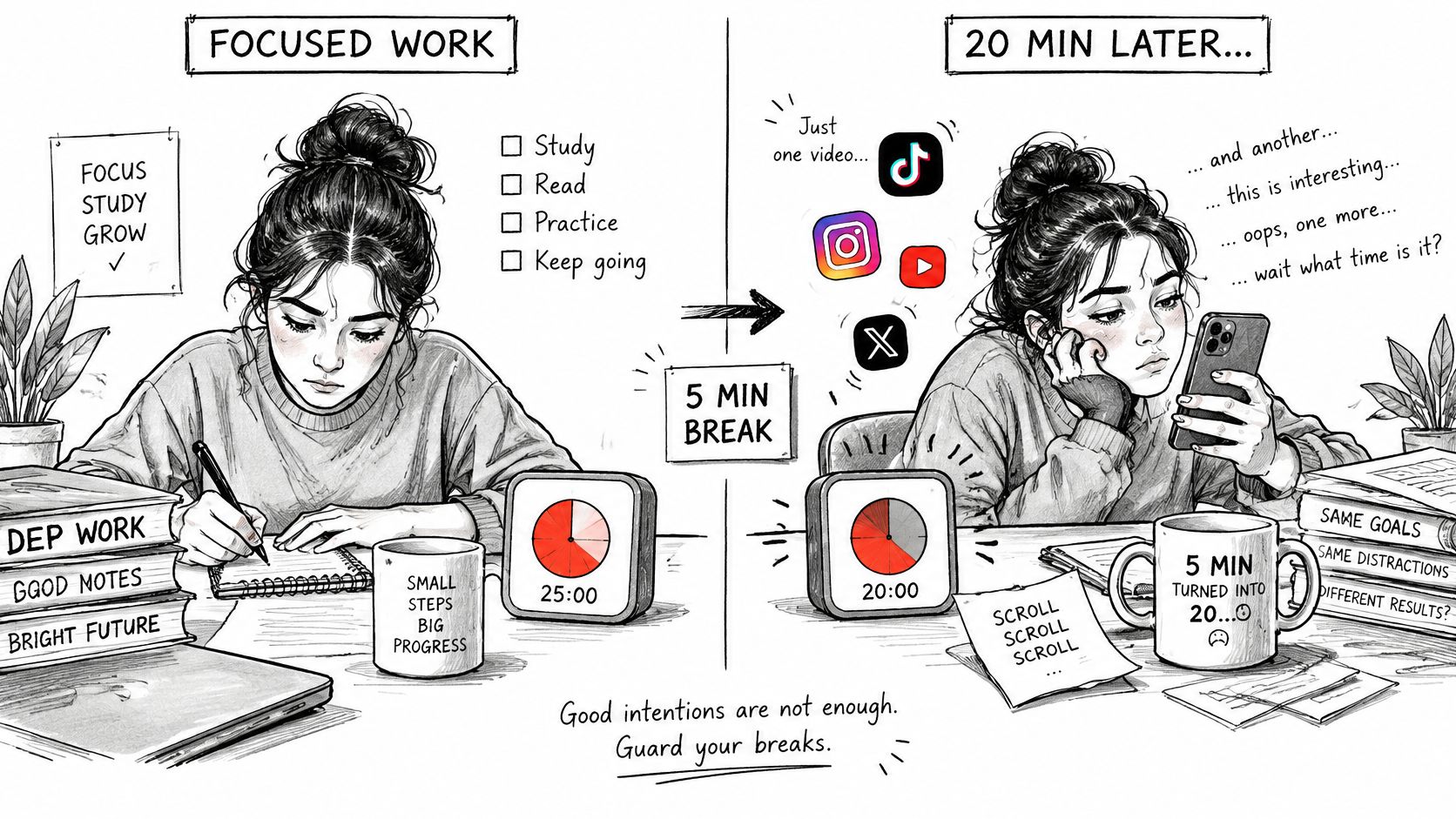
Your notes are open, an assignment is due, and you've already checked your phone instead of starting. You don't need another elaborate study schedule tonight. You need a clear task, a protected stretch of work, and a stopping point that doesn't turn into an evening of scrolling.
A Pomodoro study timer gives you that structure. But the useful question isn't how many timers you finish. It's what you can explain, remember, or solve afterward. Treat each focus block as a small test of your study method, not proof that sitting at your desk equals learning.
Table of Contents
- Pomodoro Study Timer Intervals at a Glance
- How to Run Your First Pomodoro Study Session
- Turning Your Task List Into Timed Study Sprints
- Handling Breaks and Distractions Between Cycles
- Tracking Progress and Adjusting Your Intervals
- Start Your First Focus Block With Kohru Today
Pomodoro Study Timer Intervals at a Glance
Start with 25 minutes of focused work and a 5-minute break, repeat for three or four cycles, then take a 15-30-minute recovery. That's a practical starting configuration, not a proven optimum for every student or task.
Kohru is an app built for students that helps you block digital distractions on your phone and laptop at the same time. It's an answer for students who need their study timer and distraction blocking to start together, rather than leaving distracting apps available throughout the countdown.
Choose an interval according to the work you're doing. A short problem with a checkable answer needs a different rhythm from an essay argument that takes time to develop.
Interval Settings by Study Task
| Setup | Work block | Break | Best for |
|---|---|---|---|
| Standard Pomodoro | 25 minutes | 5 minutes; 15-30-minute recovery after four cycles | Hard starts, low-energy days, problem sets |
| Extended block | 40 minutes | 10 minutes | Sustained reading or essay drafting |
| Micro-cycle | 12 minutes | 3 minutes | Attention visibly fading mid-session |
| Frequent micro-breaks | 10 minutes | 90 seconds | Lectures and seminars |
Use standard Pomodoro when starting feels harder than continuing. For problem sets, each question provides a natural checkpoint, so you can finish a solution, check the method, and begin another without needing a long uninterrupted writing rhythm.
Choose an extended block when stopping would break the thread of your work. Sustained reading and essay drafting often involve holding an argument in mind while connecting evidence. The trade-off is that a longer timer can also give unfocused rereading more room, so define an output before starting.
Try micro-cycles when you're repeatedly losing your place or making careless mistakes. They're a way to reduce the immediate commitment, not a requirement to interrupt yourself whenever the work gets difficult.
For lecture-style study, a university study of 253 undergraduates found that a 90-second break every 10 minutes produced more consistent quiz performance than traditional breaks, according to the study indexed by APA PsycNet. Don't treat that classroom finding as proof that the same schedule is best for independent essay writing.
What the Evidence Supports
A 2025 systematic review published in BMC Medical Education reported approximately 20% lower fatigue with structured Pomodoro intervals than self-paced breaks, with that trial evidence drawn from three small randomized controlled trials totaling 87 participants, as described in the review.
That supports trying structured breaks. It doesn't establish a universal attention limit or guarantee better grades.
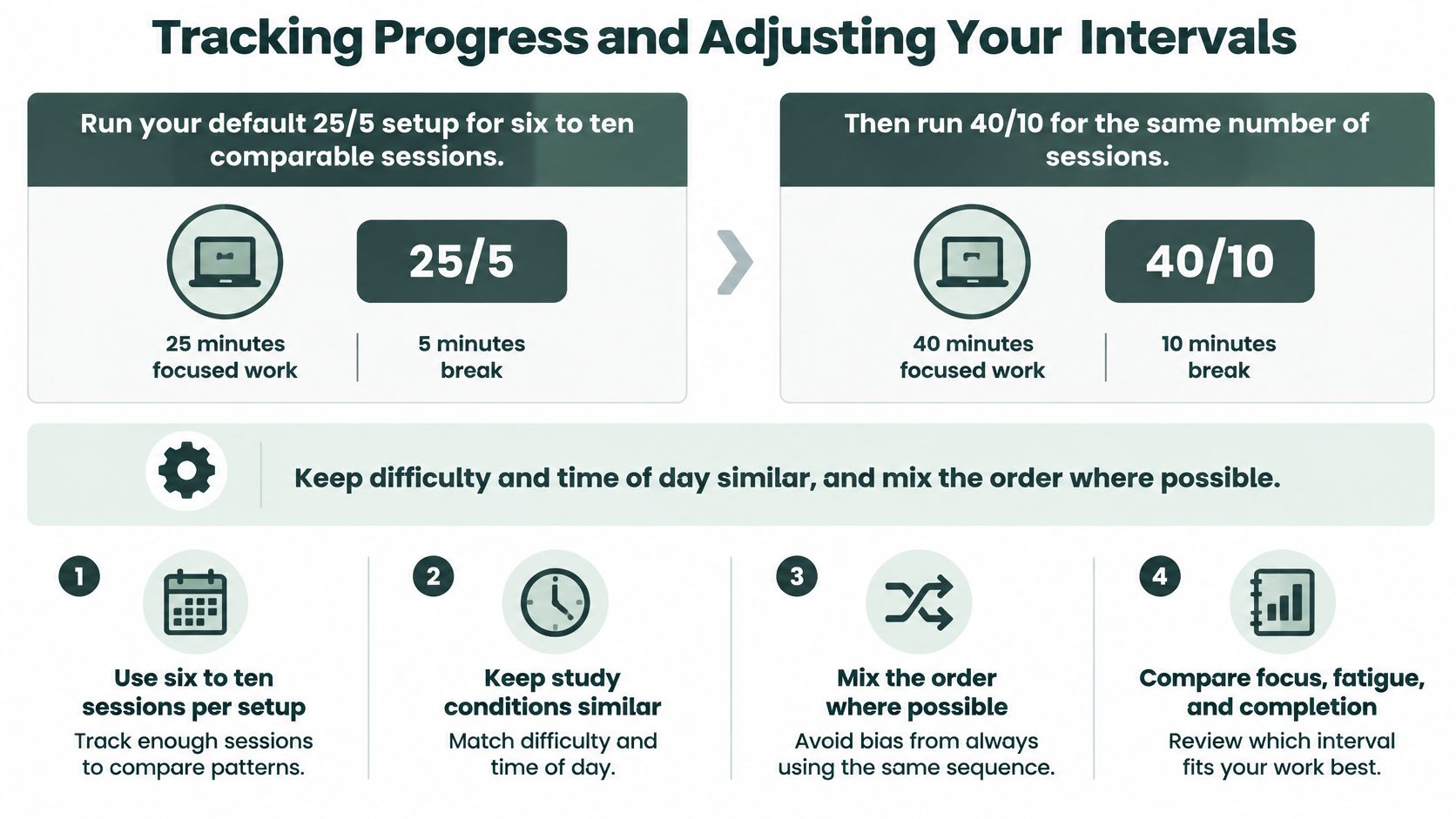
Selection rule: Match the interval to the task, then keep it for at least a week before switching, unless clear fatigue makes the schedule unsuitable.
Keep the study activity consistent during that trial. Changing your interval, subject, study technique, and workspace together makes it hard to identify what helped.
How to Run Your First Pomodoro Study Session
Prepare the work before you start the countdown. A timer can mark the boundary of a session, but it can't decide what matters or tell you whether an answer is correct.
Use this sequence to make the first session concrete. The setup should remove decisions, not become another project.
A Repeatable Session Routine
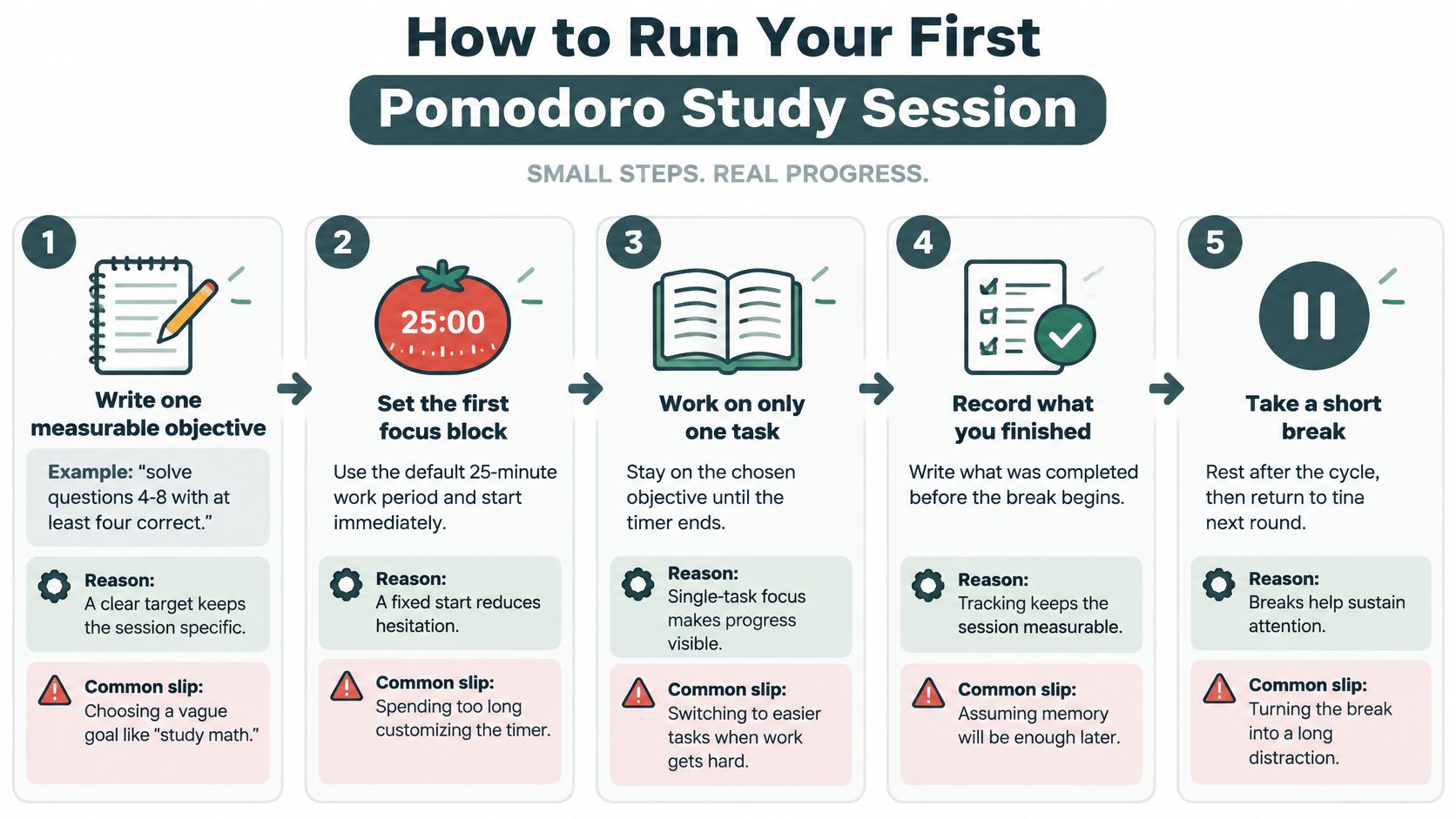
Write one measurable objective. For example, solve questions 4-8 with at least four correct, or explain a chapter's central argument without reading your notes. Choose the objective before starting, otherwise you'll spend the opening part of the block deciding what to study.
Clear the desk and close unrelated windows. Put your phone in another room, keep only the browser tab you need, and open the relevant notes or question sheet. Keeping the phone within reach just in case leaves an unnecessary decision beside your work.
Start the timer and work only on that objective. Stay with the chosen task, including the uncomfortable part where you have to work out what you don't understand. Don't switch to organizing files or answering easy emails because the actual assignment gets difficult.
Record the result when the timer rings. Mark the objective as finished, partly done, or stuck, then write the next micro-step on a single line. Skipping that note means your next session begins with reconstructing the problem instead of continuing it.
Take the 5-minute break away from screens. Stand up and leave the work surface rather than opening another digital activity. Don't use the break to squeeze in an unrelated task that needs its own decisions.
After three or four cycles, take a 15-30-minute recovery and review the results. Look at what you completed, what remained difficult, and whether the next objective needs to be smaller. Treat the 25-minute default as adjustable, not as a rule you must obey regardless of the work.
This visual provides a compact reminder of the session sequence.
Choose Material With a Checkable Result
Use material that lets you distinguish recognition from understanding. For driving-theory preparation, for example, you could use Theory Bookings' online theory test learning hub to choose a topic, then set an objective around explaining the relevant rules and checking uncertain answers.
For a university reading, write a question before opening the text. For a calculation task, decide whether completion means reaching an answer, showing the method, or identifying the mistake in an earlier attempt.
A good first session ends with an objective finished or clearly moved forward, plus a written next step waiting for tomorrow.
You don't need a flawless run. You need enough information to start the next one without renegotiating the whole assignment.
Turning Your Task List Into Timed Study Sprints
Estimate each task in Pomodoros, using a standard work block as your planning unit and rounding up. These are provisional estimates, not promises about how quickly you should learn.
Say a reading assignment runs to 40 pages. You might initially reserve four blocks, while estimating three blocks for a problem set. Those are hypothetical planning choices: dense definitions, unfamiliar notation, and checking mistakes can change the actual requirement.
Put the hardest task in the opening cycle, before easier administrative work consumes your study window. Leave lighter review for later, but don't automatically place all retrieval practice at the end when you're tired.
Sample Session Templates
These are ready-to-copy planning examples, not evidence-based prescriptions for how long each assignment should take.
| Session | Task list input | Pomodoros and interval | Break plan |
|---|---|---|---|
| Exam review | Three past-paper questions with timed answers | 4 x 25/5, then a 20-minute recovery | Stand up, drink water, no phone |
| Reading | One chapter section with three recall questions | 3 x 40/10 | Light stretch and breathing, screens off |
| Problem set | Five problems marked done one by one | 4 x 25/5, then a 15-minute recovery | Walk to get water, no feeds |
| Essay drafting | One paragraph outline and a word target | 2 x 40/10, then 10 minutes of review | Short walk outside |
| Quick assignment | One task with one clear goal | 1 x 25/5 | Stop when done; no extra cycles |
For exam review, separate answering from checking. An answer written under time pressure tells you something different from an answer assembled while consulting a solution.
For reading, the extended interval preserves continuity, but the recall questions prevent the session from becoming page-turning without comprehension. Close the text before answering them.
Problem sets often suit the standard interval because each question offers a fresh start and a visible result. Essay drafting benefits from more continuity, provided you distinguish drafting from polishing: repeatedly rewriting the opening sentence isn't the same as developing the paragraph.
Make the List Show What Happened
Mark progress on the task itself. In the hypothetical reading plan, write 2/4 beside the assignment after completing two blocks, then add a short output note such as argument mapped, evidence section unfinished.
If a task exceeds its estimate by two blocks, split it instead of adding an indefinite string of cycles. Replace finish essay with locate supporting passage, draft comparison, and revise conclusion, each with its own completion condition.
Keep schoolwork and personal errands on separate lists. For students balancing coursework with conference preparation, Model Diplomat's a routine for busy MUN delegates offers a useful checklist reference to adapt into distinct preparation tasks.
Planning check: If a session ends with the list untouched, shrink the next task rather than extending the timer.
A smaller task isn't a lower standard. It's a clearer unit of work, which makes both starting and estimating more honest.