You sit down to study, open the document, and promise yourself you'll begin after checking one message. A few minutes later, you're reading unrelated tabs, replaying an awkward conversation, or staring at the same paragraph without absorbing it. Then the self-criticism starts: I can't stay focused. I must be lazy. I need more discipline.
That diagnosis is usually wrong. Focus is an attention regulation problem, shaped by mind-wandering, task difficulty, emotional load, sleep, movement, and interruptions. Once you identify which part of the system is failing, you can change the conditions instead of trying to bully yourself into concentration.
Table of Contents
- Why You Can't Stay Focused (It's Not Willpower)
- Find Your Focus Problem (Quick Self-Diagnosis)
- The Real Reason Notifications Still Distract You
- Build a Focus System That Actually Works
- Graduated Strategies for Managing Digital Interruptions
- Habit Tracking and ADHD-Friendly Adaptations
- Your 7-Day Focus Reset Plan
Why You Can't Stay Focused (It's Not Willpower)
Your attention can leave a task without your conscious permission. You may be reading a report while thinking about dinner, checking a notification while remembering an unfinished email, or writing a sentence while mentally rehearsing tomorrow's meeting. That experience feels personal, but ordinary attention drifts is common.
Across laboratory and everyday-life studies, researchers commonly report that thoughts move away from the task at hand roughly 30% to 50% of the time. In one lecture experiment, mind-wandering rose from 35% in the first half to 52% in the second half, as described in the research review on mind-wandering and attention. The exact rate depends on the task and on how researchers define “focused,” but the larger point is clear: sustained attention isn't a default human setting.
The practical conclusion: You don't fix attention drift with shame. You fix it by reducing friction, choosing a suitable task structure, and recovering deliberately.
Two forces usually operate together. The first is internal drift, such as boredom, worry, fatigue, or an unformed next step. The second is interruption residue, the mental trace left after an alert, message, tab switch, or quick phone check. You might return to your work physically while part of your attention remains attached to the interruption.
This is why generic advice fails. “Try harder” ignores attention biology. “Turn off every notification” ignores family responsibilities, accessibility needs, emergencies, and the anxiety of becoming unreachable. People who search for “can t stay focused” need a system that adapts to their attention pattern, not another lecture about discipline.
For practical help with avoidance, task initiation, and related patterns, these evidence-based strategies for procrastination provide useful context. Start by treating your difficulty as information. Your mind is showing you where the current environment or task design doesn't work.
Find Your Focus Problem (Quick Self-Diagnosis)
Don't choose a timer or blocker until you know what keeps breaking your attention. Read these profiles and select the one that best describes what happens during a normal work or study period.
Chronic drifting
You begin reasonably well, then your thoughts slide toward unrelated ideas, tabs, or household tasks. The task itself may not feel frightening. It fails to hold your attention. Try first: reduce visible choices, define one small output, and work in a short session with a written “return point” for each interruption.
Task-initiation paralysis
You know what needs doing, but starting feels disproportionately difficult. You reorganize files, research tools, or wait for the right mood. Once you begin, the work may become manageable. Try first: shrink the opening action until it feels almost trivial, such as opening the document and writing one rough sentence.
Mental fatigue
You can start, but concentration weakens as the task continues. Dense reading, calculations, coding, and revision become harder to process. Try first: match session length to cognitive demand and schedule a real break before your performance collapses.
Anxiety-driven distraction
Your attention keeps checking threats, uncertainty, messages, mistakes, or future consequences. Blocking apps alone won't solve a nervous system that expects bad news. Try first: write the worry and the next controllable action on paper before beginning.
Hyperfocus followed by a crash
You work intensely when interest, urgency, or novelty is high, then lose the ability to resume once the energy disappears. A rigid schedule can make this worse. Try first: stop with a clear restart note, eat or move before exhaustion, and set a flexible weekly target instead of protecting a daily streak.
If two profiles fit, choose the one that causes the most expensive failure. “Can't start” needs a lower entry barrier. “Can't sustain” needs pacing and recovery. Those are different interventions, even when both look like procrastination from the outside.
The Real Reason Notifications Still Distract You
The problem isn't always the number of alerts. It's often the mental after-effect of being interrupted. A notification can create a question, obligation, emotional reaction, or fear of missing something. Checking it may take a moment, but returning your attention to the original task requires you to reconstruct context.
Research involving 160 university students found that notification frequency didn't significantly predict cognitive or emotional outcomes. Alert fatigue and attention disruption were stronger predictors of reduced well-being, while interviews described cognitive intrusion, mental overload, and difficulty with digital self-regulation, according to the study on notification fatigue and student well-being.
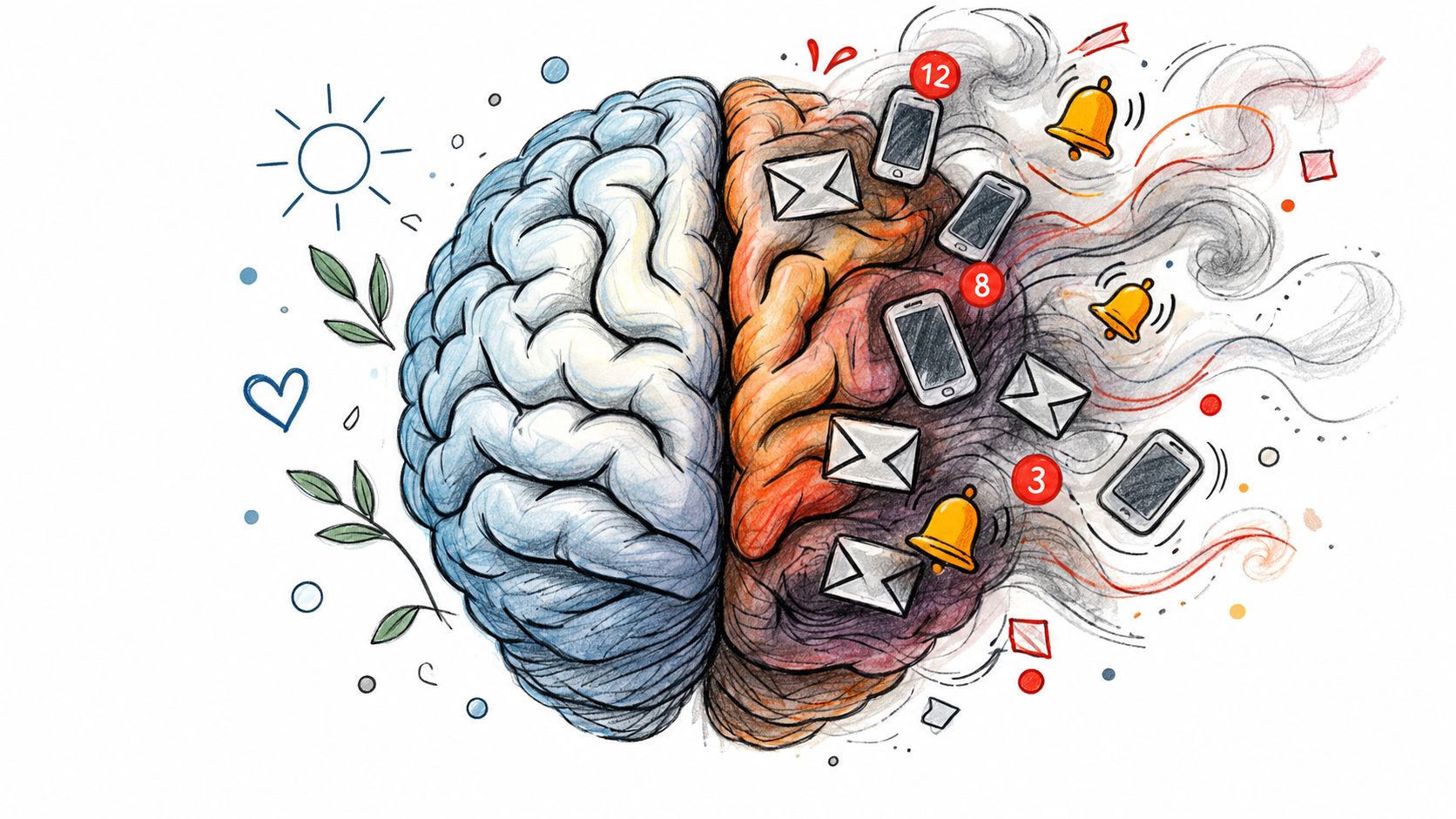
A single message can derail you because it changes your internal state. A work alert may trigger urgency. A family message may trigger concern. A social notification may invite comparison or curiosity. Even after you close the app, your brain keeps evaluating the unresolved item.
Turning off everything can also backfire. Parents may need calls from school, remote workers may need a manager's message, and people with health or accessibility needs may rely on device alerts. Total silence creates an unrealistic rule, then produces guilt when real life breaks it.
Use a simple interruption audit instead:
- Notice the trigger: Was the distraction visual, audible, emotional, or self-initiated?
- Name the residue: Did you feel curiosity, urgency, worry, or a need to respond?
- Record the return cost: Did you lose the task's context, or only a brief moment?
- Change one setting: Reduce the category that creates the most residue, not every category at once.
This reframes the question. Don't ask, “How do I become strong enough to ignore my phone?” Ask, “Which alerts change my mental state, and which can wait?” That answer will determine the right level of control.
Build a Focus System That Actually Works
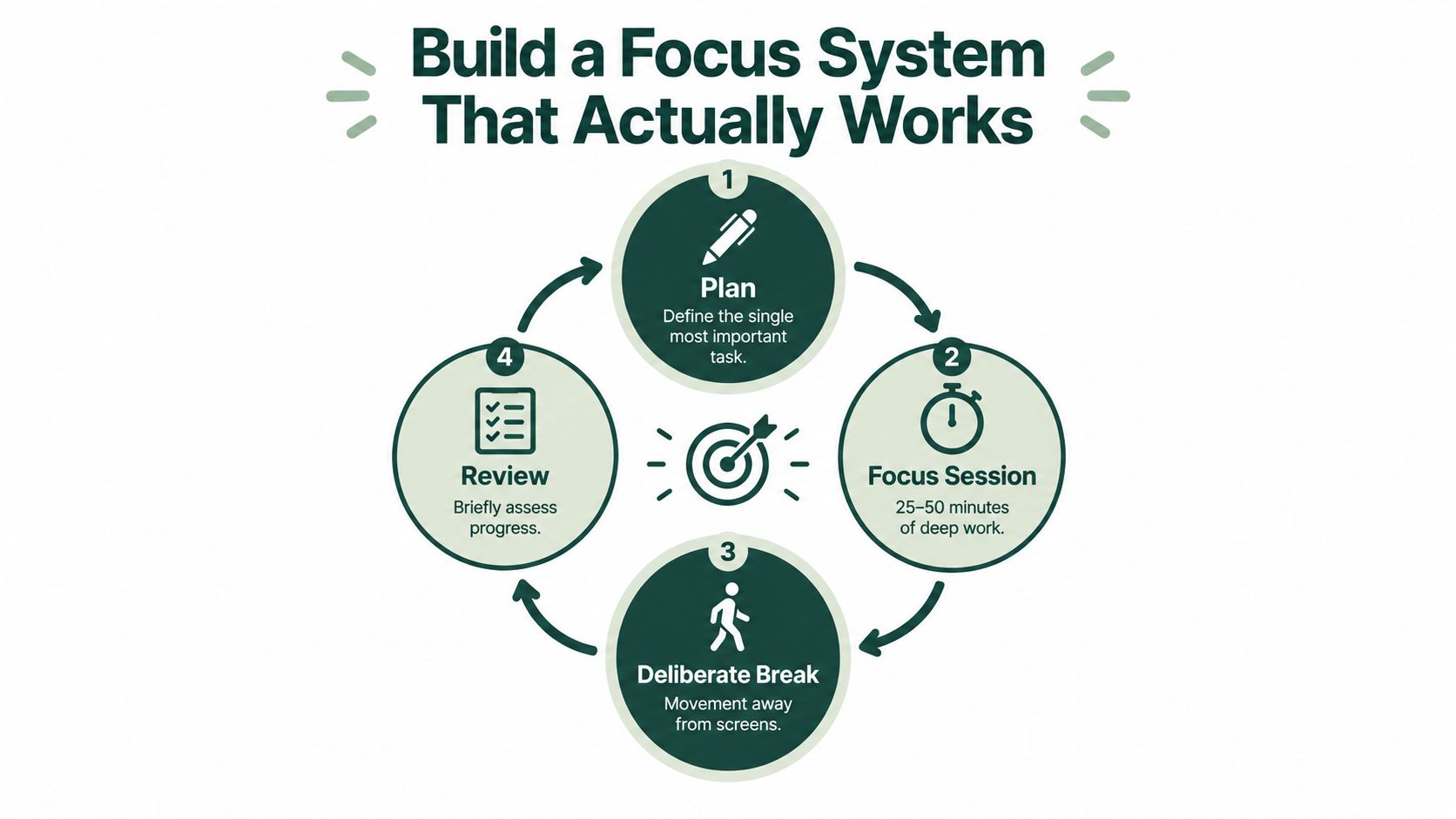
A reliable system removes decisions at the moment you need to begin. Use four parts: plan, session, break, review. Keep the routine simple enough to repeat on a bad day.
Plan one visible outcome
Choose one task and define its finish line. “Study biology” is vague. “Answer the practice questions for chapter three and mark the questions I can't explain” gives your attention a target. For professional work, “improve the proposal” is weaker than “rewrite the opening and add the missing pricing assumptions.”
Put the task in front of you before opening communication tools. If starting is your main problem, use a task list that turns the selected item directly into a session. Kohru is one option that combines Smart To-Do Lists with one-click Focus Sessions, app and website blocking across a phone and laptop, customizable durations, and break settings.
Choose a session that fits the work
Use a shorter session for initiation, a moderate session for routine execution, and a longer session only when the task can hold attention without excessive strain. The clock is a boundary, not a test of character. If you repeatedly fail at a long session, shorten it instead of declaring yourself incapable.
During the session, keep a capture note beside you. When an unrelated thought appears, write a few words and return to the next visible action. This prevents your brain from treating every thought as an emergency.
Make the break physically different
A break should change your sensory input. Stand, walk, stretch, drink water, or look out a window. Scrolling through another feed isn't recovery. It keeps your attention in the same reactive mode.
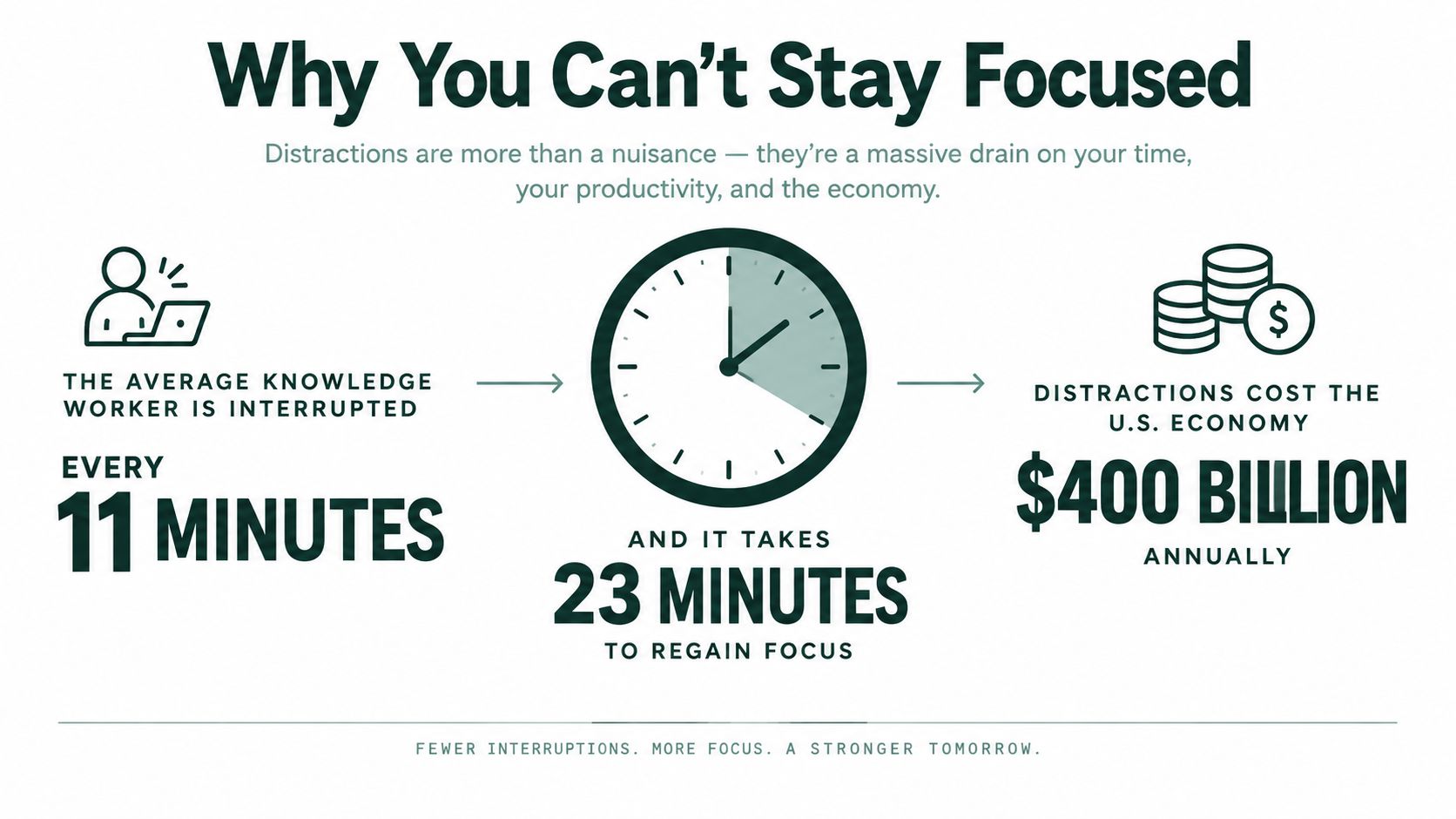
Research summarized by the American Psychological Association on interruptions and attention estimated that workplace interruptions consumed 2.1 hours per employee per day and were associated with approximately $588 billion in annual lost productivity for the U.S. economy. The same source describes a visual-attention experiment in which participants who took a short break maintained performance for 40 minutes, while performance declined among people who worked continuously without a break.
For longer academic or research projects, the PhD time-management tips from Thesis Book Project offer a useful reminder: protect time for defined work rather than hoping an entire open day will become productive.
Review without self-judgment
At the end, record what you completed, what interrupted you, and what you'll change next time. Track completed sessions or weekly focus time, not a perfect streak. The review turns failure into calibration.
Use this short video as a visual prompt for setting up the cycle in practice.
Graduated Strategies for Managing Digital Interruptions
“Turn off all notifications” is an attractive rule because it's easy to remember. It's also too blunt for most lives. Choose the lowest level that protects your attention, then increase control only when the lighter setting fails.
| Level | Strategy | Best For | Trade-off |
|---|---|---|---|
| 1 | Quiet hours for low-priority apps | People whose alerts are frequent but rarely urgent | You may still check manually |
| 2 | Priority contacts only | Parents, caregivers, on-call workers, and people managing emergencies | Important messages can still interrupt |
| 3 | Scheduled communication windows | Students, freelancers, and teams that can set response expectations | Requires colleagues and family to understand the schedule |
| 4 | Full app blocking during Focus Sessions | Severe drift, high-residue alerts, and demanding solo work | You must create an emergency route outside blocked apps |
Start with quiet hours
Silence marketing, social, promotional, and nonessential work alerts first. Keep calls or messages from priority contacts available. This removes ambient noise without forcing you to disappear.
Add communication windows
Check email and chat at planned points rather than whenever a red badge appears. Tell collaborators when you'll respond and identify the channel for urgent matters. People often tolerate delayed replies when the expectation is clear.
Use full suppression selectively
Reserve full blocking for work that requires continuity, such as writing, exam preparation, analysis, or coding. Before starting, send any necessary message and set an emergency contact path. The goal isn't isolation. It's protecting a specific period from low-value switching.
A sensible policy: Start with the lightest intervention that works for your profile. Increase restriction by category, not through an emotional decision to block your entire life.
Inbox clutter also creates avoidable attention checks. If unwanted messages keep pulling you back into email, use a practical guide on how to stop unwanted emails and then apply the same principle to app notifications. Remove recurring sources instead of relying on repeated acts of resistance.
Habit Tracking and ADHD-Friendly Adaptations
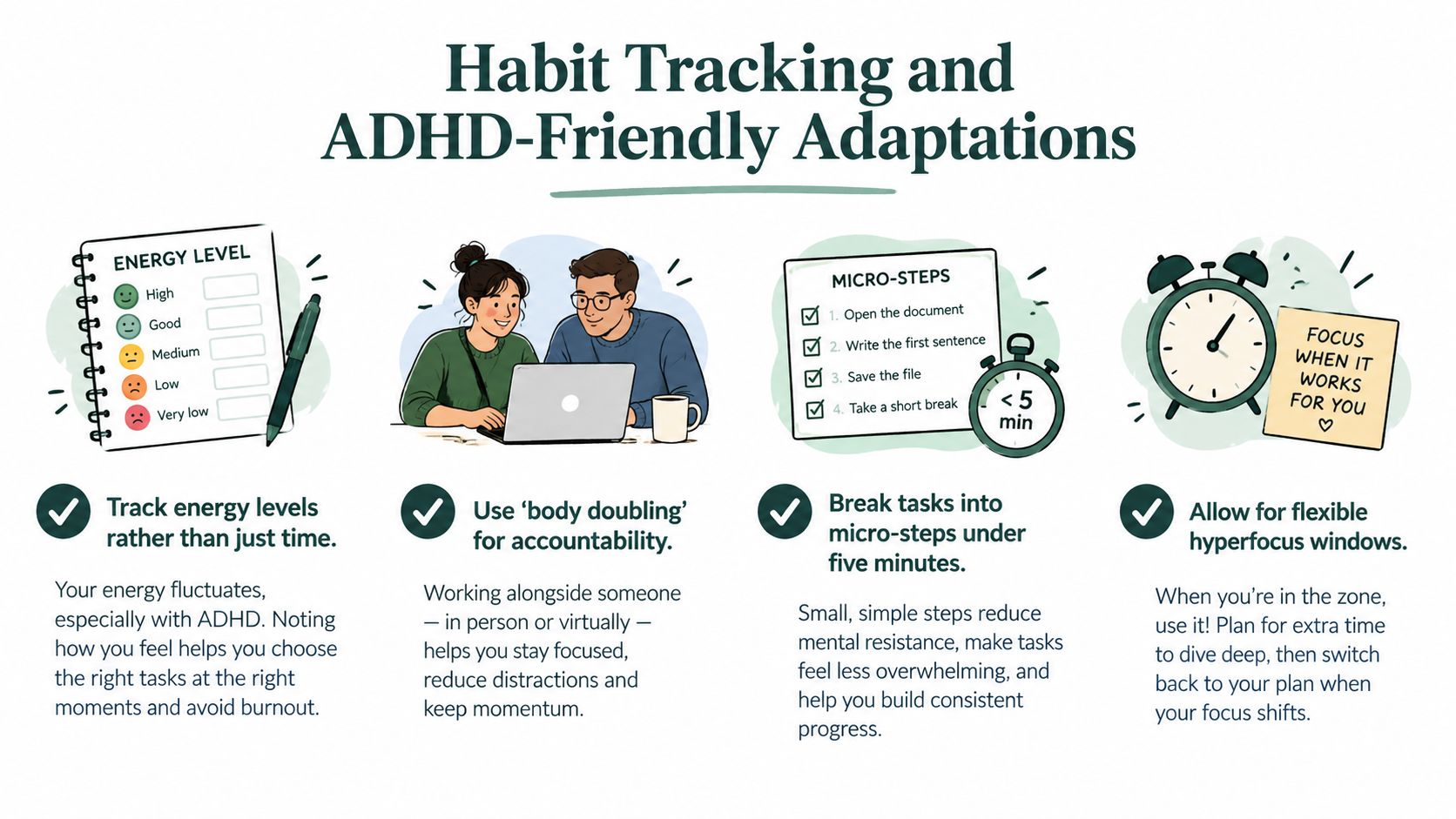
Daily streaks reward consistency, but they can punish people whose attention fluctuates. Miss one day and the visible break can turn a small disruption into abandonment. A flexible weekly target works better because it measures recovery and repetition rather than pretending every day has the same energy.
Track three things: the kind of task, your available energy, and the support that helped you begin. Someone who completed a demanding reading session after walking and using body doubling has learned more than someone who only marked “productive” on a calendar.
Match the intervention to the failure
If you can't start, use micro-steps. Put the book on the desk, open the assignment, write the heading, or create the first file. Your first goal is contact with the task, not impressive output.
If you can't sustain, use novelty, movement, and difficulty scaling. Alternate reading with retrieval questions. Switch from passive review to explaining the material aloud. Change location when the environment has become stale.
If you hyperfocus, plan an exit. Stop at a useful transition, write the next action, and leave the materials ready. Protect food, hydration, sleep, and movement instead of treating exhaustion as proof of commitment.
Physical activity deserves a place in this system, not as a moral obligation but as an arousal tool. Evidence summarized by an ADHD research organization on executive function and physical activity indicates that cognitively engaging physical activity can improve attention problems in school-aged children with ADHD, while broader reviews associate physical activity with executive functions, planning, processing speed, working memory, and academic behavior.
Use movement experimentally. A brief walk before reading may help one person; standing while reviewing notes may help another. If attention problems significantly impair school, work, relationships, or daily life, seek an assessment from a qualified clinician rather than trying to diagnose yourself through productivity content.
Your 7-Day Focus Reset Plan
Treat the next week as an experiment. Don't overhaul your entire life on the first day. Change one condition, observe what happens, and keep only what improves your ability to begin, continue, or recover.
- Day one, remove one friction point. Clear the desk, close unused tabs, and place the first task in view. Success means you begin with fewer decisions.
- Day two, define one output. Replace “work on my thesis” with a concrete result, such as drafting a subsection or sorting sources into a named group.
- Day three, run a short session. Choose a duration you can complete without bargaining. For a drifting profile, success means returning after distraction. For an initiation profile, success means starting promptly.
- Day four, install a real break. Move away from the screen and notice whether your second session feels more usable.
- Day five, choose an interruption level. Begin with quiet hours or priority contacts. Increase suppression only if low-value alerts continue to break your work.
- Day six, add a movement cue. Walk before a difficult task, stretch between sessions, or work standing for part of the period. Record whether your energy changes.
- Day seven, review the evidence. Keep the settings that helped, drop the ones that created unnecessary stress, and set a flexible weekly target for the next week.
Your result isn't “I focused perfectly.” A better result is knowing which conditions help you start, which interruptions leave residue, and how long you can work before recovery becomes necessary. Focus is a regulated skill. You build it by testing the system, not by waiting to become a different person.
Kohru can help you put this plan into practice with one-click Focus Sessions, cross-device distraction blocking, task-based session setup, flexible durations, breaks, and weekly habit targets. Visit Kohru to create a focus routine that supports your actual attention pattern.
