You sit down to study or work with a clear intention, then a notification appears. A quick reply becomes an email check, the email check turns into a search, and soon you're switching between unfinished tasks without making meaningful progress. Often, the problem isn't a lack of motivation. Unclear priorities, visible distractions, and poorly matched work sessions can make concentration harder than it needs to be.
Concentration building exercises work best when you practice them in small, repeatable sessions and match them to the task in front of you. A brief attention primer can help you start, a timed interval can support routine work, and a longer protected block may suit writing, research, or complex problem-solving. The eight methods below form a flexible toolkit, from quick preparation and task clarity to environment design and active learning. You can also combine them with these science-backed concentration techniques when you want a broader focus routine.
Table of Contents
- 1. Pomodoro Technique
- 2. Deep Work Blocks
- 3. The Two-Minute Rule
- 4. Mindfulness and Meditation for Attention
- 5. The Eisenhower Matrix
- 6. Environment Design and Attention Architecture
- 7. Spaced Repetition and Interleaving
- 8. Time Blocking and Batch Task Processing
- 8-Method Concentration Techniques Comparison
- Turn Eight Exercises Into a Focus Routine
1. Pomodoro Technique
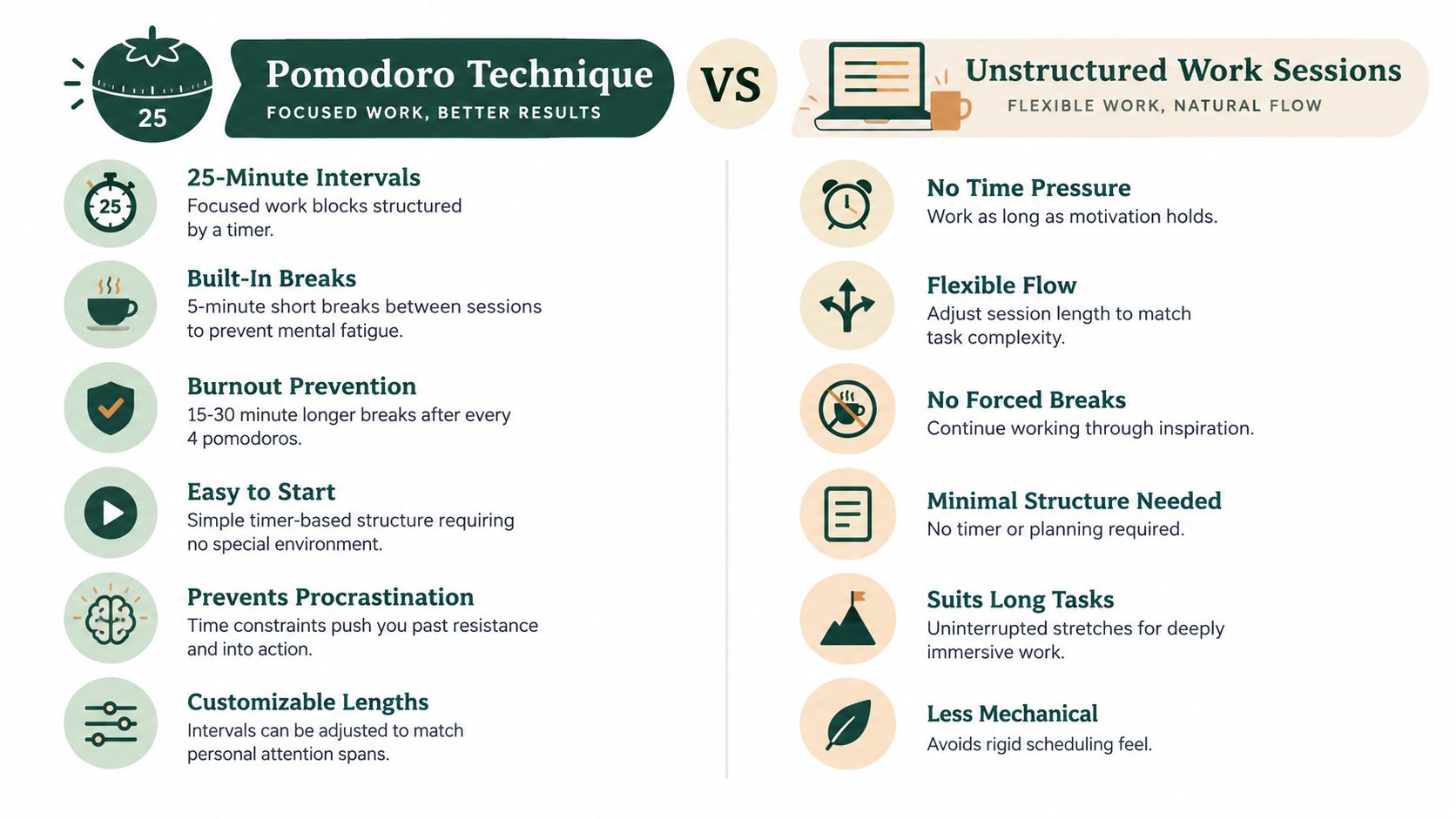
The Pomodoro Technique gives your attention a clear boundary. Instead of asking yourself to work indefinitely, you choose one task, set a timer, and focus until the interval ends. A useful starting structure is 25 minutes of focused work followed by a 5-minute break.
Before starting, write one specific outcome. “Study anatomy” is too broad. “Review the muscles of the upper limb and answer practice questions” gives the session a visible finish line. Put your phone away, close unrelated tabs, and start the timer. During the interval, capture unrelated thoughts on paper rather than acting on them.
Use the break as actual recovery. Stand up, stretch, drink water, or look away from the screen. Checking social media may keep your mind in a reactive mode, so it's better to choose an activity that lets attention settle. After four rounds, take a longer recovery break of 15 to 30 minutes.
Adjust the interval to the work
The 25-minute format is a starting point, not a rule. A freelance writer might use one interval for outlining, another for drafting, and a third for editing. A software developer may prefer a longer session for deep coding, then use a shorter interval for code reviews. A medical student could block one round for anatomy flashcards and another for practice questions.
Practical rule: If the timer interrupts you while you're producing high-quality work, try a longer interval. If you repeatedly lose focus before the timer ends, shorten the session and rebuild gradually.
For work requiring more continuity, test 45-minute or 90-minute adaptations. Kohru's custom Focus Sessions can pair a chosen duration with distraction blocking, while a task list can help you assign each session to a defined piece of work. Track completed sessions for a week, but judge the method by task completion and learning quality, not by the number of timers you start.
2. Deep Work Blocks
Some tasks need more than a short interval. Writing a dissertation section, designing software architecture, analyzing research data, or planning a strategic project requires time to understand the problem before producing a strong result. A deep work block protects that continuity by reserving an extended period for one demanding outcome.
Start with a 90-minute block. Choose the result before you begin, then prepare every material you'll need. Open the relevant documents, gather references, fill your water bottle, and decide what “finished for this block” means. Remove notifications and let colleagues, family members, or housemates know that you're unavailable unless something is urgent.
A doctoral candidate might use the block to draft one argument rather than “work on the dissertation.” A software architect could create a system diagram and record unresolved decisions. A remote worker might reserve the first part of the morning for strategic planning before meetings begin.
Build a repeatable ritual
Use the same location, preparation sequence, or quiet background sound when possible. A ritual can reduce the number of decisions between sitting down and beginning. Schedule demanding work during the period when you're usually most alert, but don't assume that morning is automatically best. Your own completed work and fatigue levels are more useful guides.
Protect the ending as carefully as the beginning. Stop for a deliberate recovery period, note what you completed, and write the next action for the following session. Extending a block only makes sense when your work quality remains steady. If your final portion becomes distracted or error-prone, return to a shorter block.
Extended focus isn't about sitting still for as long as possible. It's about giving one difficult task enough uninterrupted time to develop.
Kohru can structure a longer Focus Session while blocking distracting apps across your phone and laptop. That support matters because a deep work block fails when every interruption requires a fresh decision about whether to respond.
3. The Two-Minute Rule
Small unfinished tasks can occupy attention even when they take little time. A simple message, an appointment confirmation, or a file placed in the wrong folder may keep resurfacing while you're trying to study. The Two-Minute Rule works best as a pre-focus clearing exercise, not as permission to interrupt yourself during demanding work.
Scan your task list and identify actions that take about two minutes or less. Complete those quick wins in a short batch. Capture anything larger in a task system instead of pretending it can be finished immediately. If replying to a message requires research, scheduling, or emotional effort, it isn't a quick task just because the first step looks small.
Use it before, not during, focused work
A student might process straightforward emails, download lecture materials, and put reference books on the desk before beginning a study session. A professional could answer simple Slack questions and record longer requests before entering a deep work block. A remote worker might put away a few items that would otherwise remain visually distracting, then leave household tasks alone until the planned break.
Try a 10 to 15-minute quick-wins block before your main session. Separate work and personal tasks so that clearing a work inbox doesn't turn into handling every personal responsibility at the same time. Kohru's Smart To-Do Lists can help distinguish quick actions from substantial tasks and turn a selected item into a distraction-free session.
Protect the boundary: During deep work, capture new tasks and return to the current task. Don't restart the quick-wins cycle every time a small request appears.
Be realistic about estimates. When you're unsure whether something fits the rule, capture it for later. Batching similar actions also helps. Process simple messages together, handle routine administration together, and reserve your best attention for work that needs judgment. The exercise isn't about completing everything quickly. It's about preventing minor obligations from competing with the task you deliberately chose.
4. Mindfulness and Meditation for Attention
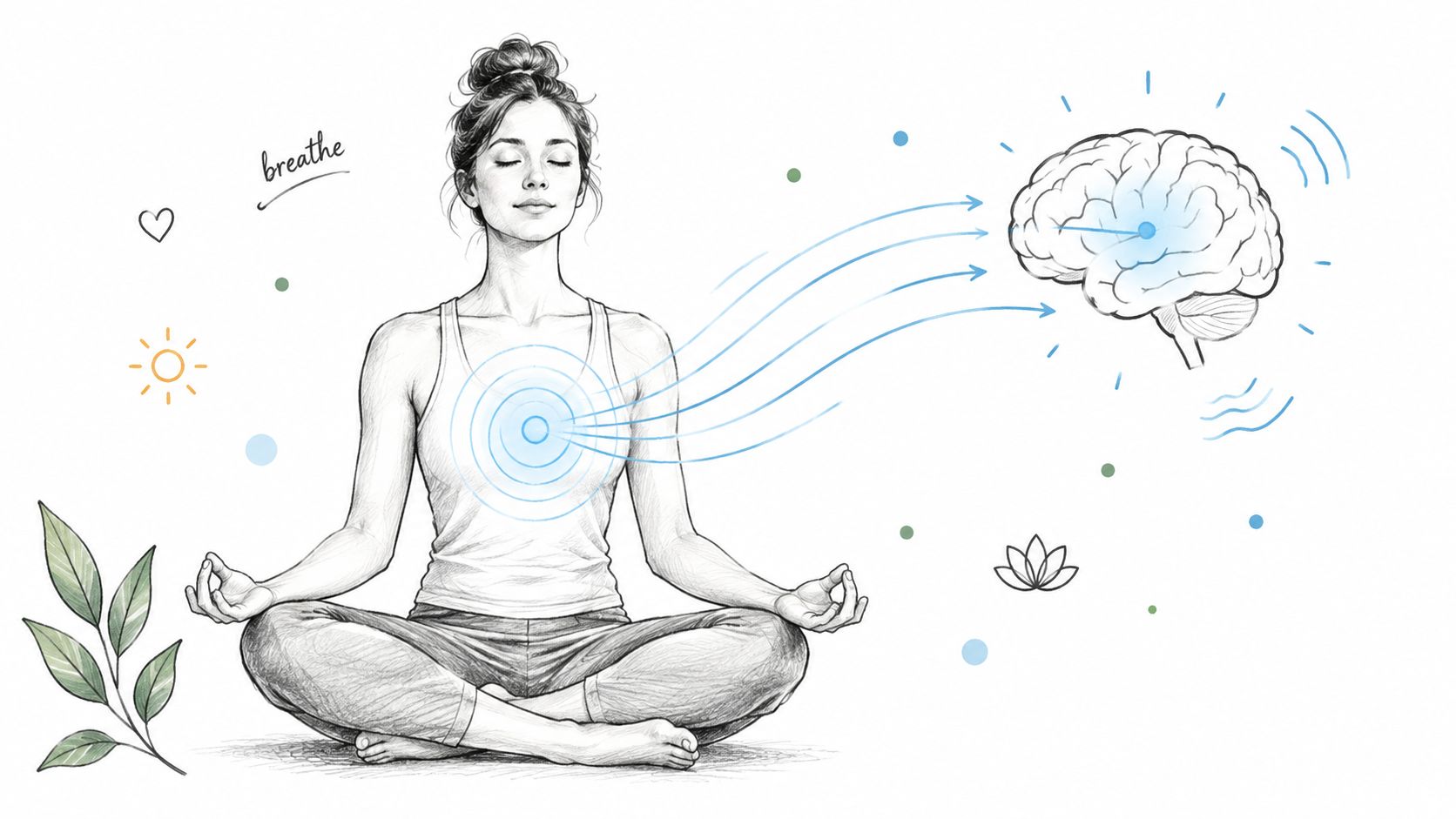
Mindfulness trains a specific concentration skill: noticing that attention has wandered and returning it to a chosen anchor. The anchor may be the breath, a sound, or sensations in the body. The practice isn't successful only when your mind stays perfectly still. Each calm return is a repetition of attention control.
Begin with 5 to 10 minutes. Sit comfortably, let your posture be upright without becoming rigid, and notice the natural movement of breathing. When you notice planning, worry, boredom, or a sound pulling attention away, label it gently and return to the breath. You don't need to criticize yourself or solve the distraction before returning.
A student might practice before opening an exam review guide. A researcher could use the exercise before a long analysis session. A remote worker may find that a short morning practice creates a clearer transition into work. People with ADHD or other attention differences may use mindfulness as a complement to task structure and professional support, not as a substitute for either.
Keep the practice measurable and flexible
After the entry period feels manageable, progress toward 15 to 30 minutes if that supports your routine. A guided practice from Headspace, Insight Timer, or Calm may make starting easier. You can also try breath focus, a body scan, or a walking practice and keep the format that you'll repeat.
A 2021 meta-analysis found small but measurable improvements from meditation-based attention training in generalized attention, with related findings for executive control, inhibition, and updating in its published analysis. The pattern supports a realistic expectation: meditation may strengthen particular attention skills, but it shouldn't be treated as a dramatic broad-cognition shortcut.
Use the practice before a Pomodoro or deep work block, then review whether you begin tasks more smoothly. The best version is the one that fits your actual schedule and helps you return to work with less friction.
5. The Eisenhower Matrix
Concentration becomes easier when you know what deserves it. The Eisenhower Matrix sorts tasks by urgency and importance, giving you a way to separate genuine priorities from external noise.
Write down your current tasks, then place each one into a quadrant:
- Important and urgent: Handle the immediate issue and reduce the chance that similar work becomes a crisis.
- Important but not urgent: Schedule protected time for work connected to your goals.
- Urgent but not important: Delegate, automate, shorten, or group the task where possible.
- Neither urgent nor important: Remove it or defer it without allowing it to occupy your best attention.
A PhD student might classify an imminent submission problem as urgent and important, routine email as urgent but less important, and literature synthesis as important but not urgent. A student could place exam preparation in the second quadrant while putting social media in the fourth. A remote worker may discover that strategic planning has been displaced by meetings that feel urgent but don't advance the main project.
Turn priorities into sessions
Choose one important task from the second quadrant and assign it a protected focus session. Define “important” according to your goals, not according to whoever sent the most recent message. Review the matrix weekly and update it when projects, deadlines, or responsibilities change. A broader review can help when priorities shift across a term, quarter, or project phase.
Kohru's Work and Personal task separation can provide a practical foundation for keeping competing responsibilities visible without mixing them into one undifferentiated list. Pair the matrix with a calendar, then protect the scheduled session with app and notification controls.
The easier variation is to sort only today's tasks into four groups. The harder variation is to examine recurring urgent work and plan earlier actions that prevent it from returning. This makes the matrix more than a labeling exercise. It becomes a concentration system that gives your attention a defensible destination.
6. Environment Design and Attention Architecture
Your surroundings can either support the task or repeatedly ask for your attention. A phone within sight, a crowded desk, message previews, and open entertainment tabs all create opportunities for interruption. Environment design reduces those opportunities before you need willpower.
Start with a short setup exercise. Remove visible items unrelated to the current task, silence nonessential alerts, place your phone outside your immediate visual field, and keep only the documents or tools you need on the desk. Choose a consistent cue, such as the same desk corner, headphones, or a “do not disturb” sign, to signal that a focus session has begun.
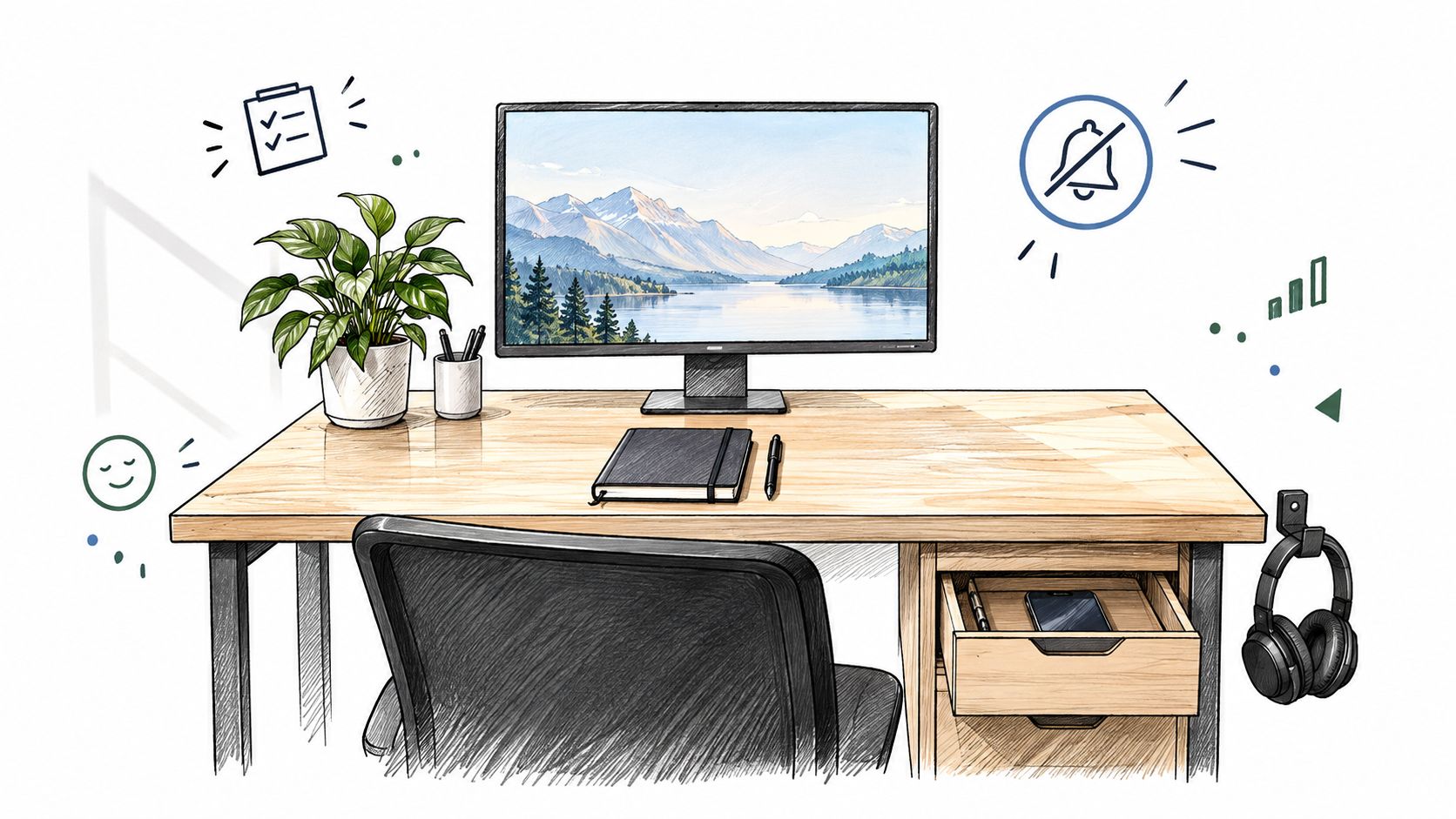
A student might use one monitor, store the phone in a bag, and leave only the assigned reading open. A remote worker could close the office door, use headphones, and keep household tasks out of the work area. A professional in a shared office may book a quiet room or use a visible availability signal. A researcher might arrange materials before an analysis block so that searching for supplies doesn't become an excuse to wander.
Adjust the difficulty
The easier variation is to silence alerts and clear one small work surface. The harder variation is to create a dedicated focus space used only for demanding work, with separate browser profiles and automatic app blocking. Kohru can block distracting apps and sites during a timed Focus Session, extending physical environment design into your digital environment.
Make distraction inconvenient, not forbidden. A phone stored across the room requires a deliberate action. A phone on the desk asks for attention every time the screen lights up.
Control lighting, temperature, and noise according to personal preference. Background music or white noise helps some people and distracts others, so test it rather than treating it as a universal solution. Use the easiest arrangement that protects the specific task, then repeat it until preparation becomes automatic.
The setup can be brief. It only needs to remove the distractions most likely to break your attention and make the desired action easier to begin.
The video below offers another perspective on arranging a workspace for focused activity.
7. Spaced Repetition and Interleaving
Learning methods can build concentration while improving how you work with information. Spaced repetition distributes review across separate sessions. Interleaving mixes related subjects or problem types instead of allowing you to repeat one familiar pattern until it feels easy.
Use a simple retrieval cycle. First, recall the material without looking at your notes. Then check your answer, identify the error, and schedule the next review. For interleaving, mix related problems within a study session. A mathematics student might alternate problem types instead of completing a long set of only one format. A language learner could combine vocabulary retrieval, grammar practice, and conversation exercises.
A medical student may use Anki to review anatomy across repeated sessions. A researcher could space literature review and synthesis rather than rereading a large collection in one sitting. A high school student can mix algebra, geometry, and interpretation problems when preparing for an assessment.
Make retrieval the focus task
The easier variation is to review a small set of cards without notes and correct them immediately. The harder variation is to combine several related subjects, explain the connection between them, and solve unfamiliar problems without prompts. Both variations require active effort. Passive rereading may feel smooth, but it gives you fewer opportunities to notice what you can't yet recall.
A 2016 meta-analytic review of working-memory training, which covered 87 studies and 145 independent experiments, found reliable immediate gains on trained or closely related tasks but no convincing transfer to intelligence, reading comprehension, arithmetic, or other real-world cognitive skills compared with treated controls as reported in the review record. That finding supports a careful design choice: connect concentration exercises to the actual material and performance you care about.
Protect review sessions from digital interruptions with a timed focus block. An Anki session, a set of practice questions, or a written explanation can each become a clear task. Difficulty isn't evidence that the method failed. Retrieval effort is part of the learning process, so schedule reviews before you feel completely ready to forget.
8. Time Blocking and Batch Task Processing
Time blocking answers two questions before the day becomes busy: when will you work, and what kind of work belongs there? Batch processing then groups similar activities so that you aren't repeatedly switching between creative, administrative, social, and analytical modes.
Create a weekly template with blocks for demanding projects, meetings, communication, administration, and recovery. Assign difficult work to the period when your attention is usually strongest. Group email into planned windows instead of leaving the inbox open all day. Add transition space between very different activities, especially when you need to move from a meeting into writing or from study into personal responsibilities.
A remote worker might reserve mornings for a strategic project, afternoons for meetings, and a later block for administration. A student could separate reading, problem-solving, and exam review rather than letting every subject compete within one unscheduled afternoon. A freelancer may assign different client projects to separate blocks, reducing the mental cost of reconstructing context each time.
Combine the calendar with a focus method
Time blocking differs from Pomodoro. Time blocking decides when and what you'll do. Pomodoro structures the work inside that appointment. You might reserve a morning block for research, then complete it as several short intervals. Or you might schedule one 90-minute block for writing and use a single protected session.
The easier variation is to plan only the next workday with two or three meaningful blocks. The harder variation is to create a repeatable weekly template, protect deep work appointments, and review the schedule against what really happened. Kohru's Focus Sessions can align with each block while its task-based workflow keeps the chosen activity visible.
Leave room for changes. A schedule that collapses after one unexpected request won't help concentration. Review the template weekly, preserve patterns that support completion, and adjust durations when the work consistently takes longer or shorter than expected.
8-Method Concentration Techniques Comparison
| Technique | Implementation complexity | Resource requirements | Expected outcomes | Ideal use cases | Key advantages |
|---|---|---|---|---|---|
| Pomodoro Technique | Low, simple timer and routine | Timer/app, optional app blocker, to-do list | Faster starts, sustained short-term focus, reduced fatigue | Students, writers, multitask workflows, quick tasks | Easy to adopt; built-in breaks prevent burnout; customizable |
| Deep Work Blocks | Medium–High, scheduling, rituals, discipline | Long uninterrupted time, environment control, app blocking | High-quality output, flow state, deeper learning | Research, writing, complex problem-solving, professional projects | Enables deep concentration; lowers context-switching; high-impact work |
| The Two-Minute Rule | Very low, quick pre-focus habit | Minimal; judgment and a capture system (to-do tool) | Reduced mental clutter, immediate momentum, fewer small distractions | Pre-focus clearing, email triage, quick admin tasks | Immediate wins; lowers cognitive load; prevents task buildup |
| Mindfulness & Meditation | Medium, consistent daily practice needed | Time (5–30 min/day), optional guided apps | Improved attention control, reduced stress, long-term attention gains | Priming before work, attention training, stress-prone individuals | Evidence-backed attention gains; builds meta-awareness transferable to tasks |
| Eisenhower Matrix | Low–Medium, initial categorization + reviews | Simple matrix tool or notes, weekly review time | Clear priorities, less reactive work, better time allocation | Multi-project professionals, students balancing tasks, planners | Reduces decision fatigue; focuses on high-impact work; clarifies priorities |
| Environment Design & Attention Architecture | Medium, one-time setup + maintenance | Physical adjustments, app blockers, possible purchases (headphones) | Immediate drop in distractions; sustained concentration improvements | Open offices, shared spaces, chronic procrastinators, ADHD accommodations | Reduces reliance on willpower; creates automatic focus triggers; long-term benefits |
| Spaced Repetition & Interleaving | Medium, scheduling and discipline required | Spaced-rep software (Anki), planning, regular review time | Stronger long-term retention, more efficient study time, better recall | Students, language learners, researchers, anyone learning complex material | Scientifically proven memory gains; encourages active recall; reduces total study time |
| Time Blocking & Batch Task Processing | Medium, weekly planning and protection of blocks | Calendar system, routine review, coordination for meetings | Fewer context switches, higher efficiency, predictable workflow | Knowledge workers, remote workers, freelancers managing multiple clients | Reduces decision fatigue; batches similar tasks; protects deep work periods |
Turn Eight Exercises Into a Focus Routine
You don't need to adopt all eight concentration building exercises at once. Start by creating a short beginning ritual that makes attention easier to direct. Spend 5 to 10 minutes with mindful breathing, then scan for quick tasks that really need immediate action. Capture anything larger instead of carrying it into the focus session.
Next, choose the session structure that matches the work. A student reviewing familiar material may begin with a Pomodoro interval. A professional drafting a strategy document or a researcher analyzing data may need a 90-minute block. If you're unsure, start shorter, monitor the quality of your work, and extend the session only when you can sustain attention without excessive fatigue.
Protect the session with environment design. Silence nonessential notifications, move the phone out of sight, close unrelated tabs, and prepare the materials before the timer starts. A digital blocking tool such as Kohru can support this step by blocking distracting apps during a Focus Session, while Smart To-Do Lists can connect the session to one specific work or personal task.
Use the learning methods where they belong. Spaced repetition and interleaving are especially useful for students, language learners, and researchers because they turn study time into active retrieval rather than passive review. The Eisenhower Matrix and time blocking help decide which tasks deserve protected attention before the day fills with urgent requests. The Two-Minute Rule keeps small tasks from competing with that protected time, as long as you use it before the session rather than inside it.
Review your results after one week. Ask whether you completed more meaningful tasks, retained more material, or started work with less resistance. Keep the methods that improve your actual outcomes. Adjust the interval, break timing, environment, and task difficulty to fit your attention pattern instead of copying someone else's routine.
A 2025 systematic review of exercise interventions found consistent improvements in several attentional domains, including concentration, selective attention, sustained attention, processing speed, and response accuracy across the included studies, concluding that exercise can serve as a non-pharmacological strategy for improving attention in children and adolescents in the published review. A separate randomized study reported improved attentional test performance after 8 weeks of endurance, strength, and coordination training, with the coordination group showing the strongest improvement among the exercise groups. In a monitored cooperative high-intensity interval program lasting 12 weeks and 24 sessions, secondary-school students improved selective attention by 14.2% and concentration by 8.41%, with mathematical calculation rising 15.5%, all at p < 0.001 in the study report. These findings support adding movement to a broader routine, while keeping expectations specific and realistic.
Response can also vary between people. A 2025 college-student study found that a brief mindfulness intervention improved attentional processing more strongly among participants with higher inattention symptoms in its reported findings. That's a useful reminder for educators and learners: the best exercise may depend on your baseline attention, symptoms, task, and environment. If concentration problems are persistent or interfere significantly with school, work, or daily life, consider discussing them with a qualified health or education professional.
Kohru offers one-click Focus Sessions, automatic distraction blocking across phone and laptop, task-based session setup, custom durations, and a break system for study or work. Visit Kohru to choose one task, protect a focus block, and turn these concentration building exercises into a routine you can repeat.
