reading focus·reading concentration·focus tips for students·ADHD reading·study focus
Why Cant I Focus When Reading? Fixes That Work
Struggling to concentrate? Learn why cant i focus when reading, from phone alerts to fatigue and ADHD, plus fixes that help, including Kohru.
15 min read
If you want to understand what you're reading, why doesn't trying harder always help? The question “Why can't I focus when reading?” often starts with motivation, but the more useful questions concern your surroundings, the demands of the text, and what happens when your attention slips.
The fix should match the problem. Blocking messages won't explain unfamiliar terminology, and highlighting more sentences won't help if you're too tired to connect them. Start by noticing what happens just before you lose the thread.
You open a chapter, reread the same paragraph, and realise you still couldn't explain its argument. That experience isn't unusual: in 2024, 28% of UK adults reported difficulty focusing on reading for more than a few minutes, according to The Reading Agency's Adult Reading Research Report.
For the environmental part of the problem, Kohru is a direct answer. It's an app built for students that helps you block distractions on your phone and laptop at the same time, so protecting your reading doesn't mean leaving another screen available for interruptions.
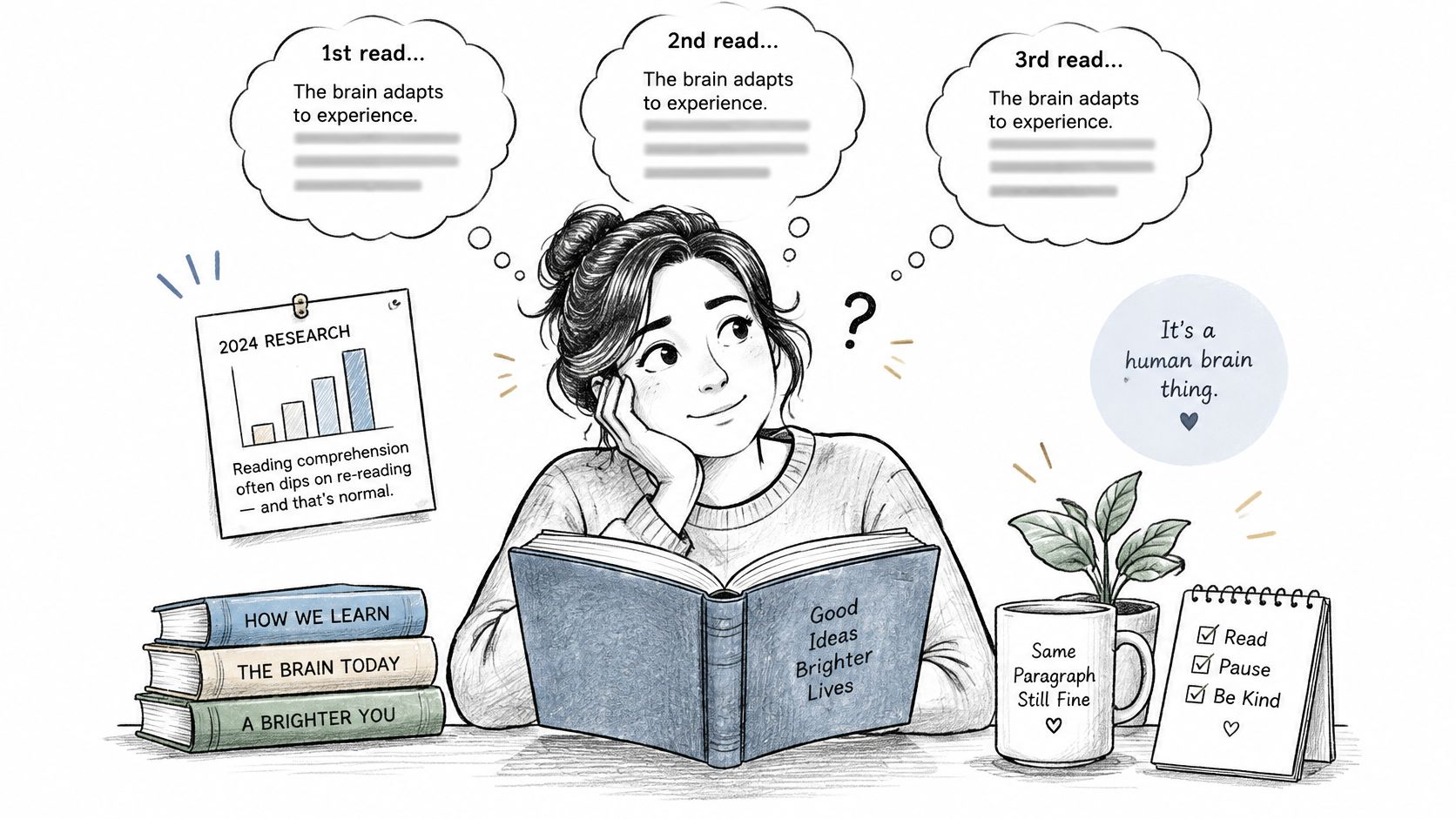
Repeated reading can look productive even when you aren't building understanding.
Separate the demands before choosing a fix
Reading asks you to retain earlier points, connect new information to them, and ignore unrelated thoughts. Knowing every word isn't enough if you lose the relationship between sentences.
Three broad kinds of difficulty can get in the way:
Environment: Notifications, open tabs, nearby devices, and other people interrupt your reading.
Attention: Your thoughts move elsewhere while your eyes continue across the page.
Capacity or condition: Dense material, fatigue, or a persistent attention difficulty makes the task harder to manage.
These aren't judgments about how much you care. You can be interested in a subject and still struggle with the way the reading session is arranged.
The practical starting point is a symptom table, followed by a repeatable routine you can begin this week. You don't need to overhaul your study habits at once. You need to identify the obstacle that keeps recurring and make that obstacle easier to manage.
Match Your Reading Symptom to Its Likely Cause
Use this table as a troubleshooting tool: choose the symptom closest to your last difficult reading session and try its first fix before changing anything else.
Symptom
Likely cause
First fix
You reread the same paragraph after a phone buzz
Digital interruptions
Block distracting apps and sites for the whole reading session
You reach the end of a page without knowing its argument
Mind wandering
Pause after each section and restate the main claim from memory
Dense sections lose you after a few sentences
Working-memory overload
Read in shorter blocks and keep a one-sentence summary visible
Focus fades late in a long session
Fatigue or low energy
Shorten the session, read when alert, and check your sleep
You understand the words but not why they matter
Weak background knowledge
Preview headings and define key terms before reading
Reading feels so dull that you keep skipping ahead
Low engagement with the material
Write one question you want the text to answer before you start
Treat the cause as a working hypothesis
The table isn't a diagnosis. Several causes can overlap, and the most obvious symptom doesn't always reveal the whole problem.
Say you're reading a biology chapter and keep checking messages whenever a technical passage appears. Messaging is the interruption, but unfamiliar vocabulary may be prompting the escape. Begin by removing messaging, then notice whether the passage still becomes difficult at the same point.
Change the strongest obstacle first. If you block distractions, alter your schedule, switch books, and start a new note-taking system simultaneously, you won't know which change helped.
Practical rule: Judge a fix by whether you can explain the passage afterward, not simply by whether you stayed seated.
Notice whether the problem extends beyond reading
Difficulty that also affects conversations, work, household tasks, or relationships deserves more than another study technique. Persistent low mood or anxiety is also a reason to consider professional support rather than assuming the problem is ADHD.
If you're unsure how mood and attention symptoms overlap, Integrative Psychiatry of America's guide to distinguishing depression from adult ADHD offers context for a conversation with a clinician. It's a resource for understanding possibilities, not a substitute for assessment.
For one week, keep a brief reading log. Record the text, when focus broke, what happened immediately beforehand, and whether you could summarise the passage. Write observable details, such as checking a message or encountering an unexplained term, rather than labelling yourself unfocused.
The repeated pattern gives you a better starting point than your most frustrating session.
Digital Interruptions That Cost You Reading Time
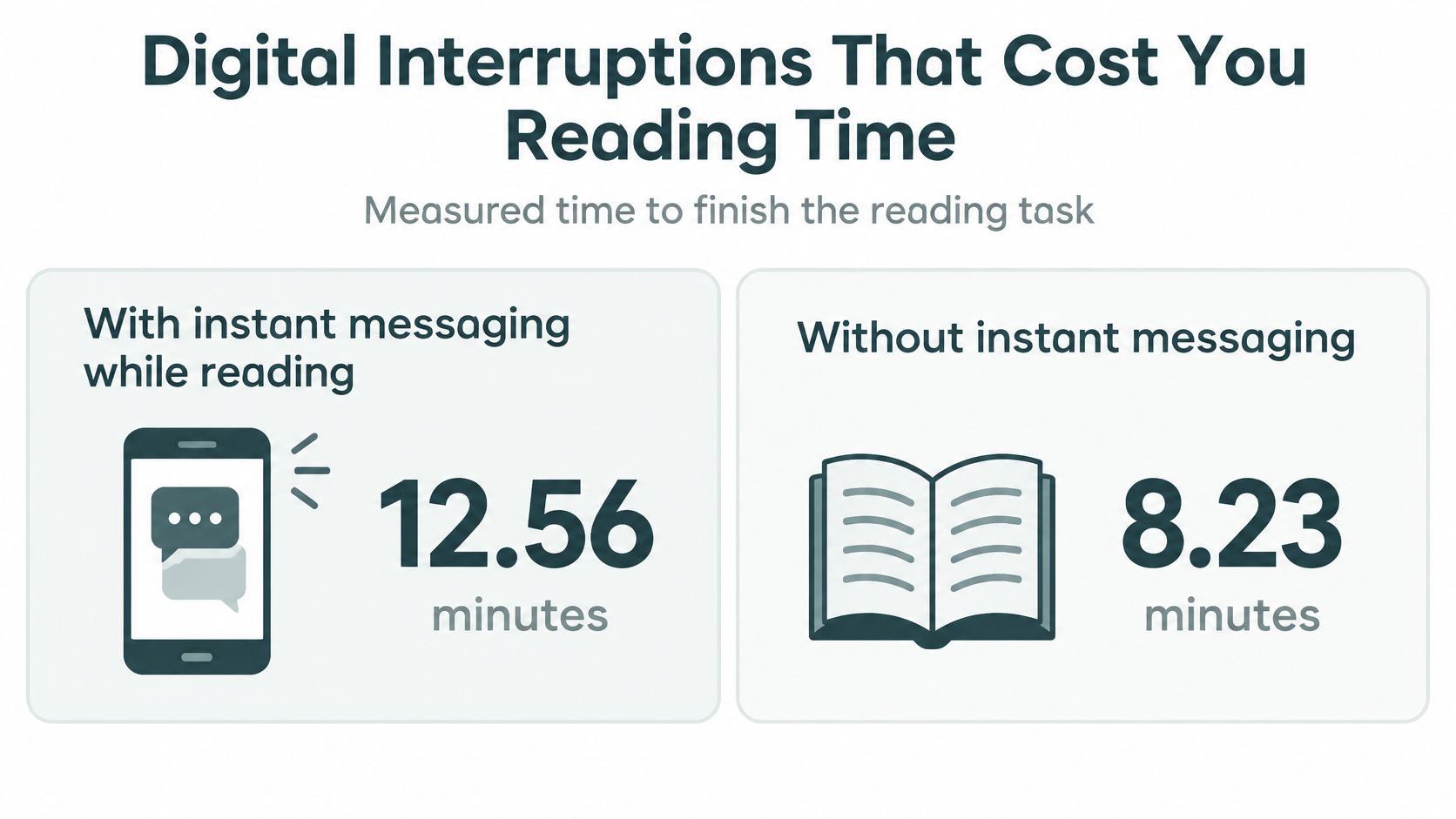
In student research summarised by Kohru's guide to stopping multitasking, participants using instant messaging while reading took an average of 12.56 minutes, compared with 8.23 minutes without multitasking, approximately 53% longer. That's time spent completing the reading task, not time spent looking at messages.
The comparison makes the cost easier to see.
Why a brief glance can create a longer detour
Suppose you're following an argument about housing costs. You've just connected a claim about supply to an example about planning restrictions when a message arrives.
After answering, you return to the same sentence, but the earlier connection is less accessible. You scan backward to recover what the author was explaining. The interruption includes both the message and the work of finding your place in the argument again.
A review of media multitasking in university learning linked multitasking with poorer attention, working memory, recall, reading comprehension, and efficiency. It also noted that comprehension doesn't decline in every situation, so finishing with an adequate answer doesn't necessarily mean multitasking had no cost.
Time away from the page isn't the whole interruption. Returning to the page and returning to the argument aren't always the same event.
Protect the reading on both screens
Putting your phone away helps little if you immediately open the same conversation on your laptop. The reverse is possible too: you close distracting browser tabs, then reach for your phone when the reading becomes demanding.
Kohru's synchronised Focus Sessions address that escape route. Selected distracting apps can be blocked on an iPhone while the browser extension blocks distracting websites on a laptop, keeping the reading period protected across both devices.
Set up the space deliberately:
Keep necessary material accessible: Open the assigned text, required references, and your notes before beginning.
Remove optional destinations: Close social feeds, shopping pages, news tabs, and unrelated conversations.
Plan for genuine interruptions: Tell anyone who needs you when you'll be available, and arrange a way to handle urgent contact.
Don't use a distraction-free session as a reason to ignore essential responsibilities. Make those arrangements beforehand so you aren't repeatedly deciding whether to check.
Which interruption wins most often: a group chat, email, a social feed, or an unrelated search? Name it specifically. That's the first interruption to remove, rather than relying on a general promise to use your devices less.
Mind Wandering and How to Catch It Early
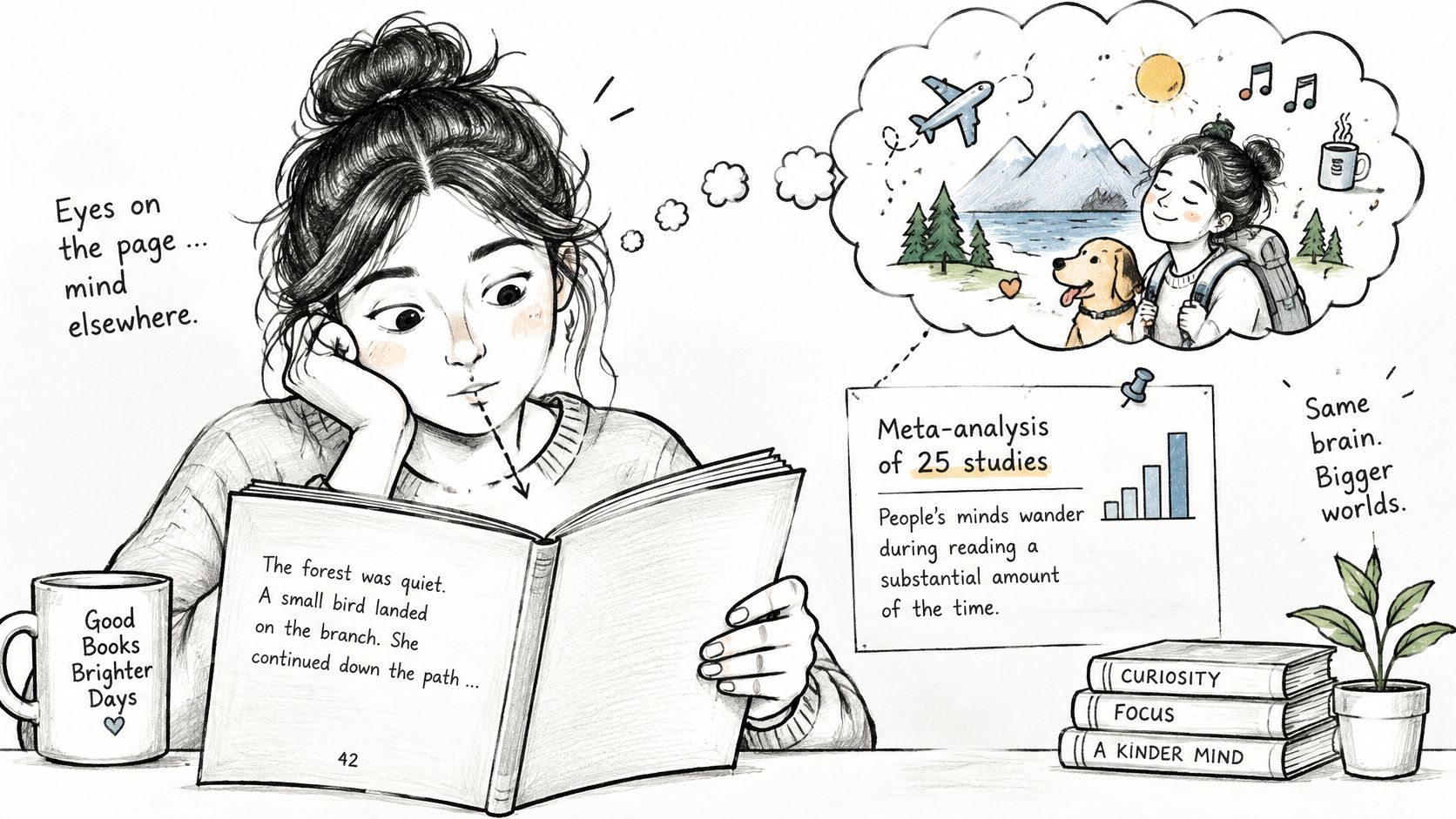
Mind wandering happens when your attention shifts from the text to your own thoughts while your eyes keep travelling down the page. You might be planning dinner, replaying a conversation, or thinking about an approaching deadline without noticing when you stopped following the author.
This is what attention drift can feel like during an otherwise quiet reading session.
A meta-analysis of mind wandering and reading comprehension covering 25 studies found a pooled association of r = −0.21 between mind wandering and comprehension, with more wandering associated with poorer understanding; it also found that wandering increased as text difficulty rose. The association doesn't tell you why any particular reading session went badly, but it helps explain why unnoticed drift matters.
Think of a driver who stays in the lane but can't recall the last few exits. The outward activity continues while awareness of the journey becomes patchy. During reading, you can keep turning pages without retaining how the ideas fit together.
Catch the drift before it becomes a lost chapter
Use this brief check at a paragraph or subsection boundary:
State the main claim from memory without looking at the text.
Name a supporting detail that explains or backs up that claim.
Write down any term you can't explain in your own words.
Keep each answer short. You're checking whether you followed the passage, not producing polished revision notes.
If you can't recall the claim, return only to that segment. Look for the sentence carrying the argument, then check how the surrounding sentences support or qualify it.
For another format alongside your reading practice, you can watch this video.
Make returning easier
When a distracting thought concerns something you need to do, put a brief reminder on paper. Then return to the passage rather than trying to solve the unrelated task while reading.
Before difficult material, preview headings and clarify unfamiliar vocabulary. An overview gives you somewhere to place new ideas, and a small glossary reduces the temptation to abandon the argument whenever an unfamiliar term appears.
Success isn't never drifting. It's noticing the drift early enough to return without losing a large stretch of meaning.
How Working Memory Limits What You Can Absorb
Working memory is the mental workspace you use to hold earlier claims while processing the current sentence. It lets you remember what a pronoun refers to, compare an example with a definition, and keep the author's question in mind.
Experimental work with skilled adult readers, recorded in ERIC's study of working memory, mind wandering, and comprehension, found that differences in working-memory capacity related to comprehension partly through differences in susceptibility to mind wandering. In plain language, maintaining the argument and keeping attention on it are connected demands.
Set down what you don't need to carry mentally
Think of carrying groceries. You might manage four bags but struggle with twelve; setting some down lets you move the rest safely. Those numbers are an analogy, not a measure of mental capacity.
Dense reading creates a similar practical problem. You may be decoding unfamiliar terms, checking symbols, following cross-references, and retaining earlier claims at the same time.
Use these methods to reduce the load:
Read in short blocks: Stop at a meaningful boundary, such as the end of an explanation, rather than forcing yourself through an entire chapter.
Keep the current argument visible: Write a one-sentence summary on a sticky note, such as “The author argues that restricted supply raises housing costs.”
Separate dense claims: Turn a packed paragraph into a short list showing the claim, reason, exception, and conclusion.
Externalise definitions and symbols: Keep a glossary or notation key beside the text so you don't have to reconstruct meanings repeatedly.
These notes should make the passage easier to handle. Copying whole paragraphs adds work without necessarily clarifying the argument.
Recognise overload rather than demanding more effort
Suppose a statistics passage introduces an unfamiliar symbol and immediately uses it in a comparison. Write down what the symbol means before continuing. You can then spend your attention on the comparison instead of repeatedly asking what the notation represents.
Fatigue deserves the same practical consideration. If you're sleepy or repeatedly losing your place, shorten the task and reserve demanding texts for a time when you feel more alert.
Set down the definitions, symbols, and intermediate claims on paper. Keep your attention available for understanding their relationship.
The memory check should come after a manageable block, not after more material than you can reasonably reconstruct. Needing a definition in nearly every paragraph, or repeatedly forgetting a sentence you just understood, is a useful signal to reduce the load before continuing.
When Attention Problems Point to ADHD
Not every reading problem is a study-habit problem. ADHD can contribute to attention difficulties during reading, and in 2023 an estimated 15.5 million U.S. adults, or 6.0% of the adult population, had a current ADHD diagnosis, according to the U.S. Centers for Disease Control and Prevention.
That figure isn't a way to diagnose yourself. Struggling with an assigned chapter, particularly when you're tired or distracted, doesn't establish ADHD.
Look for a broader, persistent pattern
A professional conversation becomes more important when attention problems interfere with life beyond reading. Relevant experiences to describe include:
Difficulty across settings: You lose track during conversations, meetings, chores, and study.
Unnoticed switching: You find yourself doing something else before recognising that you left the original task.
Restlessness or impulsivity: You repeatedly interrupt activities, act before considering consequences, or struggle to remain with a task.
A long history: Similar difficulties were present during childhood, even if they weren't recognised or assessed.
These are reasons to seek evaluation, not a checklist that confirms a condition. A clinician needs to understand your history, the impact on your life, and other possible explanations.
Sleepiness, anxiety, and low mood also deserve attention. Don't assume that every concentration difficulty has the same cause, or that a blocking app can resolve a health concern.
Bring concrete examples to an assessment
Keep a two-week log across different tasks. Note the time, what you intended to do, what broke your attention, and the consequence, such as missing an instruction or leaving a chore unfinished.
Bring that record to a doctor, psychologist, or campus support service. You don't need a perfect log, and you shouldn't delay seeking help if the difficulties are already seriously affecting you.
While you're waiting, try an external timer, smaller task boundaries, or body doubling, which means working alongside another person who is also completing a task. Treat these as practical supports and notice whether they help, rather than expecting them to establish or rule out a diagnosis.
A diagnosis is a reason to get appropriate support, not a verdict on intelligence, effort, or academic potential.
Why Dull or Unfamiliar Text Drains Your Focus
You can remove every notification and still struggle if the passage feels meaningless. Sometimes you understand the individual words but don't know why the author considers them important.
Reading an unfamiliar subject is like looking at a city map without knowing the neighbourhood. You can follow the streets, yet you don't know which destinations matter or how they connect to your purpose.
Give the reading a destination
Unfamiliar material requires more preparation, while dull material needs a clearer reason to engage. Before reading closely, try this sequence:
Preview the structure. Read the headings, subheadings, and any summary to identify the topic and direction.
Define the key terms. Choose five or six central terms and write a plain-language explanation of each before tackling the opening argument.
Write a question. Ask what causes the problem, how the method works, or whether the evidence supports the conclusion, then check afterward whether the text answered it.
You aren't trying to learn the chapter before reading it. You're giving yourself enough orientation to recognise what each passage contributes.
Purpose check: Replace “finish the pages” with a question you genuinely need those pages to answer.
For example, a methods chapter becomes more concrete when you're trying to decide whether a technique suits your dissertation. Instead of collecting isolated descriptions, you can look for assumptions, limitations, and reasons to choose that method.
Interest doesn't have to arrive before you begin. A useful question can give you something specific to investigate.
If no question seems worth asking, check whether the material fits your current goal. You may need a clearer assignment objective, an introductory explanation, or a different source before spending more time on close reading.
Build a Reading Routine That Protects Your Focus
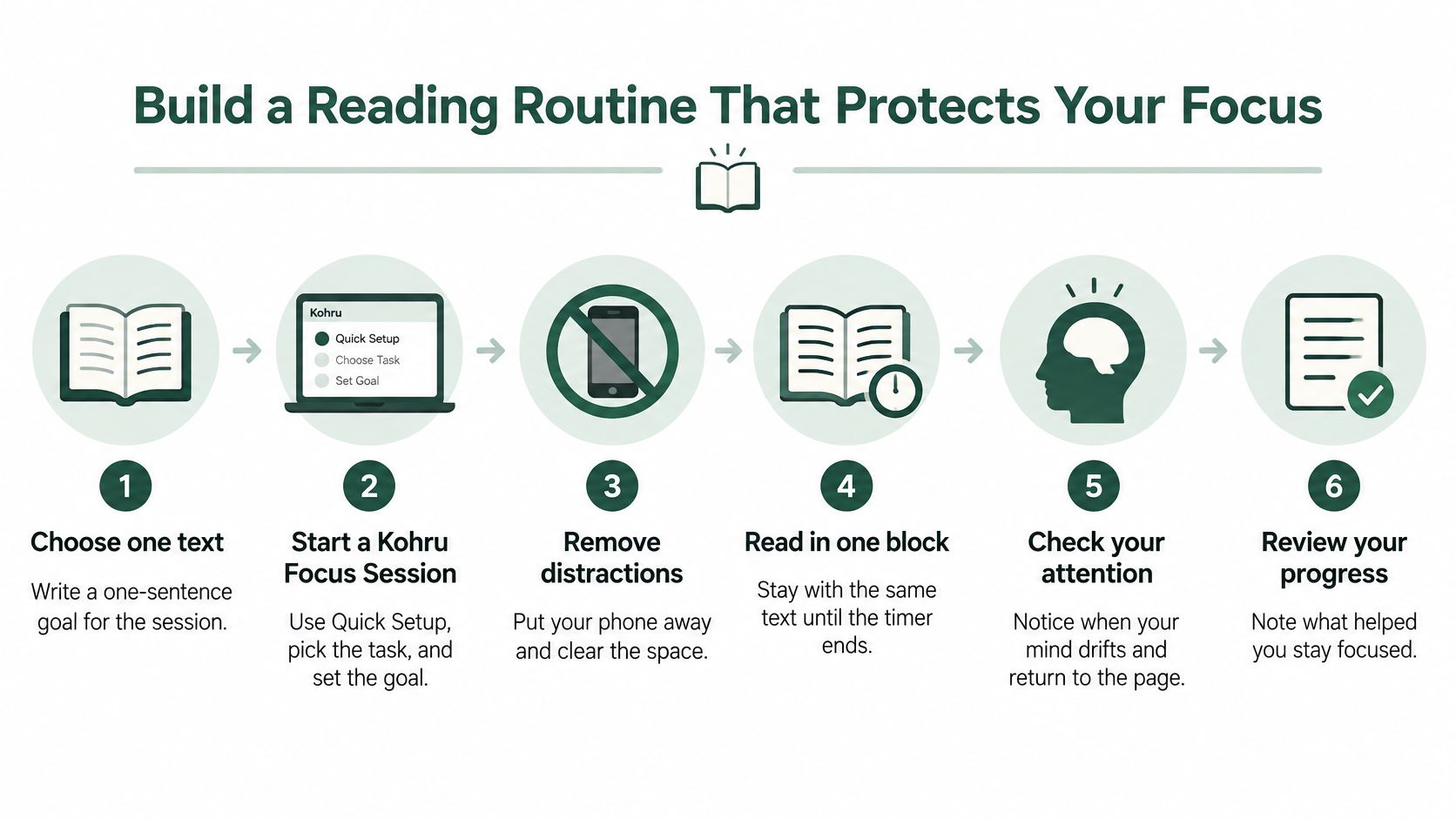
Choose one text and write a session goal. Make the goal about understanding, such as explaining an author's main claim and evidence, rather than merely reaching a page number. Keep the assignment narrow enough that you can recognise completion.
Start a Kohru Focus Session with Quick Setup. Pick the reading task and set a goal, then choose a session duration that fits the material and your current energy. Prepare required references before starting so you don't need to browse without a clear purpose.
Keep phone apps and laptop sites blocked throughout the session. When a focus session starts, our Chrome extension automatically blocks the sites that pull you off track. Leave necessary reading resources available, put your phone out of reach, and keep paper nearby for unrelated reminders.
Read in a short, meaningful block. Stay with the same text rather than alternating between assignments whenever a passage becomes uncomfortable. At a section boundary, use the attention check to decide whether you're ready to continue or need to repair your understanding.
Summarise from memory and mark unresolved terms. Close or cover the passage and explain what you understood in ordinary language. If your explanation breaks down, identify the precise claim or term that needs attention instead of automatically restarting the whole reading.
Review your progress on the Dashboard. Our Dashboard tracks focus time, completed tasks, and distraction-free streaks, with time-period filters for reviewing changes. Pair those activity records with your own comprehension notes, because time spent focusing doesn't by itself establish what you learned.
Keep the routine easy to repeat
Our Smart To-Do Lists separate Work and Personal tasks, and each task becomes a distraction-free focus session. For a reading assignment, use a concrete task description, such as understanding a chapter's explanation of a particular problem, rather than a broad label such as studying. Kohru is an app built for students; the useful role here is protecting the conditions in which reading can happen.
Use the visual sequence as a reminder when setting up your next session.
Make the next adjustment specific
Run the routine for two weeks, then return to the symptom table. Look for the symptom that still repeats, not the session that felt worst.
If interruptions have stopped but dense passages remain difficult, keep the blocking in place and adjust how you handle the text. If understanding is good early and poor late, reconsider timing and session length rather than adding more notes.
Change only the fix that matches the remaining problem. Keep a brief record of what you could explain afterward and where you needed help. That gives you a practical basis for deciding whether the next step is a study adjustment, support with the subject, or a professional conversation about persistent attention difficulties.
Kohru helps you block distracting apps and websites on your phone and laptop at the same time, giving your reading session a protected space. Visit Kohru, choose your next reading task, and start a Focus Session with a clear understanding goal.