
A missed day can end a habit tracker before the habit itself has a chance to take hold. A student's late class or a professional's shifting deadline can break a daily streak, even when the person still has time to complete the habit later in the week.
The problem is often method mismatch: a rigid daily chain does not fit a week that changes from day to day. Pair flexible weekly targets with protected, distraction-free time, then choose a tracking method that matches how predictable your schedule is. Kohru is a focus and habit-tracking app built for students. Research on smartphones, laptops, and classroom multitasking examines how these devices relate to multitasking in class, a reason to protect focus across devices.
A tracker should help you recover after a missed session, not turn one interruption into a reason to quit. If a family obligation, long shift, or late class disrupts Friday, the useful question is whether you can resume the habit, not whether the week still looks perfect. That distinction matters for students and professionals whose schedules do not repeat neatly.
The eight methods below are ordered from most flexible to most structured. Choose based on the week you really have, rather than forcing every habit into a daily streak.
Table of Contents
- 1. Flexible Weekly Targets
- 2. Habit Stacking
- 3. Tiny Habits
- 4. Seinfeld Strategy (Don't Break the Chain)
- 5. Heatmap and Contribution-Style Tracking
- 6. Implementation Intentions
- 7. Bullet Journal Habit Tracker
- 8. Focus Session Logging
- 8 Habit Tracking Ideas Compared
- Build a Tracker That Survives Your Real Week
1. Flexible Weekly Targets
Set the total for the week, not a pass or fail grade for every day. Five study sessions, three workouts, or four focused writing blocks can shift when a lab runs late or a client call moves. You still see progress, but one disrupted Tuesday doesn't erase Monday's work.
A student targeting 150 minutes of study across five weekdays might do longer sessions on Monday and Thursday and skip Wednesday entirely during a packed seminar day. A remote worker aiming for three workouts per week can move a Tuesday session to Saturday after a deadline. Both finish the week having done the work, just not in the original order.
Why context matters more than a streak
Habits strengthen when a behavior is repeated in a stable context, building the cue and response link described in Carden and Wood's review of habit formation. That review also cautions that reminders can help short term but may hold back longer-term formation if you stay dependent on them. Track where and after what cue you completed the session, not only that you completed it. A dashboard showing rolling adherence and recovery after a miss tells you more than a streak count.
University of Birmingham research supports that flexibility. In research on implementation intentions and habit compliance, reinforcement helped maintain compliance even though compliance didn't automatically produce the same level of automaticity. In plain terms, showing up imperfectly is worth protecting.
Kohru uses this model directly. Its Habit Tracking replaces rigid daily streaks with flexible weekly targets, supported by cues and motivational systems, and it blocks distractions across phone and laptop at the same time so counted sessions stay protected. It's built for students and also works for professionals.
- Limit the load: Set two or three weekly targets rather than many small ones.
- Protect the time: Schedule a fixed focus block for each target.
- Review weekly: Check the total at week's end and set the next target then.
- Keep it visible: Use a dashboard view to see weekly progress at a glance.

2. Habit Stacking
Habit stacking borrows a cue you already own. The formula is simple: After I [current habit], I will [new habit]. You don't have to remember a new time or invent motivation at the moment of action. The existing routine does the reminding.
James Clear popularized the approach in Atomic Habits, and it works best when the anchor is boringly reliable. Brushing your teeth, pouring coffee, sitting down at your desk, plugging in your laptop. If the anchor only happens on good days, it's not an anchor.
Try this stack in practice. After I brush my teeth at night, I will write down three things I studied today. It takes a minute, and it turns vague revision into recall. Or use a morning version: After I pour my morning coffee, I will review my task list for the day. A professional can add one line to that list, naming the single task that gets a protected focus block before messages take over.
Make the first version embarrassingly small
- Choose a daily anchor: Pick something you already do without fail.
- Add one habit only: Let one stack settle before building a chain.
- Cap it at two minutes: Small enough that tired-you still does it.
The trade-off is real. Stacking fails when you attach three new behaviors to one anchor and turn breakfast into a self-improvement ceremony. One cue, one small action, tracked plainly. When you're reviewing your task list after coffee, that is also a natural moment to notice whether yesterday's session produced progress or if you just ticked a box while distracted.

3. Tiny Habits
When a habit keeps dying at the starting line, shrink it until starting feels almost silly. BJ Fogg at the Stanford Behavior Design Lab built the Tiny Habits method around that idea. You pair an anchor moment with a tiny behavior, then add an immediate celebration. Ability and a prompt do the heavy lifting, not motivation alone.
A student might use this: After I open my laptop, I will read one paragraph of my textbook, then celebrate with a fist pump. One paragraph sounds trivial, but it opens the book, and opening the book is usually the hard part. A beginner exerciser can try: After I put on my running shoes, I will do two push-ups. The shoes are the commitment device. The push-ups are just proof you started.
Make the first version so easy that skipping it takes more explaining than doing it.
Tracking matters here, but keep the log tiny too. Mark anchor, action, celebration. If you only record the final size of the session, you'll miss why some days worked. The same logic applies to routines outside study, including practical ways to pray every day, where a small anchored action beats an ambitious plan that needs a perfect morning.
- Go smaller than feels impressive: One paragraph, two push-ups, one flashcard.
- Celebrate on purpose: Choose something you genuinely enjoy, not something performative.
- Grow it late: Only increase difficulty after the tiny version feels automatic.
The honest limitation: tiny can stay tiny if you never review it. Put a weekly check on your calendar. If the habit felt automatic all week, raise it slightly. If it didn't, keep the size and fix the anchor.

4. Seinfeld Strategy (Don't Break the Chain)
The don't break the chain method makes consistency visible: complete a habit, mark an X on a calendar, and repeat. It is commonly attributed to Jerry Seinfeld, who reportedly advised a young comic to write jokes daily and mark each day on a wall calendar. The growing chain can motivate you, but it can also make one missed day feel like failure.
A graduate student might mark each day they finish 30 minutes of reading. A writer might add a red X after a drafting session. Put the calendar somewhere visible, so it serves as a prompt rather than a private record you forget to check.
Where the chain breaks people
A daily chain is demanding when schedules shift. A late work shift, a deadline, or a low-energy day can break the pattern even when the habit still matters. Set a version of the habit that fits a difficult day, and decide in advance how you will respond to a missed mark.
A randomized study of 1,704 students across 18 Swedish universities examined goal-setting and self-monitoring for health behaviors. It found no strong, consistent effect from goal-setting alone on several behaviors; benefits associated with self-monitoring were limited and did not persist at later follow-ups, as reported in the randomized student study on goal-setting and self-monitoring. The study did not test streaks or chain-based tracking, so it cannot tell us whether marking daily Xs helps people maintain habits.
- Set a minimum version: Count ten minutes on a rough day, if that is enough to keep the habit meaningful.
- Choose a recovery rule: For example, resume the habit the next day after a miss rather than abandoning the calendar.
- Match the method to your week: If a daily chain feels too strict, use a weekly target instead.
Add a brief note beside the X, such as energy, distraction, or task difficulty. If missed days follow late shifts, adjust the schedule or task size. The calendar should help you make a practical change, not turn a disrupted week into a judgment about your character.
5. Heatmap and Contribution-Style Tracking
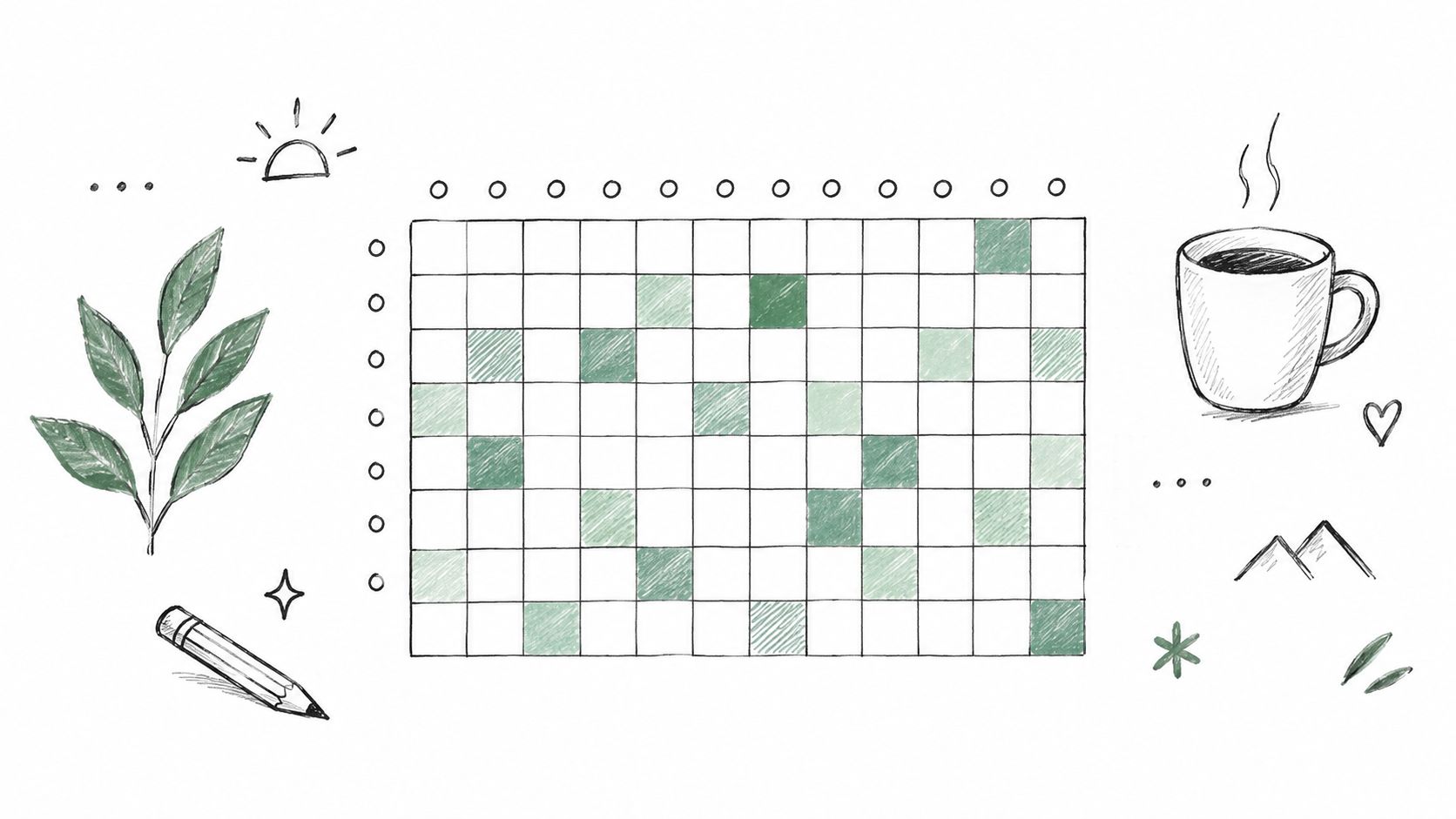
A heatmap trades daily judgment for pattern recognition. Each completion becomes a colored square on a grid, similar to contribution graphs used in software development. After a few weeks, you stop asking whether today was perfect and start asking which contexts actually support the habit.
Open-source tools such as Loop Habit Tracker use this history style well. A researcher reviewing a month of squares might notice reading collapses every Friday and move lighter tasks to that day instead of forcing a heavy literature session. A professional might see a clear dip during a busy quarter and plan recovery time rather than pretending the dip was laziness.
Read it weekly, not hourly
Checking the grid after every session turns reflection into surveillance. Review it once a week and look for day, time, and cue patterns. Which location produced the most completions? Did sessions after breakfast beat sessions after dinner? That is usable design information.
Heatmaps also expose a question most trackers ignore: when should reminders disappear? A pilot study of 18 participants found just-in-time reminders improved initial adoption of a morning exercise habit, while gradually fading reminders produced greater habit strength, as described in the pilot study on fading just-in-time reminders. Use prompts heavily at launch if you need them, then taper as the squares fill in without them. Reactivate prompts during exams or schedule disruptions instead of treating that as failure.
- Track three to five habits maximum: More grids means less insight per grid.
- Note the reason for misses: Annotate travel, illness, or deadline weeks.
- Track cue success: Note whether the session followed your intended cue.
6. Implementation Intentions
Vague goals ask future-you to make decisions under pressure. Implementation intentions remove that negotiation. You write an exact if-then plan that links a situation to an immediately executable behavior: If it is 7:00 p.m. after dinner, then I will review flashcards for 20 minutes.
Psychologist Peter Gollwitzer developed this line of research, and the numbers are worth taking seriously. A 2025 meta-analysis covering 642 independent tests found effects ranging from small-to-moderate through moderate-to-large across cognitive, emotional, and behavioral outcomes, d = 0.27-0.66, with stronger effects when plans used a contingent if-then structure, reflected strong motivation, and were rehearsed, as summarized in the 2025 meta-analysis of implementation intentions.
That means your tracker should capture cue, action, timing, and context, not just whether something happened. "Study more" isn't a plan. A pre-session prompt that restates your if-then line is.
Two plans you can copy tonight
- Study cue: If I sit down after dinner, then I will open my flashcard app for 15 minutes.
- Distraction cue: If I feel the urge to check social media during study time, then I will open my notes instead.
Practical rule: If you can't picture the exact moment the habit starts, you're tracking a wish, not a plan.
Rehearse the plan once when you write it. Pair it with a protected focus session so the cue leads into an environment that supports the action. In your weekly review, count which cues produced completions. A cue that never fires needs replacing, even if it sounded sensible on Sunday.
7. Bullet Journal Habit Tracker
Paper has one advantage apps can't copy. You can't doomscroll inside a notebook. The Bullet Journal system, created by Ryder Carroll, uses a monthly grid with habits down the side and days across the top. You mark completions by hand and review the spread at month's end.
A student might run columns for study, exercise, and sleep on one spread, adding a short note on days when a session felt focused or scattered. A freelancer can track daily writing with colored pens and use monthly review pages to spot which client weeks squeezed writing out. The handwriting slows you down just enough to notice what the marks mean.
The video below shows a simple setup you can copy without buying specialty supplies.
Keep the craft project under control
The failure mode is predictable. The layout gets prettier, the tracking gets thinner, and eventually you're maintaining a scrapbook about habits you aren't doing. Draw the grid in five minutes and spend the saved time on the habit itself.
- Use one symbol system: A filled box, a dot for a minimum version, blank for missed.
- Review monthly: Set aside ten minutes to read the spread and adjust one thing.
- Add context sparingly: One word next to a missed day beats a paragraph of excuses.
Paper also handles the recovery conversation well. A blank square on paper looks neutral. It doesn't flash red or reset a counter to zero. For students and professionals who abandon apps after one bad week, that emotional difference is not trivial. It's often the reason the system survives.
8. Focus Session Logging
A student can spend an evening at a textbook and still get little done if notifications keep breaking concentration. Focus session logging records how much protected time you actually give study or deep work, rather than whether you merely sat down to do it. Track focus minutes to see which sessions hold up under your real schedule.
The distraction can affect learning. OECD analysis of 15-year-olds across 81 education systems found that students who reported being distracted by peers using digital devices in some, most, or every mathematics class scored lower by an amount equivalent to approximately three-quarters of a school year, according to OECD analysis of digital devices and student success. A systematic review of 26 studies grouped reported causes of digital distraction into technology distractors at 51.95%, personal needs at 37.66%, and instructional-environment factors at 10.39%. Personal performance issues appeared in 66.67% of reported consequences, according to the systematic review of digital distraction causes.
Use the log to spot a pattern, not to chase a perfect daily streak. A high school student preparing for exams might track 90 focused minutes each evening and notice that concentration drops when sessions begin after 10 p.m. A remote worker could compare weekly deep-work hours and use the record to decide whether meeting-heavy days need a protected morning block.
Kohru offers one-click Focus Sessions that block digital distractions across phone and laptop, with custom durations, difficulty modes, and a dashboard for focus time and tasks completed. It is built for students and also works for professionals who want to log focused time. A useful log records time you can genuinely concentrate, not just time spent with a timer running.
- Start modest: Choose a daily target that fits an ordinary day, not an unusually quiet one.
- Block distractions: Use app blocking during a session so the logged time reflects protected work.
- Schedule breaks: Choose sessions you can repeat, rather than pushing through one long stretch you dread repeating.
8 Habit Tracking Ideas Compared
| Method | Implementation Complexity | Resource Requirements | Expected Outcomes | Ideal Use Cases | Key Advantage |
|---|---|---|---|---|---|
| Flexible Weekly Targets | Low; set a weekly frequency or total | Calendar or habit tracker; optional focus tools | Consistency across the week without requiring daily completion | Busy or changing schedules | Missed days do not erase progress |
| Habit Stacking | Low; link a new action to a reliable routine | Existing daily routine; no special tools | New habits become easier to remember and repeat | Adding small behaviors to established routines | Uses familiar cues instead of relying on memory |
| Tiny Habits | Low; define a very small action and celebration | Anchor moment; no special tools | Easier starts that can grow gradually | Building habits when motivation or confidence is low | Very low barrier to action |
| Seinfeld Strategy (Don't Break the Chain) | Low; mark each completed day | Calendar or chart; pen or app | Visible daily streak and momentum | Habits suited to daily repetition | Simple, immediate visual feedback |
| Heatmap and Contribution-Style Tracking | Moderate; record and review completions | Grid-based tracker or app; periodic review | Long-term patterns and completion trends become visible | Identifying when habits succeed or falter | Reveals patterns beyond a basic checklist |
| Implementation Intentions | Low to moderate; write specific if-then plans | Planning time; optional tracker | Clearer cues and improved follow-through | Behaviors tied to specific times, places, or situations | Reduces in-the-moment decisions |
| Bullet Journal Habit Tracker | Low to moderate; create and maintain a monthly grid | Notebook and pen | Completion records plus regular reflection | People who prefer customizable, screen-free tracking | Flexible, low-distraction format |
| Focus Session Logging | Moderate; set targets and record focused time | Timer or tracking app; optional distraction blockers | Measurable focus time and progress trends | Study or deep-work routines | Makes focused effort visible and trackable |
Build a Tracker That Survives Your Real Week
The best habit tracking idea isn't the most impressive one. It's the one still standing during exam week, a deadline crunch, or a sick day when your normal routine disappears. Every method on this list fails in a predictable way. Weekly targets can drift without a review. Tiny habits can stay tiny forever. Chains and streaks motivate until they punish. Paper encourages reflection but gives you no blocking when distraction is the actual problem.
That is why the strongest setups usually combine two pieces: a flexible target that forgives a bad day, and a specific cue that tells you when the behavior starts. Add distraction blocking for study or deep work, and you've removed the three most common failure points in one system. The tracker stops asking you to be a different person with a tidier schedule. It starts fitting the week you have.
Your three-step starting plan
Step one: Pick two or three habits tied to one outcome you care about now. Not ten. A student might choose flashcards after dinner and one protected study block. A professional might choose a morning task review and three deep-work sessions.
Step two: Set weekly targets instead of daily streaks, and give each habit an if-then cue. Write the cue where you'll see it, rehearse it once, and track whether sessions happened after that cue. If a cue repeatedly fails, change the cue before you blame your consistency.
Step three: Protect each session with distraction blocking and log the context. Record time, place, and whether the session produced meaningful progress. After one week, review the pattern and adjust one variable only. Smaller task, different cue, fewer reminders, or a different time of day.
Kohru bundles those three steps for students who don't want to assemble them from separate tools. It offers flexible weekly habit targets, one-click Focus Sessions that block distractions on phone and laptop simultaneously, and a dashboard that shows progress at a glance. It won't do the studying for you, and no tracker will. It removes the friction and fragility that usually kill the system before the habit has a chance.
Don't redesign your whole life tonight. Choose one method from this list, attach it to two or three habits, and run it for a single week. Judge it on Friday by what you learned about your cues and contexts, not by whether every box is filled. A tracker that teaches you how your week works will outlast a perfect streak every time.
If your streaks keep collapsing under a real student schedule, try Kohru's flexible weekly habit targets paired with one-click Focus Sessions that block distractions on your phone and laptop at the same time. You'll get a clear dashboard for focus time, tasks completed, and weekly progress, without treating one missed day as failure. Start your first protected session today at Kohru.
