
Your laptop is open, the textbook is somewhere in a tab, and your phone is close enough to check without thinking. You mean to study. Twenty minutes later, you've read the same sentence three times and haven't started the assignment.
The fix isn't to wait until you feel motivated. It's to find what's blocking the start, then change the conditions. Kohru is built for students and helps block distracting apps on your phone and websites on your laptop at the same time, so your study plan isn't competing with two screens full of interruptions.
Table of Contents
- Why You Cannot Make Yourself Start Studying
- Turn the Decision to Study Into an If-Then Plan
- Block Your Phone and Laptop at the Same Time
- Use Retrieval and Spacing Instead of Rereading
- What to Do When You Are Exhausted or Behind
- When the Problem Is Executive Dysfunction Not Laziness
- Your 7-Day Starter Routine and Common Questions
Why You Cannot Make Yourself Start Studying
When you're stuck, the problem often isn't that you don't care. It's the gap between intending to study and beginning a specific task. “Study biology” is vague, effortful, and easy to postpone. “Open the cell division chapter and answer five questions” gives you an action you can do now.
Academic procrastination is common, not proof that you're lazy. In a 2022 study of 323 undergraduate students at a public university, 81% were classified as procrastinators, compared with 19% categorized as non-procrastinators. Within the procrastinating group, 20% said they seldom procrastinated, 22% almost usually, and 39% always on academic tasks (2022 study of academic procrastination). Those figures point to a practical problem: starting can be harder than knowing you should study.
Practical rule: Don't ask yourself to feel ready. Make the first action small and visible.
Diagnose the bottleneck before reaching for another generic study tip. Are you putting off a task because it's unclear? Are your phone and laptop pulling you away? Do you start but lose track, or are you too exhausted to think clearly? Each problem calls for a different fix. If procrastination feels like a recurring struggle, these tips for young adults who procrastinate offer another useful way to think about getting unstuck.
Turn the Decision to Study Into an If-Then Plan
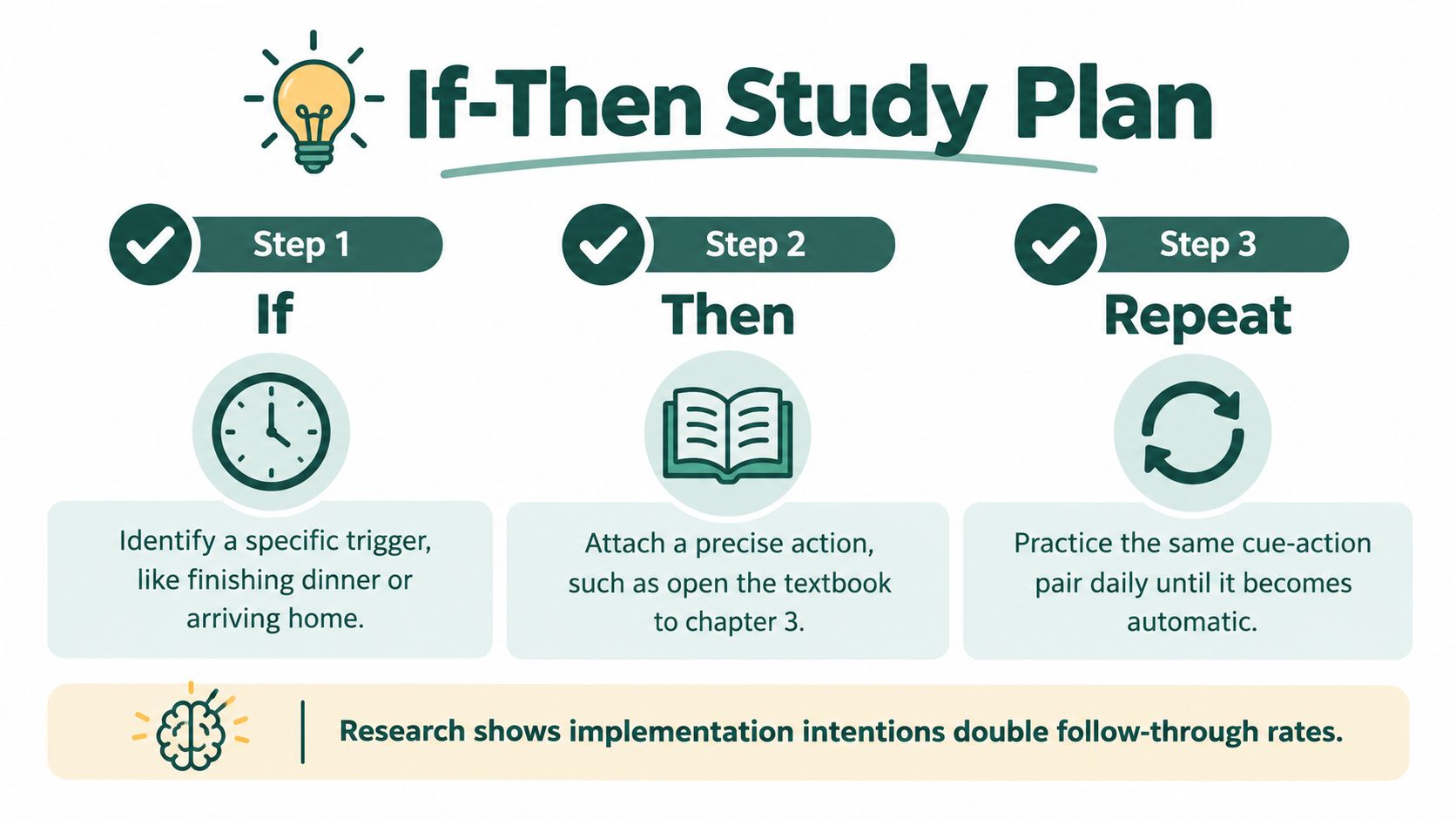
“I'll study tonight” is a wish, not a plan. It leaves the time, place, task, and starting point undecided, so you have to make all those choices when you're already tempted to put studying off.
Use an if-then plan instead. Tie a clear cue to a specific behavior, choose where you'll do it, and make the first dose short enough that you can begin without negotiating with yourself.
Copy and adapt: If it's [time and day], then I'll [specific action] at [location] for [minimum time or output], with [main distraction] put away.
For example: “If it's 7:00 p.m. on weekdays, then I'll sit at my desk, put my phone away, and answer biology retrieval questions for 10 minutes.” The point isn't to guarantee a long session. It's to make a real start easy enough that you don't avoid it.
Choose your first plan based on your actual week:
- Undergraduate midterms: If I finish dinner, I'll sit at the library desk and answer five questions on the next lecture topic.
- Graduate literature review: If I sit down after my morning class, I'll open the draft and write one paragraph summarizing a paper.
- Professional certification: If I get home from work, I'll do 10 minutes of practice questions at the kitchen table.
Prepare the relevant book, notes, or question set in advance. Define success by an observable result, such as answered questions or a written summary, not by sitting at a desk for a certain number of hours. A weekly review helps you spot a cue that keeps failing and replace it with one that fits your routine.
A 2023 meta-analysis of implementation-intention interventions among university students found a statistically significant improvement in physical-activity behavior compared with controls, with a standardized mean difference of 0.31; broader evidence across 642 independent tests found effects from d = 0.27 to 0.66 for if-then plans, with stronger outcomes when plans were rehearsed (meta-analysis of implementation intentions). That evidence concerns behavior beyond studying, but the planning principle is directly useful: decide what happens when your chosen cue arrives.
Block Your Phone and Laptop at the Same Time
A study plan can be clear and still collapse if your phone keeps offering messages and your laptop keeps offering unrelated tabs. Trying to ignore both screens by willpower alone makes each study session harder than it needs to be.
A survey of 637 university students at Ankara Medipol University found that increased smartphone-use time was significantly associated with poorer academic performance. The study identified social-media and entertainment-app use as behaviors that reduced study time and made concentration more difficult; students with higher smartphone-addiction levels also reported more academic procrastination (survey of smartphone use and academic performance). The practical implication is simple: don't treat every distraction as a character flaw. Change what's available during the study block.
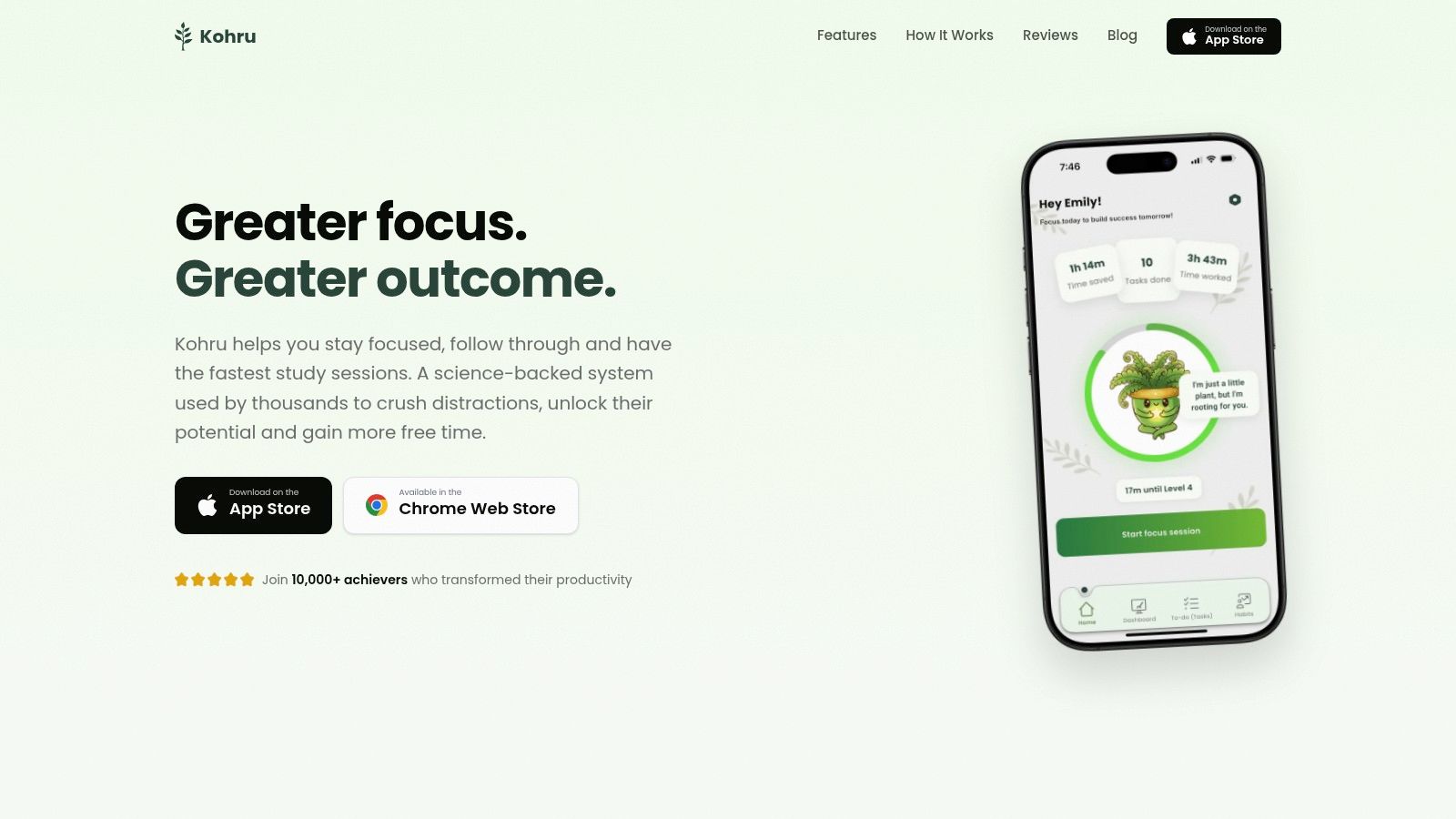
Kohru offers one-click Focus Sessions, with phone app blocking and a browser extension that blocks distracting websites on your laptop. It synchronizes the session across both devices, so you don't secure one screen while leaving the other open as an escape route. You can choose a custom session duration, difficulty mode, and scheduled breaks.
That cross-device part matters. Research on smartphone distraction distinguishes external interruptions, such as notifications, from smartphone vigilance, the habit of monitoring or thinking about your phone. Both patterns were associated with greater mental effort and poorer learning performance, and hiding notifications may not be enough if your phone remains within reach (study of smartphone distraction in learning). Put access behind a barrier during the block instead of asking yourself to resist every alert.
Set up the session before you begin: select one task, decide what you'll produce, and choose a duration that feels manageable. If you need a break, schedule one rather than opening a feed by reflex. Use the block to protect the study period, not to make the session longer than you can sustain.
Use Retrieval and Spacing Instead of Rereading
Rereading can make a topic feel familiar without preparing you to explain it on a quiz. Use retrieval practice instead: study a small topic, put your notes away, and recall the key ideas from memory. Then check your answer and revisit what you missed after a delay.
A meta-analysis of 242 studies, 1,619 effects, and 169,179 participants rated practice testing and distributed practice as high-utility techniques, with an overall mean effect size of 0.56. A separate review found 49 effect sizes across 5,374 participants, and 57% of experiments reported medium or large benefits from retrieval practice (review of retrieval and spacing research). A 2013 review also rated practice testing and distributed practice highly, while rereading and highlighting received lower utility ratings (review of common learning techniques).
Use this simple loop:
- Study one small topic until you understand the basics.
- Close your notes and write or say what you remember, or answer practice questions.
- Check your work against the material and mark errors.
- Return to missed items later instead of spending all your time reviewing familiar material.
For a biology exam, review one concept, close the textbook, and write down what you remember about cell division. Check the sequence against your notes, mark missing steps, then make flashcards for those gaps. Schedule later attempts after 1 day, 3–4 days, and 1–2 weeks to spread practice across separate sessions rather than cramming it into one sitting.
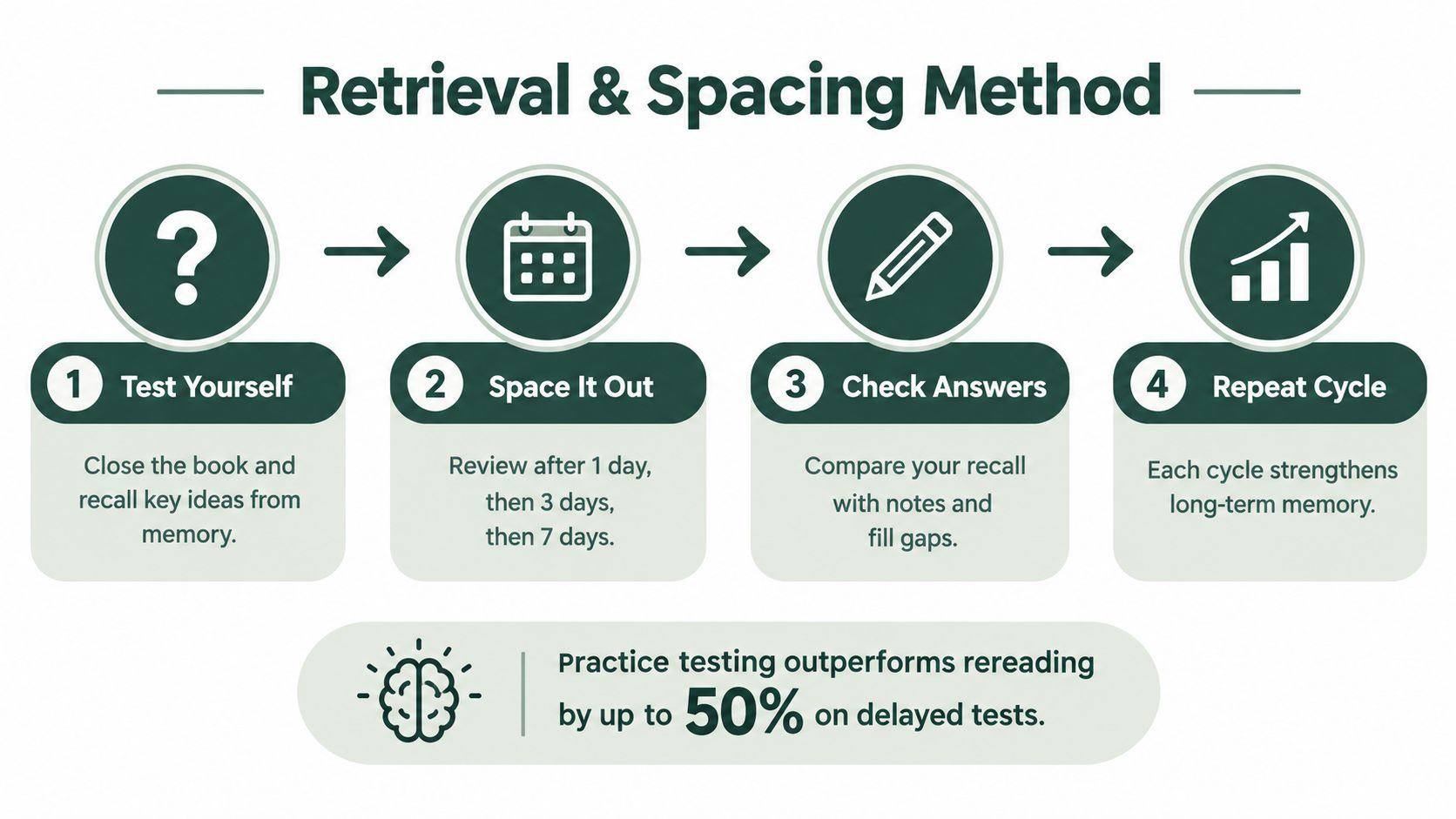
Give the work a clear boundary: spend a short time reviewing, most of the session testing yourself, and the remaining time checking mistakes and recording what to revisit. Recalling information strengthens learning, as explained in this overview of testing effect psychology.
What to Do When You Are Exhausted or Behind
When you're behind, the instinct is often to stay up later and add more hours. That can be a bad trade. A 2025 research synthesis reported that roughly eight hours of school-night sleep was most strongly associated with better test performance, particularly in mathematics and science and especially among lower-attaining students; homework and evening device use were linked with shorter sleep (2025 research synthesis on learning).
Treat the situation as triage. Protect enough sleep to think clearly, choose a small recall task, and remove the digital interruption most likely to derail it. One page of remembered notes or a small set of flashcards is a more useful start than an ambitious plan you won't begin.
Use this check when you're tired:
- You're rereading without being able to explain the idea: Close the material and try a low-stakes recall question.
- You're working late because the task keeps expanding: Set a concrete stopping point and protect your sleep.
- You keep switching to a particular app or site: Block that specific distraction during a short session.
- Your answers are getting less accurate as you push on: Stop, note what to review next, and return after rest.
Don't confuse time at a desk with learning. If you're too exhausted to retrieve anything useful, a longer session won't fix the underlying problem. Scale down the task, keep the block focused, and preserve the recovery that helps you use what you studied.
When the Problem Is Executive Dysfunction Not Laziness
Some students know what to do but can't start. Others start, then lose the thread, or finish a session only to forget the assignment that comes next. Those are different bottlenecks. “Try harder” doesn't tell you which one you're dealing with.
Consider a diagnosed undergraduate who understands the coursework but delays opening it. A two-minute entry task, such as opening the assignment and reading the first prompt, plus a visible written cue may help make the start more concrete. If distractions break focus once work begins, changing the environment and restricting access to distracting apps may be more useful than adding another reminder.
Now consider an adult learner who begins reliably but forgets deadlines and study materials. External reminders, written instructions, and a prepared checklist may address the core obstacle better than a longer timer. If performance remains inconsistent across classes or everyday tasks, accommodations or clinical support may be appropriate. The tool should fit the difficulty, not replace support.
A 2025 review found that ADHD symptoms, especially inattention, are associated with lower college academic performance, while executive functioning, study strategies, medication, and environmental supports also influence outcomes. A qualitative review of adults with ADHD identified practical supports including alarms, written instructions, external structure, distraction removal, planned breaks, and accountability (review of ADHD and academic support). A blocker can be one piece of that system, not the whole solution. For parents or learners looking for more background on executive-function challenges, Children Psych's guide for parents offers a related resource.
Your 7-Day Starter Routine and Common Questions
A routine earns its place when it gets you to start, helps you produce useful work, and makes it clear what to change when you stall. Keep the first week simple. Use the same study cue, choose concrete tasks, and match your fix to the obstacle.
| Day | Focus |
|---|---|
| Day 1 | Write one if-then plan. Choose a specific task, start a 25-minute Focus Session, and answer retrieval questions instead of rereading. |
| Day 2 | Choose a topic you studied and schedule later retrieval practice. Put the review dates in your calendar or task list. |
| Day 3 | Check whether evening device use or late studying is cutting into sleep. Set a realistic stopping point. |
| Day 4 | Identify the main blocker: starting, distraction, remembering the task, staying focused, or exhaustion. Change the plan to address it. |
| Days 5–7 | Repeat the same cue and task structure. Keep tasks concrete, revisit missed material, and extend the routine only if it is working. |
Measure progress by completed starts and useful outputs, not hours spent at a desk. Practice testing and spaced review are stronger choices than relying on rereading or highlighting alone, as noted earlier. Use the study time you have set aside to retrieve information and return to it after a delay.
Common questions
How long until studying feels less effortful?
Do not wait to feel motivated. Repeat the same cue and small starting action, then judge the routine by whether you began and produced something concrete. If the plan keeps failing, change the cue or make the first task smaller.
What if the timer goes off while I'm in the middle of a problem?
Finish the immediate step if you can do so without letting the session stretch indefinitely. Write down where you stopped, then take your planned break or schedule another focused block. The aim is a repeatable routine, not forcing every task into one sitting.
Can I use Kohru for group study?
Yes, when everyone has a clear shared task, such as quizzing each other or comparing explanations. Agree on what you will produce before you start. Keep the work period focused, then use the scheduled break to talk.
What if motivation suddenly comes back?
Use that energy to begin, not to overload your schedule. Complete the planned task, and extend the session only if your attention and work quality remain steady. Motivation can help you start, but a repeatable cue gives you a more dependable way to begin.
Today, write one if-then plan and choose the first question you will answer. Kohru can block distractions on your phone and laptop at the same time, helping protect the study block you planned. Choose a task, set a session that fits your day, and visit Kohru to get started.
