At 9 p.m., the document is open, the deadline is tomorrow, and you're still “getting ready to start.” Your phone is beside the keyboard, a dozen distracting tabs are open, and the vague promise to work later has already failed. This is the moment when most productivity advice becomes useless. You don't need another inspirational quote. You need a system that makes the next action obvious and escape harder.
Time management for procrastinators works when it addresses the exact point where you fail. Do you struggle to start, estimate, sustain attention, or finish? The answer determines the intervention. Kohru is an app built for students that helps block distractions on your phone and laptop at the same time, giving you a protected work window instead of asking you to rely on motivation.
Table of Contents
- The 9 p.m. Panic and a Smarter Way Out
- Why Procrastination Is the Norm and Willpower Is Not the Fix
- Turning Vague Intentions into If-Then Triggers
- Diagnosing Your Moment of Failure Before Picking a Method
- A Weekly Template That Survives Real Life
- Three Myths That Quietly Ruin Procrastinator Productivity
- Your First Seven Days and a Personal Checklist
The 9 p.m. Panic and a Smarter Way Out
A half-written essay creates a particular kind of panic. You know the assignment matters, but the task feels too large to enter. You check messages, search for unrelated information, tidy your desk, and tell yourself that you'll begin after one more break. The short-term relief feels useful, but the unfinished work remains exactly where it was.
Kohru lets you start one Focus Session and block selected distracting apps on your iPhone while also blocking selected websites and apps on your laptop. That matters for students because study often moves across both screens. A phone-only blocker leaves laptop distractions available, while a laptop-only restriction leaves social apps within reach.
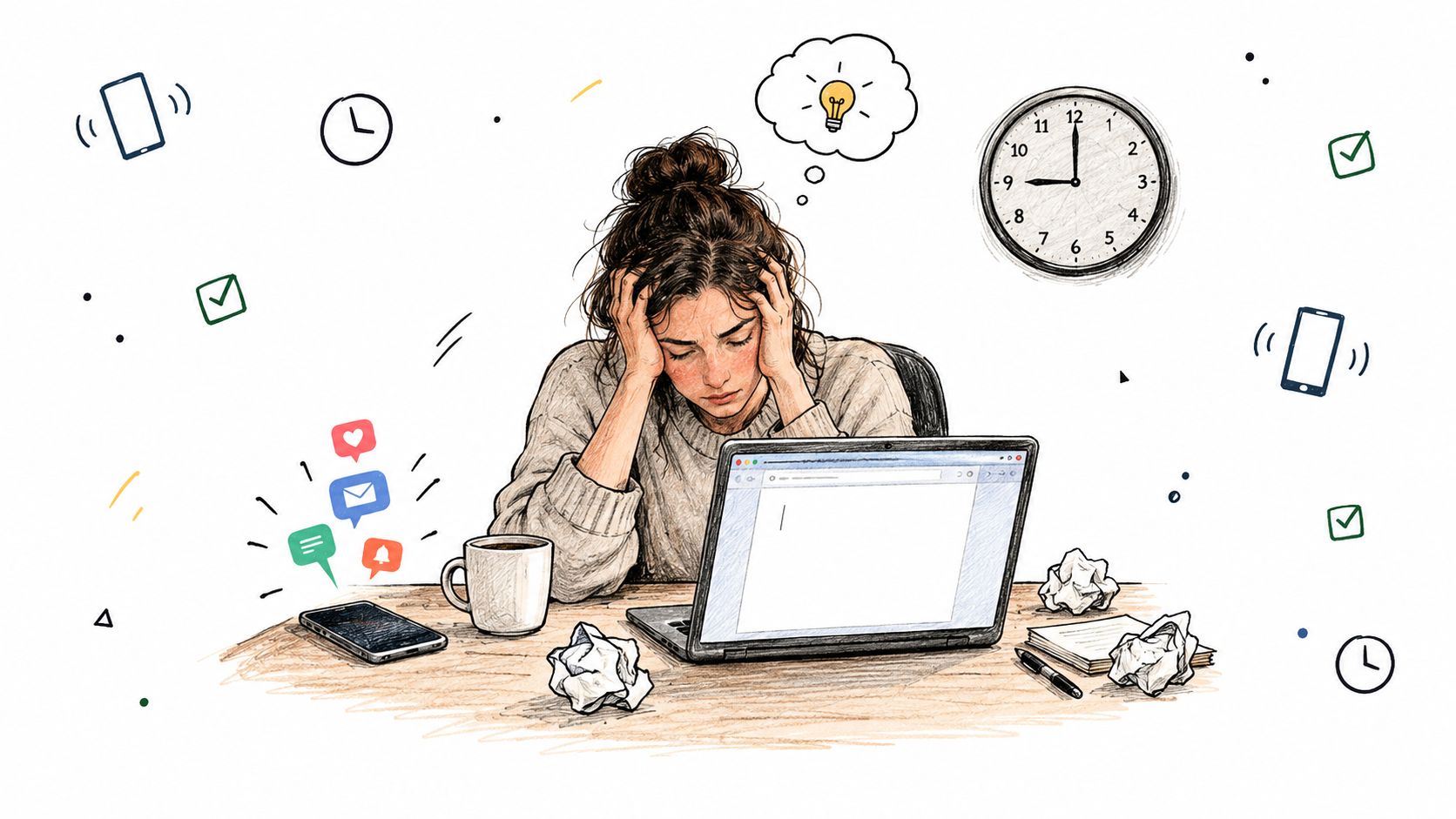
The tool isn't the whole solution. It becomes useful when you connect it to task design, weekly planning, trigger-based habits, and honest review. You choose a small action, attach it to a reliable cue, schedule a protected block, then remove the digital exits that usually interrupt the first few minutes.
A 2021 meta-analysis of 158 studies found that time management was strongly and negatively related to procrastination in school settings, and some included experimental studies demonstrated a causal effect of time-management interventions on reducing delay (the meta-analysis in Studies in Higher Education). Planning matters, but only when planning changes what you do at the moment resistance appears.
Practical rule: Don't plan to “study.” Plan the first visible action, then protect the time in which you'll perform it.
This article uses four failure points: starting, estimating, sustaining, and finishing. You'll build three habits around them: trigger-linked task design, protected weekly focus blocks, and a weekly progress review. The aim isn't to create a perfect schedule. It's to make work easier to enter and harder to abandon.
Why Procrastination Is the Norm and Willpower Is Not the Fix
Procrastination is widespread in higher education. A 2013 review reported that approximately 20–25% of the general population procrastinates, while as many as 70% of university students identify as procrastinators and about 50% procrastinate consistently and problematically (the review in European Psychologist). Other figures in the literature place college-student procrastination between 70% and 95%, depending on the definition, sample, and measurement method.
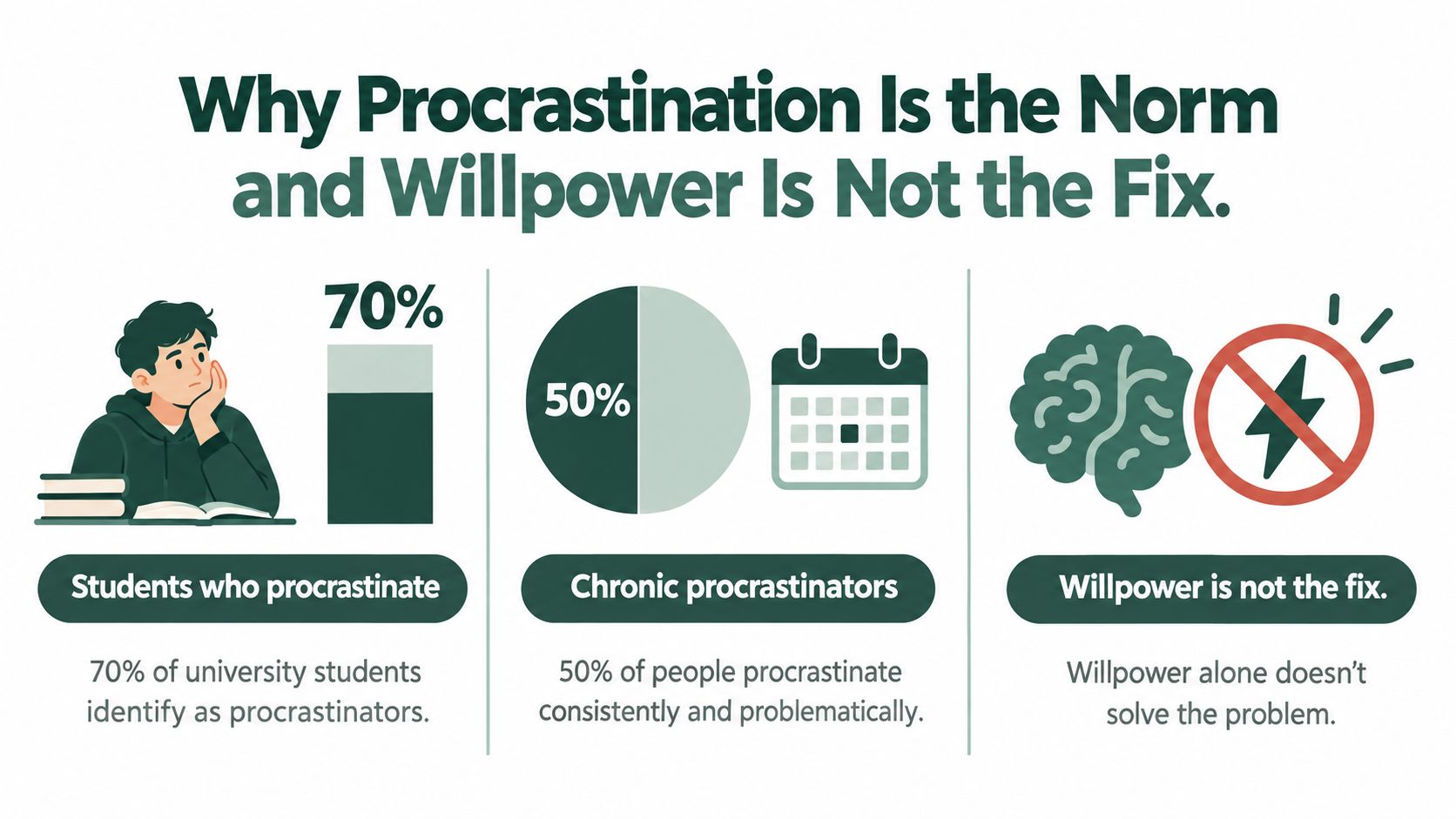
That doesn't excuse missed work. It does correct the diagnosis. You aren't uniquely lazy, defective, or incapable of managing a calendar. Students often spend the time intended for studying, writing, or exam preparation on avoidance, then compress the work into a stressful final period. A useful system must address repeated behavioural delay, not just add more tasks to a list.
Procrastination also differs from ordinary disorganisation. Disorganisation means you may not know what belongs where or when it is due. Procrastination often means you know the deadline and the next step, but the task produces dread, boredom, confusion, or self-doubt. Delay regulates that feeling briefly, even though it creates a larger problem later.
Identify the failure point
Ask yourself four blunt questions:
- Starting: Do you stare at the task before opening the file?
- Estimating: Do assignments routinely take far longer than expected?
- Sustaining: Do you reach for your phone shortly after beginning?
- Finishing: Do you polish minor details instead of submitting or moving on?
Willpower-only advice fails because motivation fluctuates precisely when an aversive task appears. External cues, prepared materials, environmental restrictions, and pre-committed work blocks reduce the number of decisions you must make under pressure.
For additional guidance on attention-related procrastination, see this practical ADHD focus guide. The important distinction is that ordinary procrastination and clinically significant impairment aren't identical. If distractibility and task-initiation problems affect many areas of life, professional assessment may be appropriate.
The first intervention is simple: stop asking whether you feel ready. Create a cue that tells you what to do.
Turning Vague Intentions into If-Then Triggers
“I should study tonight” is not a plan. It has no observable action, no location, no start signal, and no protection against interruption. An implementation intention turns it into a rule that connects a situation to a behaviour.
Use this protocol:
- Define one visible task. Write “draft the introduction's first 150 words,” not “work on the essay.”
- Choose when and where. Specify the time and location, such as the library desk after your afternoon class.
- Write the if-then rule. Use: “If it is 9:00 a.m. and I am at my desk, then I will write for one protected session.”
- Prepare the environment. Open the required document, collect sources, charge your laptop, and remove predictable distractions.
- Record the outcome. Mark whether you kept the appointment. If you missed it, change the cue or reduce the task size instead of writing a harsher plan.
A psychology student facing an essay might write: “If I finish breakfast and sit at my desk, then I will open the essay document and write the first paragraph.” That is stronger than “work on my thesis,” because the behaviour begins with an action you can see. “Open the dataset and label five rows” is executable. “Make progress on research” is not.
In a study of 152 university students, participants who formed implementation intentions were nearly eight times more likely to keep their scheduled appointments than those who did not. Self-reported low procrastinators attended at a rate of 49.4%, compared with 30.1% among high procrastinators (the implementation-intention study). External cues outperform a vague appeal to motivation.
Make the trigger enforceable
When the cue fires, don't negotiate. Open Kohru, select the task, and start a Focus Session. The iPhone and laptop restrictions then match the intention, so the environment supports the decision you already made.
Copy these templates:
- Study: If __________ happens at __________, then I will __________ for one protected session.
- Admin: If __________ happens at __________, then I will open __________ and complete __________.
- Creative work: If __________ happens at __________, then I will make __________ before checking messages.
Keep the first action small enough to begin immediately. The aim isn't to promise heroic effort. It's to create a reliable entrance.
Diagnosing Your Moment of Failure Before Picking a Method
Stop asking whether Pomodoro or time blocking is the superior method. They solve different problems. A timer can help you sustain attention, but it won't necessarily help you decide what to do. A calendar can reserve time, but it won't make an intimidating task easier to start.
Diagnose the breakdown first.
| Moment of failure | Symptom | Best countermeasure | Kohru-supported action |
|---|---|---|---|
| Starting | You avoid opening the task | Use a tiny first action and a clear cue | Begin a Focus Session immediately after the trigger |
| Estimating | Work repeatedly takes longer than expected | Compare predictions with completed sessions | Set a realistic session length and review the result |
| Sustaining | You switch to messages or websites | Remove competing stimuli and use accountability | Block selected phone apps and laptop websites |
| Finishing | You keep polishing or avoid submission | Define a visible finish line and closing ritual | End the session when the stated deliverable is complete |
Starting is an access problem
If you spend ten minutes staring at a blank document, don't schedule more time. Shrink the entry point. Open the file, write a rough heading, label the first source, or list the questions the assignment must answer. Then use an external restriction to prevent the usual escape route.
Estimating is a feedback problem
If you routinely expect a chapter to take one hour and it takes much longer, your calendar is built on optimism. Record what you planned and what you completed. Use that history to create future blocks, rather than punishing yourself with an overloaded schedule.
Sustaining and finishing are separate
A person can start easily and still lose attention quickly. Another person can focus for hours but refuse to submit because the final version feels exposed. Use bounded sessions for sustaining, then define the finish line in advance. “Revise the conclusion and export the document” is a finish line. “Make it perfect” is an invitation to continue indefinitely.
Students with ADHD may face a different bottleneck. A 2025 study found that students with ADHD had significantly higher procrastination scores than peers and identified task breakdown, short targets, realistic planning, location choice, distraction reduction, and social study as useful supports (the ADHD and procrastination study). That points toward executive-function support, not a lecture about discipline.
Use flexible weekly goals if strict daily schedules create repeated failure. Add social study when isolation makes starting harder. Choose a location that supplies structure. The right system matches the bottleneck instead of forcing every person into the same method.
A Weekly Template That Survives Real Life
Build the week around outcomes, not an enormous list of intentions. Use a short Sunday planning ritual to decide what deserves protected attention before the week fills with appointments, shifts, errands, and messages.
The planning ritual
Write the week's three priority outcomes. Then break each outcome into three to five sub-goals, a level of decomposition that a 2025 employee study found more effective than either minimal or highly granular breakdowns, especially for creative work, while also finding a positive relationship between digital-distraction frequency and procrastination (the employee study).
Schedule two to four focus sessions across the week, with each session lasting long enough to make meaningful progress without filling every available minute. Reserve a half-hour contingency slot for spillover. If one block runs late, the entire week shouldn't collapse.
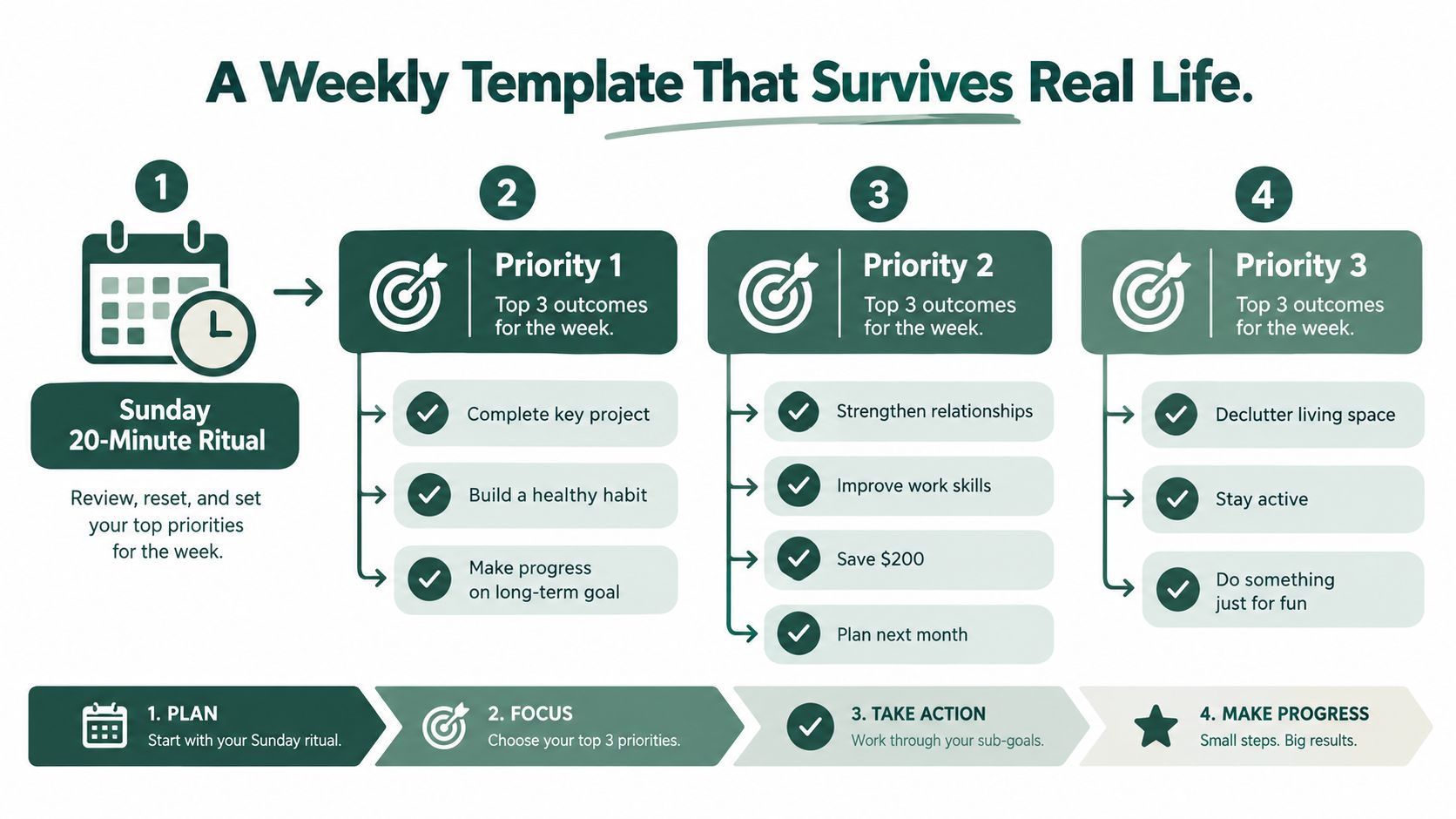
Inside each scheduled block, choose one sub-goal and start a Kohru Focus Session. The phone app can block selected distracting apps through iOS Screen Time, while the browser extension blocks selected websites on the laptop during the same session. Stop when the session ends or when the defined deliverable is complete. Don't turn every block into a test of endurance.
Flexible weekly targets beat fragile daily streaks for many procrastinators because a missed day doesn't automatically become a failed identity. Track whether you completed the planned sessions, then adjust the next week. For broader support with balancing competing responsibilities, this advice for better time balance offers another useful planning perspective.
A realistic week for a final-year student might look like this:
- Monday: Thesis sub-goal, outline the chapter argument during one protected session.
- Tuesday: Part-time shift, no major academic block.
- Wednesday: Exam revision, complete a defined set of practice questions.
- Thursday: Contingency slot for unfinished thesis work.
- Friday: Thesis sub-goal, draft one section.
- Weekend: Review notes, prepare the next week's three outcomes, and avoid scheduling every free hour.
This plan leaves room for employment, recovery, and imperfect days. That isn't a weakness. It's what makes the system usable.
Three Myths That Quietly Ruin Procrastinator Productivity
Myth one, more planning creates more productivity
Planning can become a polished form of avoidance. You reorganise lists, colour-code calendars, and divide a project into tiny fragments, but never create a protected period in which the difficult work happens.
Use moderate decomposition instead. Define a meaningful sub-goal, identify the next visible action, and leave contingency space. Overfilled calendars create a chain reaction: one delay pushes every later task into a crisis.
Myth two, daily streaks are the best measure
A daily streak rewards consistency, but it can punish recovery. Miss one day and you may decide the whole system is broken, then avoid reviewing what happened.
Measure planned sessions against completed sessions across the week. A flexible target gives you room to recover without pretending that missed work doesn't matter. Review the cause, not just the count. Did the task start too large? Was the trigger vague? Did notifications remain available?
Myth three, multitasking helps you get started
Multitasking feels easier because you can avoid committing fully to one difficult task. It also keeps digital interruptions within reach. The employee research cited above found that creative tasks were more vulnerable to digital-distraction-driven procrastination than transactional work, which makes this especially relevant to essays, design, research, and other ambiguous projects.
A single Focus Session is a better unit of work. Choose one deliverable, block the selected phone apps and laptop websites, and keep a capture note for unrelated thoughts. You don't need to solve every idea immediately. You need to stay with the task long enough to produce something concrete.
A meta-analysis of 12 randomised controlled trials comprising 646 participants found a large overall effect of cognitive-behavioural time-management interventions, with stronger effects for in-person delivery, student samples, and no-treatment comparison groups (the intervention meta-analysis). That supports structured intervention, not endless planning.
Your First Seven Days and a Personal Checklist
Give yourself a small launch challenge. Choose one priority outcome, break it into three to five sub-goals, and schedule two Focus Sessions during the coming week. Install Kohru on your iPhone and add its browser extension to your laptop before the first session, so setup doesn't become another reason to delay.
At the end of the week, review without self-judgement. Keep what worked, change what failed, and make the next task smaller or the cue more reliable. The review is not a verdict on your character. It's information for designing a system that fits your attention, schedule, and responsibilities.
Screenshot this checklist
- Diagnose the bottleneck: Decide whether you struggle most with starting, estimating, sustaining, or finishing.
- Write one trigger: Create an if-then rule for every planned session.
- Define the deliverable: State what must exist when the session ends.
- Protect both screens: Block distracting apps on the phone and selected websites on the laptop.
- Use weekly targets: Track planned and completed sessions instead of relying only on daily streaks.
- Review: On Sunday, identify the obstacle and revise the next plan.
Kohru's role is specific. It supplies the cross-device enforcement layer between task design and execution. Starting a Focus Session in the iOS app blocks selected distracting apps through iOS Screen Time, while the browser extension simultaneously blocks selected websites on the laptop until the session ends (Kohru's browser extension). That answers the practical question procrastinators face: how do you keep an intention alive when both the phone and laptop are within reach?
Run the first session before you feel ready. Start with one sub-goal, one cue, and one protected block. Motivation can arrive later. Your job is to make beginning possible.
Kohru gives you one-click Focus Sessions that block selected distractions across your iPhone and laptop, helping turn a vague intention into a protected period of work. Visit Kohru, set up your first session, and use it today for the task you've been avoiding.
