Getting better at your work isn't about grinding harder — it's about protecting your attention. Cut the noise, pick one thing that actually matters, and give it your full focus.
Table of Contents
- The Real Path to Better Work Performance
- The Fastest Ways to Improve Work Performance
- Plan Before the Day Gets Noisy
- How to Choose the Right Focus Session Length
- Protect Your Momentum
- Design Habits That Survive Busy Weeks
- Match Effort to Your Energy
- Review Results and Adjust Your System
- Fix Distractions and Reactive Communication
- How Quickly Can Focus Improve?
- What Helps When Working From Home?
- Can Students and Professionals Use Kohru?
- How Does Kohru Improve Work Performance?
The Real Path to Better Work Performance
Constantly jumping between tasks makes it nearly impossible to sink into meaningful work. As Pipefy's guide to improving work performance points out, focusing on high-impact tasks, ditching multitasking, and reducing distractions are some of the most practical ways to get more done.
That's where Kohru fits in. Built for students, Kohru is an app that blocks distractions on your phone and laptop at the same time, creating a quieter environment for studying, writing, or tackling demanding assignments.

The screenshot shows a focused work setup with notification icons disabled, illustrating how fewer interruptions can support better concentration.
The fastest productivity win is often removing interruptions before adding more effort.
The Fastest Ways to Improve Work Performance
Here's a quick breakdown of the biggest levers you can pull right now, why each one matters, and what to do first.
| Performance Lever | Why It Matters | First Action |
|---|---|---|
| Clear priorities | Keeps effort connected to meaningful results | Choose one important outcome |
| Fewer distractions | Protects mental continuity | Silence nonessential alerts |
| Focused sessions | Turns intention into finished work | Reserve a defined block |
| Recovery | Prevents declining quality | Take a real break |
Let's make this concrete. Say you're a student working on a research paper. Instead of telling yourself "work on my paper" — which is vague and easy to drift away from — you pick "finish the introduction." During that session, Kohru blocks distracting apps and sites across both your phone and laptop, so a text message or a tempting browser tab doesn't pull you off track.
That's what makes Kohru a practical answer to how to improve work performance: it makes focused work easier to start and interruptions harder to follow. The goal isn't to be busy every minute. It's to make steady progress on the work that actually counts.
Plan Before the Day Gets Noisy
Once you've picked your meaningful outcome and defined that first small action, the real work is protecting your attention before the day turns reactive. Spend five minutes planning before you open email or messages. Write down your main outcome, two supporting tasks, and the first action you'll take. This simple ritual gives urgent requests less power over your schedule.
When your list feels crowded, run it through a quick filter:
- Important and demanding: Reserve your best focus period for these.
- Necessary but simple: Group them into an administrative block.
- Useful but optional: Move them to a later list.
- Unclear: Rewrite them as a concrete action.
For example, replace "prepare presentation" with "choose three points for slide one." Clear actions make progress easier to see and make starting less intimidating.
A good work system doesn't depend on constant willpower. It makes the next useful action obvious and distractions inconvenient.
Your environment matters too. Keep only the materials needed for the current task visible, and prepare water or a snack before a long session. If afternoon energy regularly drops, these ideas can help you beat the afternoon slump at work. Then begin with one protected task, rather than trying to manage everything at once.
Focused work turns a clear priority into visible progress. Rather than pushing until you're exhausted, choose a defined period and match it to the task. A short burst suits email or simple administration, while a longer block gives a report, study chapter, or complex project room to develop.
Kohru is built for students and helps block distractions on your phone and laptop at the same time. That matters when a student studies with lecture notes open on a computer and messages arriving on a phone. One click creates a quieter session across both devices.
This infographic visualizes how task difficulty connects with session length, break timing, and the kind of work each block supports. Its main insight is simple: the best timer depends on the work, not on a universal productivity rule.
How to Choose the Right Focus Session Length
Not every task deserves the same amount of uninterrupted time. Matching your session length to the complexity of the work makes a real difference in what you actually accomplish. Here's a practical breakdown:
| Session Length | Best For | Break Guidance |
|---|---|---|
| 15–25 minutes | Email, admin, and simple tasks | 5 minutes |
| 45–60 minutes | Reports, deep study, and creative problem-solving | 10 minutes |
| 90–120 minutes | Complex projects requiring sustained thought | 20 minutes |
The shorter blocks work well for tasks that don't require you to load a lot of context into your head. Once you're doing something that demands real concentration, you need longer stretches to get into flow and stay there.
Protect Your Momentum
Before starting, write one outcome for the session, such as "draft the report introduction" or "solve ten practice problems." If a distraction appears, record it on a capture list instead of acting on it. This lets you return to the task without trusting yourself to remember the interruption.
The screenshot shows Kohru supporting a distraction-free focus setup, illustrating how one protected session can keep attention on the current task. That makes Kohru a practical answer to how to improve work performance when multiple devices compete for attention.
Protect the session first; productivity follows from fewer decisions and interruptions.
When the block ends, take the planned break away from the screen. Repeating this cycle builds mental stamina and turns focused work into a dependable routine.
There's a reason high performers talk about recovery as much as effort. Push through too many long hours and you'll notice it — slower thinking, careless mistakes creeping in, that foggy feeling where nothing quite clicks. Figuring out how to improve work performance isn't just about doing more; it's about building routines you can actually sustain without running yourself into the ground.
Kohru is designed with students in mind, and one of its most useful features is the ability to block distractions across your phone and laptop simultaneously. Between habit tracking and customizable break systems, it helps you maintain a steadier pace — especially when your schedule shifts between assignments, freelance gigs, or irregular work shifts.
Design Habits That Survive Busy Weeks
Here's the thing about rigid daily streaks: one bad day and the whole thing falls apart. Weekly targets are far more realistic. A student might aim for four focused study sessions across the week. A freelancer might set a goal of hitting two client milestones by Friday. The flexibility makes it stick.
Try building a simple cue-routine-reward loop:
- Cue: Open your project and launch Kohru before you even glance at your messages.
- Routine: Work through your planned session, then actually step away for a break.
- Reward: Log the session or do something small and screen-free that feels like a treat.
Say you're a student coming back from lunch. Clear your desk, fill up your water bottle, and start a 45-minute revision block. That same starting sequence, repeated enough, removes the mental friction of deciding what to do next. You just begin.
A sustainable routine is one you can restart after a difficult day, not one that demands perfection every single day.
Match Effort to Your Energy
Not all hours are created equal, and pretending they are wastes your best thinking. Put your hardest work into whatever window feels sharpest. For a lot of people that's the morning — writing, analysis, tough study material all go there. Save the low-energy stretches for email, admin tasks, and filing.
During a workday, take short recovery pauses before you feel drained. Stand up, look away from the screen, stretch, or walk around for a few minutes. Just don't fill every break with more scrolling — that tends to scatter your attention rather than restore it.
Kohru's break settings make recovery a built-in part of each session rather than something you remember only after you're already exhausted. The trick is stopping while you still have enough left to come back tomorrow. That's what keeps a productive week from sliding into burnout.
Try this today: pick one weekly target, figure out which hour of the day you're at your sharpest, and block out a protected Kohru session with a planned break built in. That simple combination is genuinely how you improve work performance over the long haul.
Measuring progress should clarify your work, not pile on another chore. If you're trying to figure out how to improve work performance, narrow your focus to just a few signals: focused minutes, meaningful tasks completed, and deadlines moved forward.
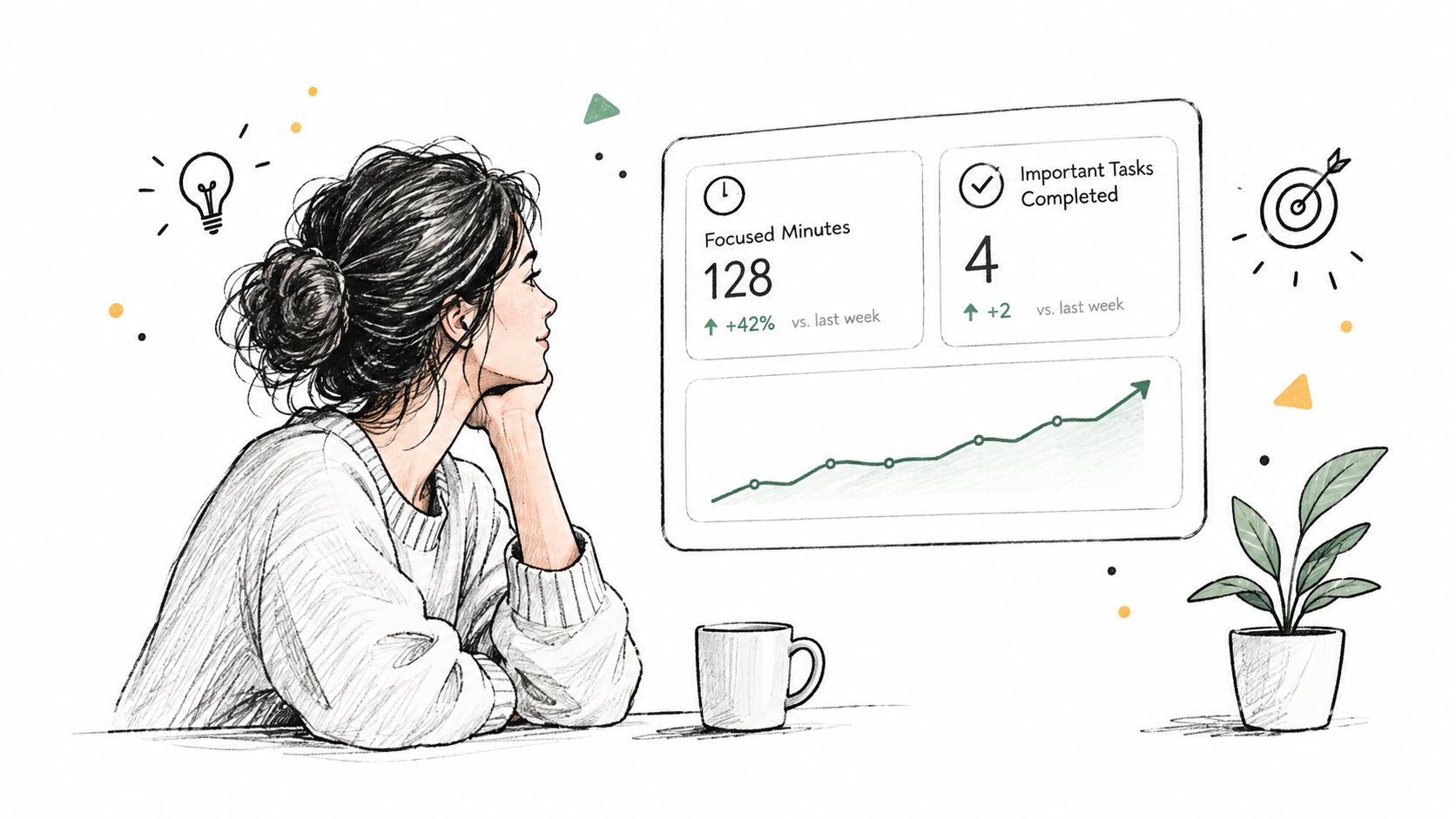
Kohru helps students and professionals review this information quickly. Its dashboard shows focus time saved, completed tasks, and streaks, while Kohru blocks distractions on your phone and laptop at the same time. That makes it easier to connect protected attention with real results.
Use tracking as a compass, not a scoreboard.
At the end of each week, ask yourself:
- Did focused minutes increase?
- Did important work move closer to completion?
- Which sessions produced the best-quality results?
- When did concentration consistently weaken?
A student might discover that two 45-minute sessions before lunch produce better revision than three distracted evening hours. A remote professional may notice that writing improves when messages are handled after, not during, the main work block. Use those patterns to adjust session length, task size, or your environment.
Review Results and Adjust Your System
Outcome quality matters more than checking dozens of shallow items. If a completed task doesn't support an important goal, it may be activity rather than progress. Kohru's weekly targets and dashboard help you notice that difference without demanding constant logging.
The same principle applies outside work. If you track physical progress, how to track strength training offers a useful example of choosing meaningful measures instead of recording everything.
Keep your weekly review to ten minutes. Choose one change for the next week, such as starting earlier, shortening afternoon sessions, or blocking notifications before opening your project. Small evidence-based adjustments make sustained performance easier.
Even a solid plan falls apart when distractions, fuzzy priorities, or oversized tasks take over. If you're busy all day but never finish anything that matters, pick one visible outcome and shrink it down to something you can actually start. "Draft the opening paragraph" works far better than "work on the report."
Tasks that feel heavy often become manageable once you lower the starting barrier. Set a timer for 15 minutes, then decide whether to keep going. When random thoughts pop up during that window, jot them on paper instead of switching tabs.
Fix Distractions and Reactive Communication
Constant phone checking usually means your environment needs stronger boundaries, not that you need more willpower. Kohru, built for students, blocks distractions on your phone and laptop at the same time, giving you external structure while you study or work.
Instead of reacting to every notification, set specific windows to check messages. Try 11:30 a.m. and 4 p.m., and guard your most demanding work block like it matters.
- Close unrelated tabs before you start.
- Batch all communication tasks together.
- Keep a short "later" list for tempting ideas that pull you off track.
Consistency means returning to the system after disruption, not completing every day perfectly.
When a meeting or urgent request wrecks your schedule, reset with one small task instead of writing off the whole day. A student can knock out five practice questions. A professional can revise one section of a proposal.
This is the practical answer to how to improve work performance: reduce friction, protect attention, and restart quickly. Try a Kohru session during your next difficult task, then notice what changed.
How Quickly Can Focus Improve?
Most people start noticing a difference within a few days of consistently blocking distractions. The key is to commit to one defined work session, then honestly review afterward: did you get more meaningful work done? Were you interrupted less? That simple feedback loop tells you more than any productivity metric.
What Helps When Working From Home?
Working from home blurs the line between personal and professional life fast. A few things that actually help:
- Create a dedicated workspace, even if it's just one corner of a room. Your brain needs a physical cue that says "work mode."
- Silence nonessential notifications. Not mute — silence. There's a difference.
- Schedule message checks instead of responding continuously. Batch them into two or three windows throughout the day.
Kohru handles the digital side of this by blocking distractions on your phone and laptop simultaneously, which is especially useful when your couch and your desk are in the same room.
Can Students and Professionals Use Kohru?
Yes, and it's not a one-size-fits-all situation. Kohru was designed with students in mind, but it works just as well for professionals juggling multiple projects, remote workers fighting household distractions, and neurodivergent users who benefit from stronger external structure across devices.
The common thread? Anyone who needs help protecting their attention span will find it useful.
How Does Kohru Improve Work Performance?
Here's the practical reality: managing distractions across separate screens is exhausting. You block a site on your laptop, then pick up your phone and scroll anyway. Kohru removes that friction by blocking distracting apps and websites everywhere at once.
That single change makes it easier to enter deep work, finish what matters, and stop searching for abstract answers to "how to improve work performance." You just build a daily system that protects your focus and let the results follow.
Protect your attention first, then measure the work that follows.
Try your next focused session with Kohru and give your most important task the uninterrupted time it deserves.
