Most morning routine advice is performance theater. The 5 a.m. alarm, cold plunge, elaborate journaling stack, workout, meditation, reading, and perfectly prepared breakfast look impressive in a video, but they don't answer the core question: what can you repeat when your morning includes a commute, an early lecture, a child who needs help, or a brain that refuses to initiate?
Morning routine productivity doesn't come from collecting rituals. It comes from protecting one useful block of attention. A routine that fits your sleep pattern, available time, and cognitive state will outperform an aspirational checklist you abandon after a difficult morning.
A 2025 Kantar survey of 1,046 U.S. adults found that 56% typically spend fewer than 5 to 30 minutes on their morning routine, while 90% said their routine sets the tone for mental wellness. CNBC's coverage of the survey highlights the gap between how important people consider their routine and how little time many actually have. The practical answer isn't to squeeze more rituals into the morning. It's to build a system that still works when the morning is short.
Table of Contents
- Why Most Morning Routine Advice Fails You
- Design Your Routine Around Your Chronotype
- Timeboxing Your Morning Into Focus Blocks
- Cue-Based Habit Triggers and Rituals That Stick
- Troubleshooting Mornings That Go Wrong
- Using Kohru to Protect and Track Your Morning Focus
- Your Two-Week Morning Routine Experiment
Why Most Morning Routine Advice Fails You
The popular morning routine narrative confuses early with productive. It assumes that waking before everyone else automatically creates clarity, discipline, and momentum. In practice, an early alarm can just move your tiredness to an earlier part of the day.
Influencer-style routines also hide the work required to maintain them. They assume a quiet home, predictable responsibilities, plenty of transition time, and enough mental energy to make several decisions before the first meaningful task begins. Students have lectures and shared housing. Professionals have commutes and early meetings. Parents have interruptions. People with ADHD may understand exactly what they need to do and still struggle to begin.
A productive routine must solve those conditions instead of pretending they don't exist.
Practical rule: If your routine only works on an ideal morning, it isn't a routine. It's a vacation plan.
The most useful design separates three variables:
- Sleep opportunity: Did you allow enough time for sleep and recovery?
- Circadian preference: Does your body and mind tend to become ready for demanding work early or later?
- Task timing: When does the specific task you need to complete receive your best attention?
Most advice collapses those variables into one command, wake earlier. That shortcut creates unnecessary guilt. It also makes people judge themselves by whether they completed a checklist instead of whether they completed meaningful work.
A better system uses cue-based triggers, timeboxed blocks, fallback versions, and focused-time tracking. You don't need to perform a long sequence before earning the right to work. You need a reliable transition from waking to alertness, a way to choose one priority, and a protected opportunity to make progress.
The test is simple. Design a routine for your actual weekday, run it consistently enough to observe what happens, and adjust the timing or sequence based on your energy and completed work. Testing beats copying. Your morning should serve your responsibilities and attention, not someone else's filming schedule.
Design Your Routine Around Your Chronotype
A productive morning isn't necessarily an early morning. Before choosing a wake time, separate the question of when you wake from the question of when you can think well.
Three variables to keep separate
Sleep opportunity is the foundation. If you shorten sleep to create a supposedly disciplined morning, your routine may reduce the attention it was meant to protect. The relevant question isn't whether you can force yourself out of bed. It's whether your schedule gives you a reasonable chance to be rested.
Circadian preference describes when your body tends to feel naturally alert and ready for demanding work. Some people become focused soon after waking. Others need a slower start. Evening chronotypes may be capable of excellent work later in the day while feeling poorly matched to an early, high-intensity routine.
Task timing concerns the work itself. You might be alert in the morning but better suited to administrative tasks until your mind warms up. Or you may handle email immediately but produce your strongest writing later. Don't assume that alertness and creative performance arrive at the same time.

A 2025 survey of 1,130 U.S. workers found that 52% reported peak performance between 8 and 11 a.m., while 15% reported peak performance after 2 p.m. The survey report from Zety also makes the important limitation clear: preferred productivity windows don't establish that early rising causes better performance. Use the finding as a reminder to observe your own pattern, not as a reason to set an arbitrary alarm.
Run a personal timing check
For a practical starting point, use this chronotype assessment guide to think about your natural timing. Then apply the result to your actual work rather than treating a label as a permanent identity.
For several working days, record:
- When you woke and whether you felt rested.
- When your mind first felt capable of sustained attention.
- Whether your first focused session felt easy, neutral, or forced.
- Which type of task you completed most successfully.
- Your subjective energy after the session.
Look for a pattern. If you work well immediately after waking, place your most demanding task first and keep the opening ritual short. If you need a slow start, use light, movement, washing, breakfast, or a simple household task as a deliberate ramp into focus. If your strongest work arrives later, protect the morning for preparation and place your deepest task in the time window that supports it.
University students, remote workers, and evening chronotypes often need a schedule that doesn't resemble a conventional office morning. A student may use the first available quiet period before class for review, then reserve creative work for later. A remote worker may begin with low-friction planning and schedule deep work after the household settles. The right routine is the one that matches your real attention, not the one that looks most disciplined from the outside.
Timeboxing Your Morning Into Focus Blocks
A routine becomes useful when every activity has a job. Stop asking, “What should I do every morning?” Ask, “What does my available window need to accomplish?”
Build the morning around three blocks:
- Wake and alertness: Use one action that helps you become physically present, such as outdoor light, gentle movement, water, washing, or a brief walk.
- Decision reduction: Choose one priority and remove the need to renegotiate it later.
- Protected focus: Work on that priority without switching to messages, feeds, or unrelated tasks.
The exact duration should match your schedule. A short block completed consistently is more useful than an impressive block that depends on perfect conditions.
Cut rituals that only create control
Some activities improve readiness. Others make you feel organized without moving important work forward. Journaling can clarify a decision, but writing several pages may become avoidance when the priority is already obvious. Planning can reduce uncertainty, but reviewing every task can bury the one item that deserves attention. Checking email can feel productive while placing your attention under someone else's control.
Use a strict test: does this activity increase alertness, reduce a decision, or support the protected task? If it does none of those things, move it later or remove it.
To manage cognitive load effectively, prepare the first task before the morning begins. Write the opening action in concrete terms, such as “open the draft and revise the introduction,” rather than “work on project.” The more specific the start, the less mental energy you'll spend figuring out how to begin.
The visual's three-part sequence is a useful model, but its displayed durations are examples, not universal requirements. Your focus block can be shorter when your morning is compressed and longer when your schedule genuinely allows it.
Adapt the same structure to different lives
A student with an early lecture might use the alertness block while getting dressed and walking to campus. The planning block can happen with a paper card or a phone note, where the student identifies one reading question or assignment action. The focus block might be a quiet review session before class, or a short writing sprint after arriving on campus.
A commuting professional can place the alertness block before leaving home, use the commute for a non-digital mental preview, and begin the protected block after arriving. The planning block should identify the one outcome that matters before opening email. If the first meeting takes over the morning, the protected block moves to the first defensible opening rather than disappearing.
A remote worker has more control but also more opportunities for distraction. A strong setup might be outdoor light, a written priority beside the laptop, and a protected work block before communication tools open. The worker can then assign email and administrative tasks to a separate block instead of allowing them to consume the first usable attention of the day.
| Schedule Type | Available Window | Alertness Block | Planning Block | Focus Block |
|---|---|---|---|---|
| Student with an early class | Before leaving or between campus commitments | Light movement or a short walk | Select one study outcome | Review, solve, or write toward that outcome |
| Commuting professional | Before departure and at the workplace | Wash, dress, and step outside | Identify one work result | Start the highest-value task before reactive work |
| Remote worker or freelancer | Flexible period at home | Light, movement, and a device-free transition | Write the first physical action | Protect the chosen task from digital interruptions |
Timeboxing also gives you a clean stopping point. When the focus block ends, record what you completed and decide whether the next task is administrative, collaborative, or another focused effort. That boundary prevents a morning routine from turning into an unstructured workday.
Cue-Based Habit Triggers and Rituals That Stick
Willpower is a poor trigger. Physical cues are better because they tell you what happens next without requiring a fresh decision.
Attach each routine block to something already present in your morning. After waking, step outside or stand near a bright window. After brushing your teeth, drink from the glass you placed in a visible spot. When you open your planner, write one priority before looking at the wider task list.
The goal isn't to create a flawless chain. It's to connect one physiological cue, one decision-reduction step, and one protected focus block. That is the minimum effective routine. Everything else is optional.
Build the smallest version first
A five-minute version might look like this:
- Physiological cue: Step outside, stretch, or wash your face.
- Decision reduction: Write one priority on paper.
- Focus start: Open the task and complete the first tiny action.
A fifteen-minute version gives you room to slow the transition. Add a brief walk, a drink, or a quick review of the materials you need. Keep the priority visible and begin the protected task before adding anything decorative.
A thirty-minute version can include a fuller alertness block and a short planning review, but it still needs one clear outcome. Don't fill the extra time with more habits just because it exists. Use it to make the focus start easier.
Match the cue to the person
A commuter can place shoes and a jacket beside the door, then make stepping outside the automatic first transition. A parent can keep the routine on a small card near the kitchen and use the first quiet moment to choose a single priority. A shift worker can anchor the sequence to the time they wake rather than to sunrise or a conventional office schedule.
Students often benefit from reducing visual friction. Put the required book, notebook, and pen together before bed. When the cue appears, the first task should already be physically available.
For someone with ADHD-related initiation difficulty, make the start almost embarrassingly small. Put the document on screen, write the first sentence fragment, solve one problem, or set up the workspace without demanding immediate brilliance. A visible timer, a body double, or a prewritten starting instruction can make the transition concrete.
Make starting easier than deciding. The first action should be obvious, visible, and small enough to begin while motivation is still catching up.
Use the routine's short versions without treating them as failures. The five-minute version protects continuity on a chaotic day. The fifteen-minute version restores direction when you have some room. The thirty-minute version supports a calmer morning. All three should lead to the same priority, so you don't need to redesign your day every time your schedule changes.
Troubleshooting Mornings That Go Wrong
Every routine eventually meets a snoozed alarm, a sick child, a surprise meeting, or a mind that won't engage. The failure isn't the disruption. The failure is designing a system that has no response to disruption.
Consider a student who wakes late before an early class. A long checklist is impossible, so the student skips everything and decides the routine has failed. A better response is to use the shortest version: become physically alert, choose one academic priority, and identify the next available focus opportunity after class.
A parent may lose the entire planned morning to a sick child. That day doesn't require a forced productivity performance. The recovery action can be writing down the priority and preparing the first step for the next available opening. A professional facing an unexpected early meeting can move the focus block instead of replacing it with frantic inbox checking.
Diagnose the design, not your character
Three failure patterns appear repeatedly:
- The routine is too long: Remove activities that don't improve alertness, reduce decisions, or protect focus.
- The routine has no fallback: Create short, standard, and spacious versions before disruption happens.
- The routine measures compliance instead of output: Track focused work and completed priorities, not whether every ritual appeared.
An ADHD morning may require a different entry point. Start with movement, a visible task card, or a short co-working session rather than a silent planning exercise. The right question is not “Why can't I follow instructions?” It's “Which part of the start still requires too much initiation?”
Use a recovery rule
After a disrupted morning, follow one rule: resume at the next available opportunity without trying to compensate. Don't double the routine, punish yourself with an unrealistic schedule, or abandon the week because one morning went badly.
Diagnose the failed component. Was the wake time incompatible with your sleep? Was the priority vague? Did the focus block depend on a quiet home? Did a device interrupt the transition? Change the design that broke.
A routine survives because it has a repair path. Flexible weekly targets are more durable than all-or-nothing streaks because they leave room for illness, care responsibilities, travel, and ordinary bad days. Your standard isn't perfect execution. It's returning to the system quickly enough that one disruption doesn't become a permanent exit.
Using Kohru to Protect and Track Your Morning Focus
A morning plan becomes easier to follow when the chosen priority turns directly into a protected work session. In Kohru, add that priority to the Smart To-Do List, keep it in the appropriate Work or Personal area, and convert it into a one-click Focus Session.
Choose a duration that matches your available energy rather than copying someone else's schedule. Kohru can block digital distractions across your phone and laptop, which removes the most common escape route after you open the task. Use the break system when you need a clear stopping point, then return to the same priority or record the completed result.
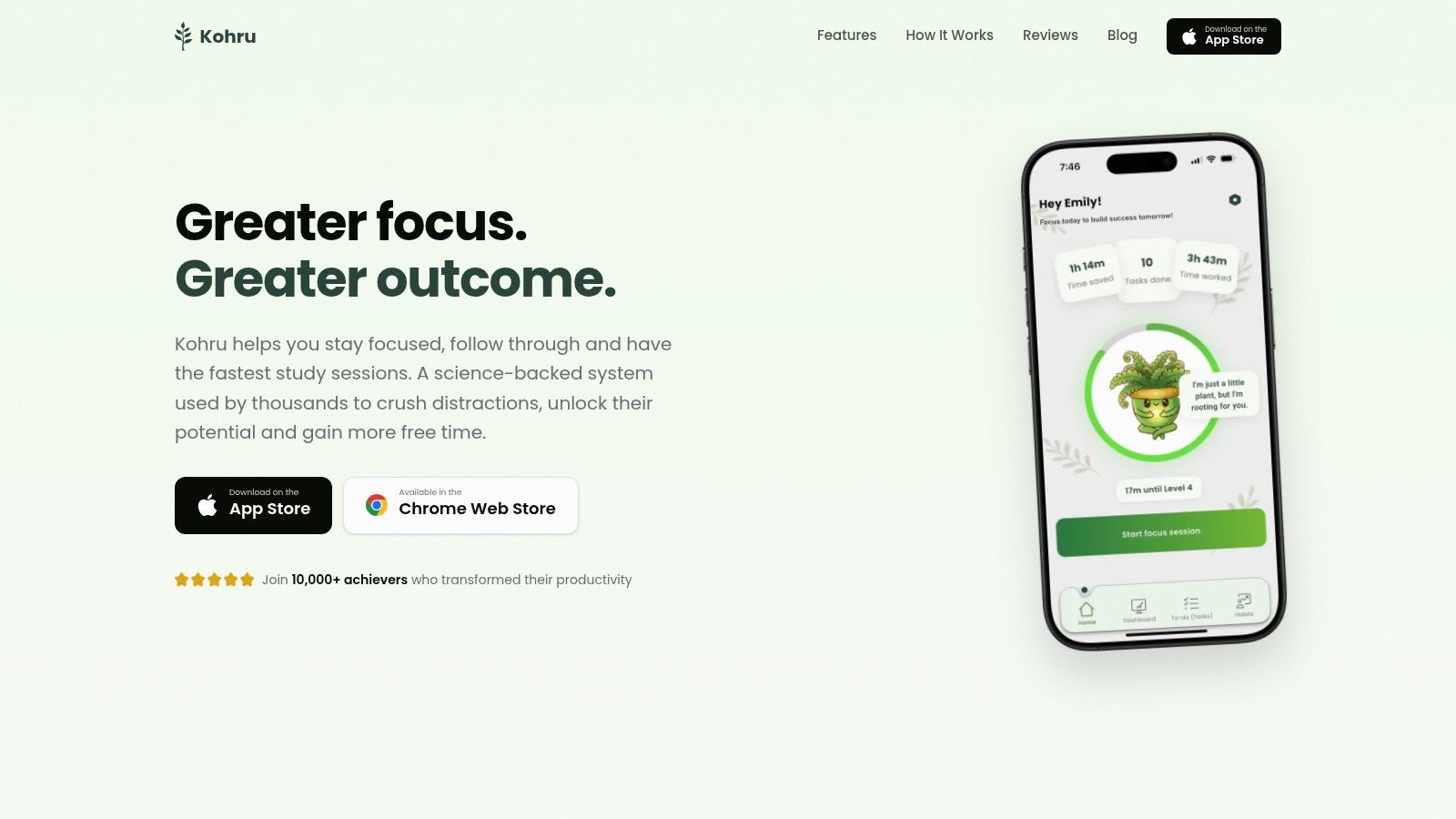
The useful measurement isn't whether you performed a beautiful ritual. It's focused time completed and meaningful tasks finished. Kohru's dashboard gives you a quick view of focus time saved and tasks completed, so you can compare the routine you planned with the work you protected.
Use Habit Tracking for flexible weekly targets instead of treating a missed morning as a broken identity. That structure fits the recovery rule: return at the next opportunity and continue building evidence about what works.
If a warm drink helps mark the transition, make it a cue rather than a productivity requirement. Some people may enjoy preparing ceremonial grade matcha as part of that reset, but the drink isn't the intervention. The valuable sequence is the cue, the single priority, and the protected session that follows.
Your Two-Week Morning Routine Experiment
Run a two-week experiment instead of searching for a permanent routine on the first attempt.
Choose a consistent wake window that fits your obligations. Then select one physical cue, one priority-setting action, and one protected focus block. Keep the sequence stable while recording:
- Sleep length
- Wake time
- Time of the first focused session
- Completion rate for the chosen task
- Subjective energy before and after the session
Use the first week to observe friction. If you felt alert but completed little, your priority may have been vague or your focus block too exposed to interruptions. If you completed work but felt depleted, examine the relationship between sleep opportunity and task timing. If the morning felt consistently forced while later work felt stronger, test a later start for demanding tasks rather than treating that result as a discipline problem.
In the second week, change one variable. Keep the cue and priority structure while adjusting the focus timing, or keep the timing while simplifying the alertness block. Track completed focus time, not your ability to imitate an influencer's checklist.
A routine worth keeping is the one that survives a bad morning. Set the target, protect the next available session, and let the evidence from your own days shape the plan.
Kohru helps you turn a single morning priority into a distraction-free Focus Session, block interruptions across your devices, and track completed work with flexible weekly targets. Start building a morning routine that works in real conditions by visiting Kohru and protecting your next focus block.
