You sit down for a quick ten-minute task before class or before your first meeting. You answer one message, open one tab to check something, and then suddenly you're late, flustered, and wondering how the morning disappeared again. If that pattern feels painfully familiar, you're not broken, lazy, or careless. Your brain may experience time differently.
For many people with ADHD, time doesn't feel steady and visible. It feels slippery. A future deadline can seem unreal until it's dangerously close. A small task can expand and fill an hour. A planner can look perfect at night and feel almost useless by noon. That gap is why so much standard advice falls flat.
Time management for ADHD works better when you stop treating it like a motivation problem. The more useful frame is this: part of the challenge is time perception, and part of the solution is external structure. In other words, you don't need more pressure. You need time made visible, tangible, and easier to act on.
That shift changes everything. Instead of asking, "Why can't I just use a calendar like everyone else?" you can ask, "How do I help my brain notice time sooner and rely less on memory and willpower?" That's a kinder question, and usually a more practical one too.
If you want another plain-language perspective on this, the Pretty Progress time management tips offer a helpful companion read that also speaks to real-life ADHD struggles rather than idealized productivity.
Table of Contents
- Introduction Why Time Feels Different With ADHD
- How ADHD Affects Time Perception and Planning
- Core Principles That Make Time Visible and Actionable
- Building ADHD Friendly Routines That Actually Stick
- Environment and App Supports That Do the Remembering for You
- Real World Examples for Students and Professionals
- Your Simple Plan to Start Today and Stay Consistent
Introduction Why Time Feels Different With ADHD
A student wakes up already doing math in their head. Shower, get dressed, grab notes, answer one text, maybe heat up breakfast. It all seems manageable. Then one tiny detour happens. The text becomes a scroll, the breakfast turns into cleaning one pan, the backpack still isn't packed, and now the bus or lecture start time feels like a wall rushing toward them.
A young professional has the same experience in a different outfit. They open their laptop planning to review a document before a morning call. A notification pops up. Then an email. Then a "quick" fix in another file. By the time they look up, the meeting starts in two minutes and they haven't done the one thing they meant to do.

Why trying harder usually doesn't solve it
People with ADHD have already tried hard. They've bought planners, color-coded calendars, made lists, downloaded apps, and promised themselves to "just be more disciplined." That effort matters. But effort alone can't fix a system mismatch.
ADHD often interferes with the feeling of time passing. So the usual advice, use a planner, estimate your day, stick to the schedule, assumes an internal clock that may not be giving clear signals. It's like asking someone to bake without an oven light and then blaming them for opening the door too late.
Time blindness often looks like poor discipline from the outside, but from the inside it feels more like missing a sense that other people seem to have.
A more useful starting point
A better approach starts with compassion and design. You can train time awareness a bit, and you can build supports outside your head that do some of the remembering for you. That means visible timers, transition cues, clear task starts, buffers, and routines that bend instead of snapping.
Think of this article as a toolkit for making time more concrete. Not perfect. Not rigid. Just easier to see and easier to use.
How ADHD Affects Time Perception and Planning
A calendar can hold every appointment you have and still fail to help at 2:17 p.m., when you meant to answer one email and somehow surface 45 minutes later in a different tab, with a half-finished task and no clear sense of where the time went.
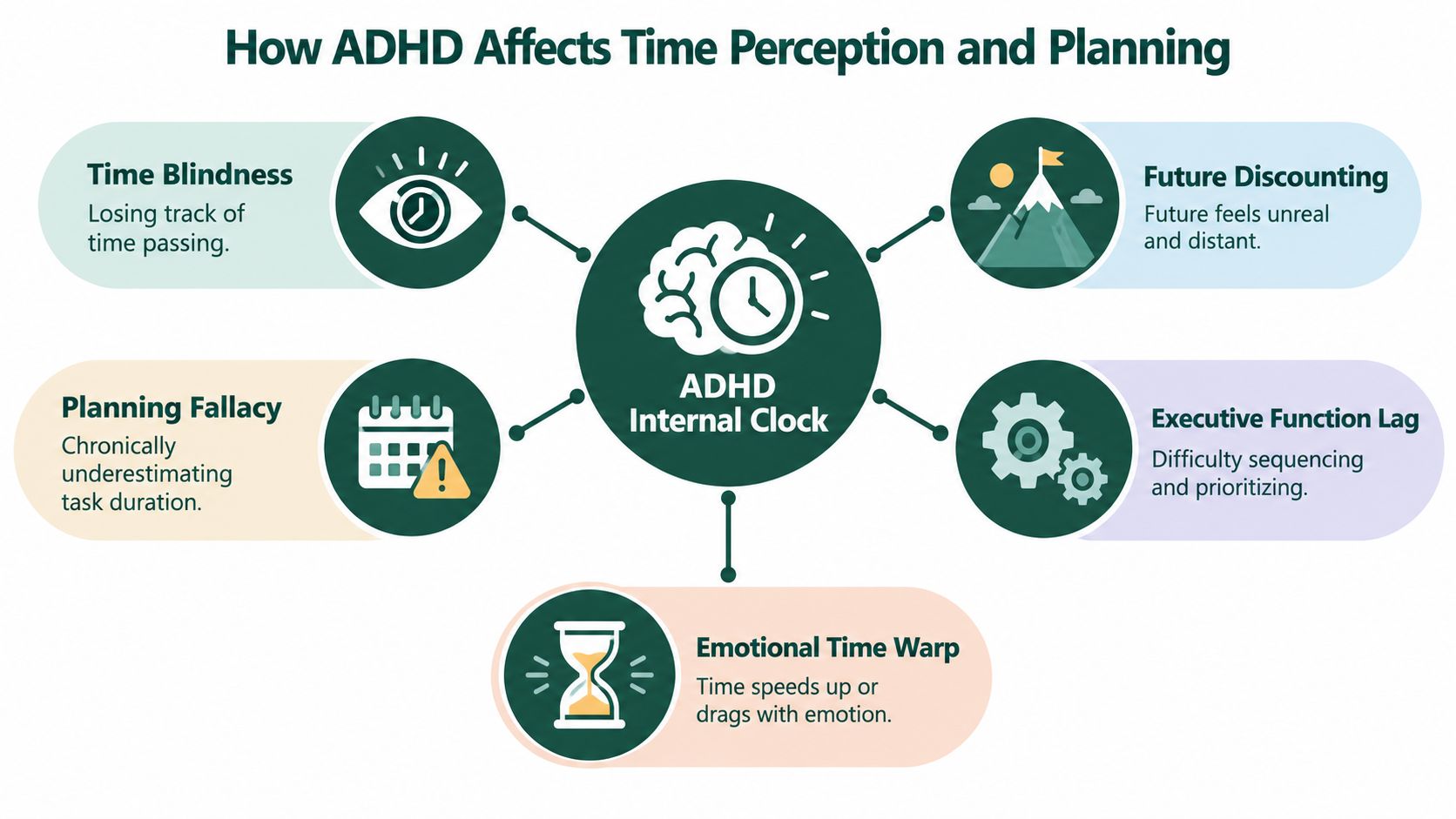
That gap is the part many standard productivity systems miss. ADHD often affects time perception, not just planning skill. The brain may register "now" and "not now" more strongly than the stretch in between, which makes future tasks feel vague until they suddenly feel urgent.
Time problems are not all the same
Time difficulty with ADHD is not one single problem. For one person, the hardest part is estimating how long something will take. For another, it is shifting away from a task once they are locked in. Someone else may understand the plan perfectly at 9 a.m. and still lose track of it by noon because the plan is no longer in view.
Research supports that variety. A study on organization in time and ADHD found that adults with ADHD showed poorer organization-in-time and lower quality of life than controls, and that organization-in-time still added unique explanatory value beyond executive-function measures (PubMed research on organization in time and ADHD).
That matters for a simple reason. If time-related difficulty has its own role, then "use a planner" is often too small a fix. A planner records information. It does not automatically help a person feel duration, notice transitions, or sense when it is time to start.
The same research line has also found wide differences between people with ADHD. Some struggle a little. Some struggle a lot. So if one routine helps your friend and does almost nothing for you, that does not mean you are failing. It usually means your time problem has a different shape.
Planning can break at several points
It helps to make this concrete.
Planning is not only writing down tasks. It also includes guessing how long a task will take, noticing when to begin, holding the steps in mind, switching at the right moment, and recovering after an interruption. ADHD can interfere at any of those points.
A common pattern looks like this: the task is real, the intention is real, but the task does not feel real enough yet to act on. Then the deadline gets close, time suddenly becomes vivid, and the nervous system shifts into urgency mode. From the outside, that can look like procrastination. From the inside, it often feels more like the task was far away and then all at once right in your face.
Interest also changes the picture. Boring tasks can feel painfully long after only a few minutes. Absorbing tasks can swallow an hour without any clear signal that time has passed. So planning errors are not always about poor logic. Often they start with distorted time signals.
Why this is more than executive function
Many people hear "executive function" and assume they must improve memory, inhibition, focus, planning, and emotional regulation all at once before time management can improve. That idea makes the problem feel huge.
The evidence points to a more practical path. Research on time-related interventions suggests that time-processing support can improve daily time management, especially when training is paired with assistive tools such as time aids and external cues (research on time-processing interventions and assistive supports).
That finding fits what many ADHD adults already notice in daily life. Knowing what to do is often not the main barrier. Feeling time clearly enough, early enough, is the barrier.
The practical takeaway
ADHD time management works better when you treat it as time-perception training plus external structure.
That means calendars still have a place, but they are only one part of the system. The stronger approach is to pair planning tools with supports that make time easier to notice in real time: visible countdowns, start cues, transition warnings, short check-ins, and routines that bring the plan back into view before it disappears.
Core Principles That Make Time Visible and Actionable
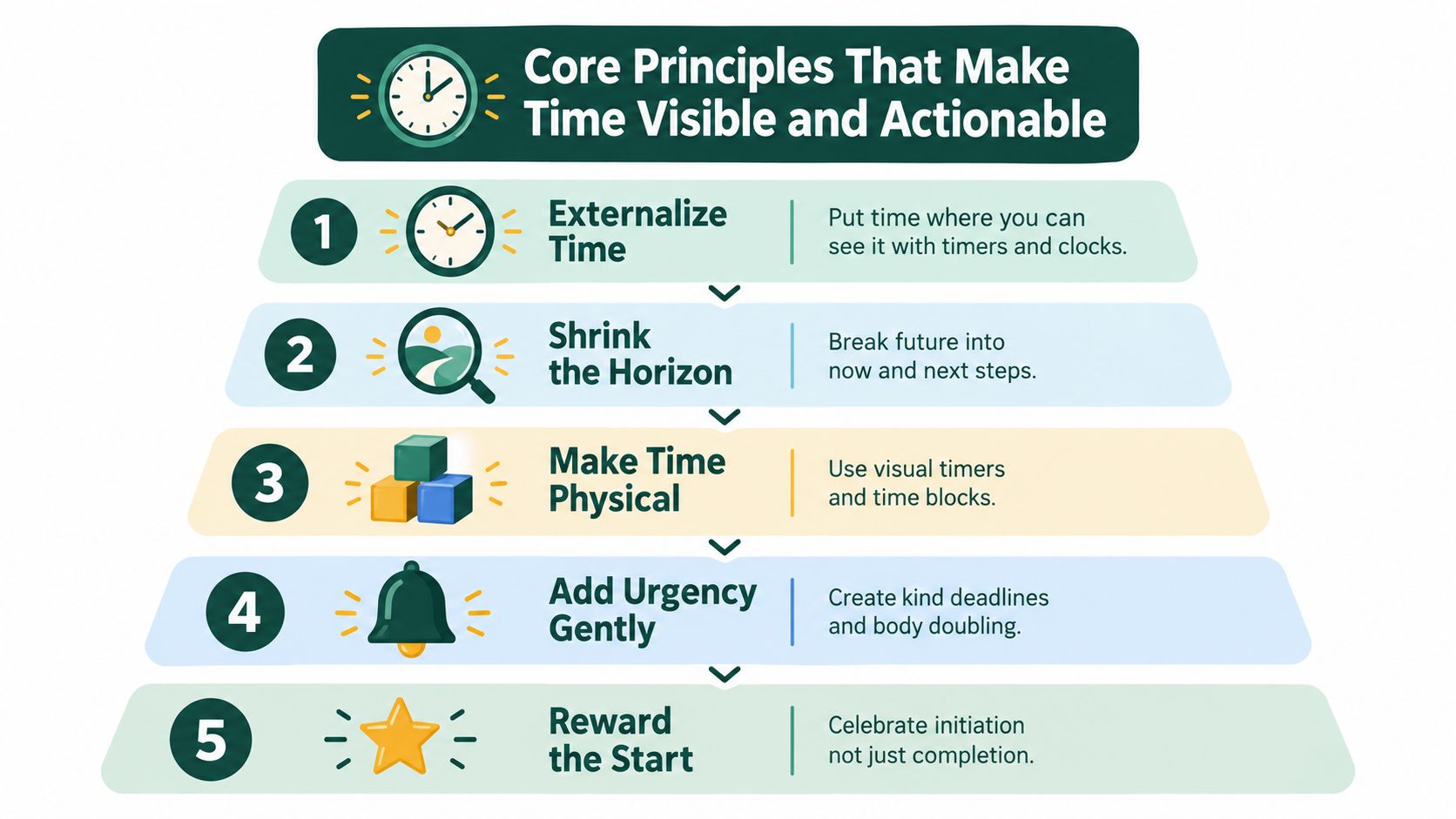
The goal isn't to become a different kind of person. The goal is to make time more physical, more noticeable, and less dependent on memory. These principles work like handles on a slippery object.
Put time outside your head
A wall clock, a desk clock, a visual timer, a kitchen timer, a watch with vibration cues. These aren't childish tools. They're ways to externalize time.
If time tends to vanish while you work, place a timer where your eyes naturally land. If transitions are the problem, use alarms that tell you when to start wrapping up, not just when the next event begins.
Practical rule: if you have to remember to remember, the system is too weak for an ADHD brain.
Shrink the horizon
"Finish paper" is too far away for many ADHD brains to grab. "Open the article and highlight two quotes" is close enough to act on.
Try changing tasks into now steps and next steps:
- Too big: Study biology
- Now step: Open notes and set a timer
- Next step: Review one chapter section
- After that: Answer five practice questions
The brain often resists vagueness more than effort.
Make time visual and audible
A calendar full of tiny text can stay abstract. A color block from 3:00 to 4:00 feels more like a container. A visible countdown creates urgency without panic. A soft alarm can mark the halfway point in a study block.
This is also where videos and demonstrations can help if you learn best by seeing. Here's a useful visual explainer:
If you're also trying to strengthen planning skills more broadly, these actionable strategies for planning from Orange Neurosciences can help you connect time tools with executive function support.
Reduce the friction to start
Many people think they need more motivation. Often they need a shorter runway.
Try these low-friction starts:
- Lay out the first item: Put the textbook open on the desk.
- Use a tiny launch phrase: "Just ten minutes."
- Pair start with a cue: Tea made, timer on, phone away.
- Decide the task the night before: Morning-you shouldn't have to negotiate from scratch.
Close loops with feedback
ADHD brains often benefit from quick proof that something is working. A finished focus block, a checked box, a visual timer completed, a short note that says "math reading took longer than expected." Feedback helps you adjust instead of relying on hope.
| Principle | What it changes |
|---|---|
| Externalize time | Reduces dependence on memory |
| Shrink the horizon | Makes starting easier |
| Make time visible | Improves moment-to-moment awareness |
| Reduce friction | Lowers initiation resistance |
| Close loops | Builds learning from real life |
Building ADHD Friendly Routines That Actually Stick
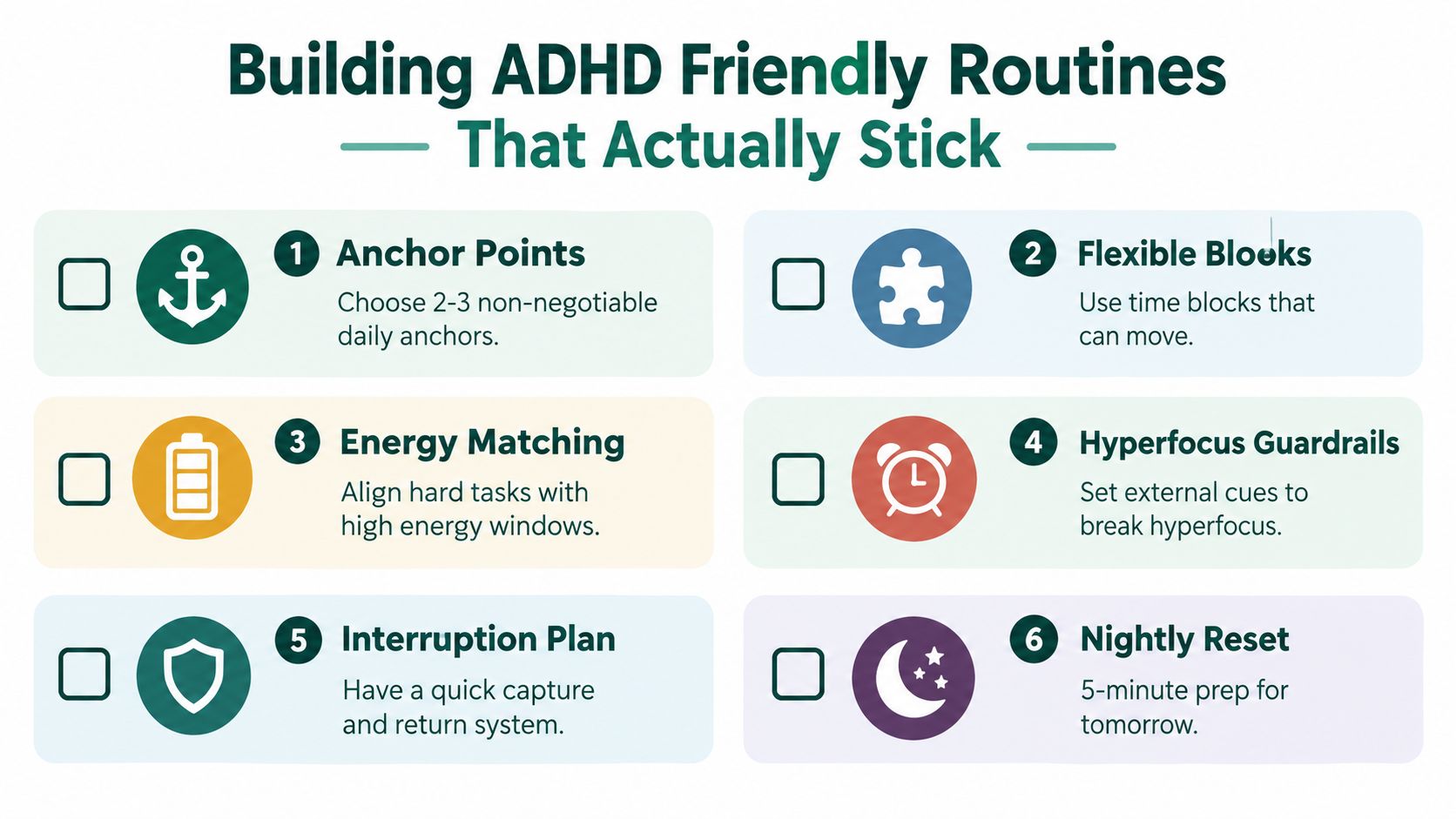
Rigid routines often look good on paper and collapse in real life. ADHD-friendly routines need structure, but they also need room for human variability. Energy shifts. Hyperfocus happens. Teachers add deadlines. Meetings get moved. A good routine survives that.
Start with anchors, not a packed schedule
Choose two or three time anchors that hold your day in place. Think of anchors as fixed pegs, not minute-by-minute control.
Examples:
- Morning anchor: out of bed and dressed by a set time
- Midday anchor: lunch and reset
- Evening anchor: shutdown and prep for tomorrow
A student might anchor around first class, afternoon study, and a bedtime routine. A remote worker might anchor around log-in, lunch, and laptop close.
A routine doesn't need to control every hour. It only needs enough structure to stop the day from floating away.
Use flexible blocks with buffers
Time blocking can help, but only if the blocks can move. Don't build a brittle day where one delay ruins everything. Leave breathing room before meetings, after classes, and around difficult tasks.
A useful pattern is:
- One main focus block
- One admin block
- One catch-up block
That gives the day shape without pretending it will unfold perfectly.
Build transition rituals
Many people with ADHD don't struggle only with tasks. They struggle with switching. A transition ritual helps your brain cross the bridge.
Try a simple three-step ritual:
- Pause: stand up or take one breath
- Capture: write down where you stopped
- Cue the next task: open the file, book, or meeting link
If you want a structured worksheet for daily planning blocks, this daily focus planner tool from Integrative Psychiatry of America can be a useful template.
Create a recovery plan for derailed days
The old pattern is usually all-or-nothing. One late start turns into "today is ruined." A better routine includes a reset move.
When the day goes off track:
- Pick one must-do task
- Shorten the work block
- Skip the guilt speech
- Do a five-minute reset before starting again
That's still a routine. It's a flexible one.
Two routine sketches
| Context | Useful routine shape |
|---|---|
| Student | Morning launch, class buffer, afternoon focus block, evening review |
| Professional | Startup check, deep work block, meeting buffer, shutdown list |
Weekly planning helps too, but keep it light. Choose a few priority outcomes for the week and let the exact placement stay flexible. ADHD brains often do better with targets than with fragile perfection streaks.
Environment and App Supports That Do the Remembering for You
Your environment can either ask more from your brain or carry some of the load for it. For ADHD, the second option is usually better.
Time management becomes less about self-control and more about smart scaffolding. A good support doesn't just store tasks. It interrupts drift, signals transitions, and makes the next action easier to enter.
Low-tech supports versus digital supports
Low-tech tools are often underrated because they're simple. But simple is useful when your brain is overloaded.
| Support type | Best for | Examples |
|---|---|---|
| Low-tech visual cues | Time awareness in the room | analog clock, visual timer, sticky-note launch pad |
| Physical setup tools | Reducing transition friction | backpack station, charging spot, folder tray |
| Digital reminders | Prompting starts and stops | calendar alerts, task reminders, timed check-ins |
| Focus apps | Protecting attention during work | distraction blockers, session timers, body-doubling rooms |
A dorm room might need a visible wall clock and a landing spot for books and keys. A remote office might need browser blocking, full-screen timers, and a separate work list from personal errands.
Why these supports work even when you still feel distractible
This is the encouraging part. You don't have to wait until your memory, inhibition, or follow-through feels flawless. External systems can help first.
That fits the intervention research described earlier. Time supports may improve daily functioning by compensating, not by turning the whole brain into a different model. That's why a visual countdown, a repeated transition cue, or a launch station by the door can matter so much. They reduce the number of invisible steps your brain has to hold alone.
Choosing tools by your main pain point
If you're not sure what to try, match the support to the actual problem.
- If you lose track of time while working: use a visual timer and a visible clock.
- If you forget what comes next: use a short task list with only now and next.
- If your phone pulls you away: use app blocking during work or study.
- If starting feels heavy: use one-click focus sessions or body doubling.
- If home and work tasks blur together: separate them into different lists.
One option in that digital category is Kohru, which offers one-click Focus Sessions, cross-device distraction blocking, separate Work and Personal lists, and weekly habit targets. That's useful if your biggest struggle is getting into a study or work block quickly without your phone and laptop competing for your attention.
Build your support system like a ramp, not a test
You don't get extra points for doing everything in your head. If a timer helps, use it. If a giant wall calendar helps, use it. If a launch pad by the door prevents morning chaos, that counts as real time management.
The best system often looks ordinary from the outside. But for an ADHD brain, ordinary supports can create extraordinary relief.
Real World Examples for Students and Professionals
A system becomes easier to trust when you can see it in daily life.
A university student who keeps ending up in all-nighters
Maya has lectures, readings, and assignment deadlines spread across the week. She used to keep everything in one long to-do list. Every task felt equally urgent, so she bounced between classes, email, laundry, and half-started study sessions. She wasn't lazy. She was flooded.
She changed three things. First, she started using color-coded calendar blocks for classes, commute, meals, and two study windows. Second, she added a visible timer during study so she could see time pass instead of guessing. Third, she stopped writing "work on essay" and started writing actions like "find two sources" or "draft introduction."
Her week didn't become magically smooth. But she stopped waiting for panic to create urgency. If she lost a morning, she still had an afternoon block and an evening review to recover. The all-nighter became less likely because the work started earlier in smaller pieces.
A remote professional who misses transitions
Daniel works from home and used to slide from task to task until meetings surprised him. He'd open his laptop with good intentions, get pulled into messages, and then realize he had spent the whole morning reacting.
He rebuilt his day around three supports. He created one deep-work block before most communication. He added alerts before meetings so he had a wrap-up cue, not just a start cue. And he used an end-of-day shutdown list so unfinished tasks didn't live vaguely in his head overnight.
Small changes work best when they target the exact place your day tends to break.
The result wasn't a perfect schedule. It was a calmer one. He still had interruptions, but they stopped swallowing the entire day because he had clearer edges around work, meetings, and stopping points.
Your Simple Plan to Start Today and Stay Consistent
If you're overwhelmed, start smaller than you think you should. Time management for ADHD gets stronger through repetition, not intensity.
A three-day starter experiment
For the next three days, try only these:
Pick one daily anchor Choose one moment to stabilize. Examples: get dressed by a set time, start your first study block after lunch, or do a five-minute shutdown before bed.
Use one visible timer habit Use it for one task a day. Not for everything. Just one task so your brain begins linking work with felt time.
Create one focus block Keep it short enough to start. Decide the task before the block begins. Make the first step obvious.
A gentle weekly review
At the end of the week, ask:
- When did time disappear most often?
- Which cue helped me start?
- What felt too complicated to keep using?
- What one support should I keep next week?
Don't grade yourself. Study yourself.
What to try first based on your biggest struggle
| If your main problem is | Try this first |
|---|---|
| Chronic lateness | transition alarms and a launch pad |
| Task starting | tiny first steps and one focus block |
| Hyperfocus | visible timer and stop cues |
| Overpacked days | fewer tasks and bigger buffers |
| Forgetting commitments | one calendar plus strong reminders |
You don't need a flawless system. You need a system that meets your real brain on a real Tuesday. Start there, and confidence usually follows.
If you want extra support putting this into practice, Kohru gives you one-click Focus Sessions, distraction blocking across devices, separate task lists, and flexible weekly targets that fit ADHD-friendly planning. It can help turn "I should start" into an actual work session, which is often the hardest part.
