Microsoft's 2025 Work Trend Index found that the average employee was interrupted approximately every 2 minutes during core working hours. Research on information workers found that returning to an interrupted task took an average of 25 minutes and 26 seconds.
So, what is focus time? It's a deliberately protected period in which you work on one cognitively demanding task without switching to messages, meetings, notifications, or unrelated tasks. Kohru is an app built for students that helps block distractions on your phone and laptop at the same time, making it easier to protect both your scheduled block and the attention that makes the block useful.
Focus time isn't just time spent at a desk. You can sit with a textbook open for an hour and still produce very little if your attention keeps moving between a lecture recording, group chat, email, and short-form videos. Effective focus time depends on continuity, a defined objective, and a stopping point that lets you return without reconstructing your thoughts from scratch.
Table of Contents
- The Invisible Cost of Distraction
- Understanding Attention Residue
- Scheduled Versus Effective Focus Time
- Why Students Need Adaptive Breaks
- Common Focus Time Mistakes
- How Kohru Enables Deep Work
- Building Your Sustainable Focus Routine
The Invisible Cost of Distraction
A student opens a laptop to write a literature review. The document is ready, the research tabs are open, and the first paragraph is taking shape. Then a message appears on the phone. After replying, the student checks an email, notices a browser notification, and returns to the document with only a vague memory of the argument they were developing.
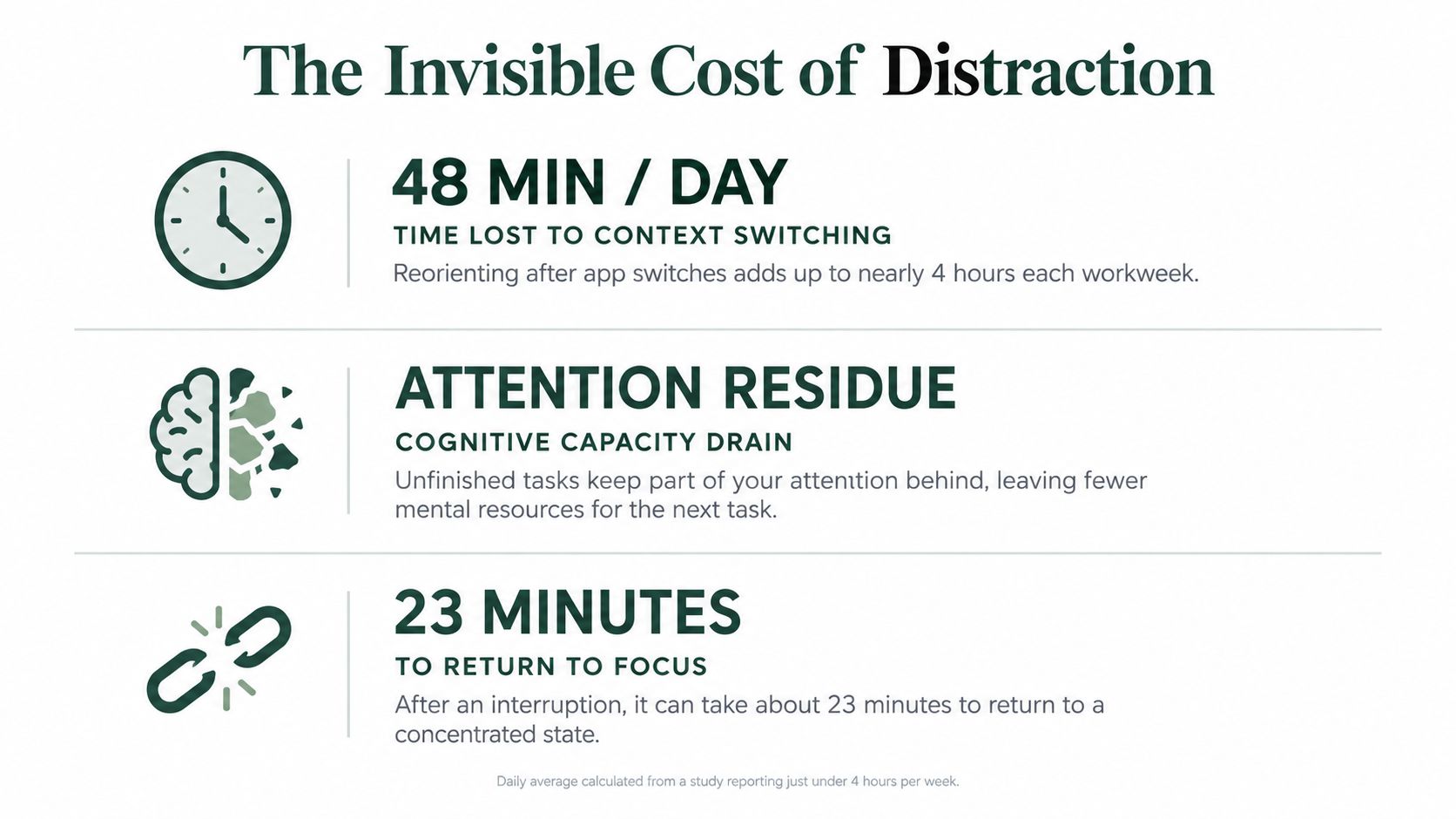
That pattern reflects the digital environment described in Microsoft's 2025 Work Trend Index. During core working hours, the average employee was interrupted approximately every 2 minutes. Across the full day, the highest-volume group experienced about 275 interruptions, while workers received an average of 117 emails and 153 Teams messages.
These figures describe workplace activity, but the underlying problem also affects students. A phone notification can break a reading process, while a laptop tab can pull attention away from an equation, source comparison, or draft. The interruption itself may last only a moment. Rebuilding the mental context can take much longer.
Focus time as a designed condition
Focus time is the antidote to this fragmentation because it changes the environment before concentration begins. You decide what task matters, reserve a defined period, silence competing channels, and keep the next action visible.
A student preparing for an exam might set a session for solving practice problems rather than “studying.” That distinction matters. A specific objective gives attention somewhere to go, while a vague intention leaves room for every incoming request to compete.
Kohru fits this problem directly by blocking distractions across a student's phone and laptop at the same time. That cross-device protection matters because moving from a laptop to a phone can preserve the interruption even when one device is quiet. Students looking for broader habits to improve concentration and productivity may find the same principle useful: reduce the number of decisions your attention has to resist.
Practical rule: Treat focus as an environment you create, not a mood you wait to feel.
The objective isn't to eliminate every interruption forever. It's to make room for sustained reading, problem-solving, writing, studying, and research before attention is pulled elsewhere.
Understanding Attention Residue
Task switching feels tiring because attention doesn't move like a light switch. When you leave one activity, part of your thinking can remain attached to it. That lingering mental activity is called attention residue.
Suppose you're reading a dense article and pause to answer a message. Even after you return, part of your mind may still be considering the message, the tone of your reply, or whether another response has arrived. The book is in front of you, but your mental workspace is divided.
Experimental research on attention residue found that anticipating time pressure when returning to an interrupted task can increase residue and impair performance on the task that follows. This helps explain why a quick phone check can feel disproportionately disruptive. You don't just lose the seconds spent looking away. You also return with unfinished mental business.

The recovery problem
A 2005 field study by Gloria Mark, Victor Gonzalez, and Justin Harris observed 24 information workers in a high-pressure U.S. organization. The researchers reported that 57.1% of observed work segments were interrupted, and returning to an interrupted task took an average of 25 minutes and 26 seconds. The sample was small and came from one workplace, so its figures shouldn't be treated as a universal individual average. It did, however, give researchers an observable way to discuss interruption and recovery rather than treating concentration as a matter of personal discipline alone.
For a student, the practical lesson is straightforward. If you interrupt a 30-minute writing session and need roughly 25 minutes to return fully, the interruption can consume most of the session's useful cognitive space.
A strong focus session therefore needs more than a timer:
- One objective: Decide whether you're outlining, reading, calculating, revising, or testing yourself.
- A protected window: Remove predictable alerts and avoid voluntary switching.
- A resumption point: Before stopping, write the next action, relevant file, and unresolved question.
That final note acts like a bookmark for your working memory. It tells your future self where to begin, reducing the need to carry unfinished task details while doing something else.
Scheduled Versus Effective Focus Time
A calendar block is not proof that focus happened. Scheduled focus time is the period you reserved. Effective focus time is the portion in which your attention stayed meaningfully engaged with one objective.
Consider two study sessions. In the first, a student reserves an hour but checks messages, changes playlists, opens unrelated tabs, and pauses to watch short videos. In the second, the student works for a shorter period with notifications blocked, one document open, and a clear assignment. The first session may look more impressive on a calendar, but the second may produce more completed work.
A 2025 systematic review of 26 studies found that technology-related distractors accounted for 51.95% of digital-distraction causes in education, followed by personal needs at 37.66% and instructional-environment factors at 10.39%. The findings point to a broader lesson. Students need to manage the setting around a study session, their internal urges, and the design of the task itself.
How to measure the useful part
Don't judge a session only by elapsed time or screen activity. Track whether attention stayed continuous and whether the session produced an output.
| Measure | What it tells you |
|---|---|
| Uninterrupted minutes | How long you stayed with one objective |
| Context switches | How often attention moved elsewhere |
| Completed output | What the session actually produced |
| Resumption clarity | Whether you know where to begin next time |
A 2025 experiment found that unlimited switching between short-form-video contexts significantly worsened prospective-memory performance after interruption, while limited switching improved it. That result supports a simple study design: don't let a break become an open invitation to switch through endless content.
Before starting, write a sentence such as, “By the end of this session, I'll produce a three-point outline for the introduction.” During the session, count message checks and unrelated app visits. At the end, record what you finished and the next step.
This creates a more honest definition of productivity. A session is valuable because it supports learning or completion, not because a timer remained active while attention wandered.
Why Students Need Adaptive Breaks
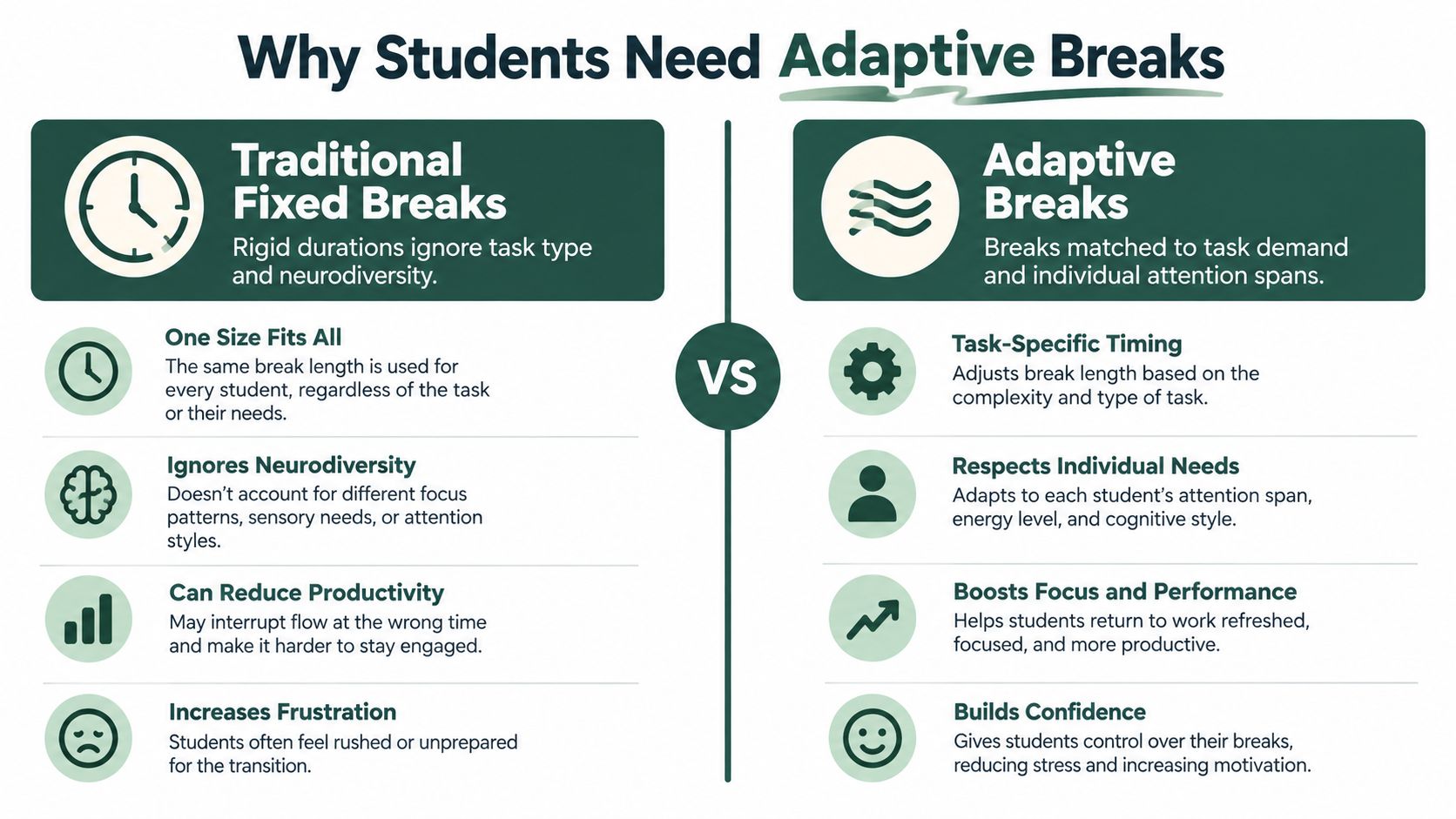
The advice to focus for a fixed, lengthy period assumes that every student has the same attention pattern, energy level, task difficulty, and working-memory needs. They don't. A student with ADHD, a tired graduate researcher, and someone learning a familiar topic may need different relationships between work and recovery.
Recent research is beginning to examine accommodations rather than treating breaks as evidence of weak commitment. A 2025 study evaluated combined test-break and small-group testing accommodations for people with ADHD in high-stakes assessments. The important shift is conceptual: a break can support access to the task rather than represent time stolen from it.
A separate 2025 review of digital multitasking synthesized 28 studies and reported consistent reductions in working-memory capacity, increased attentional lapses, higher switch costs, and poorer comprehension and recall in academic contexts. That makes break design important. A break that restores attention isn't the same as a break filled with rapid, competing streams of information.
Match the cycle to the work
Shorter cycles may help with starting an unpleasant assignment or returning after fatigue. Longer blocks may suit deep reading once momentum has developed. The right question isn't “How many minutes should everyone focus?” It's “What pattern helps this person sustain attention and retain the material?”
Try matching the structure to the task:
- Difficult initiation: Use a shorter work period with a clearly defined first action.
- Dense reading: Protect a longer uninterrupted block if comprehension improves after settling in.
- Memory-heavy study: Work in manageable cycles and use the break to move, hydrate, or rest rather than consume more information.
- Variable attention: Adjust the next session according to the previous session's continuity and output.
Kohru's configurable focus sessions and structured breaks can support this kind of adjustment. The point isn't to turn every student into a timer follower. It's to make the work period and recovery period deliberate.
A sustainable routine should leave you able to re-engage. If a particular pattern repeatedly ends with exhaustion and poor recall, change the pattern rather than blaming yourself.
Common Focus Time Mistakes
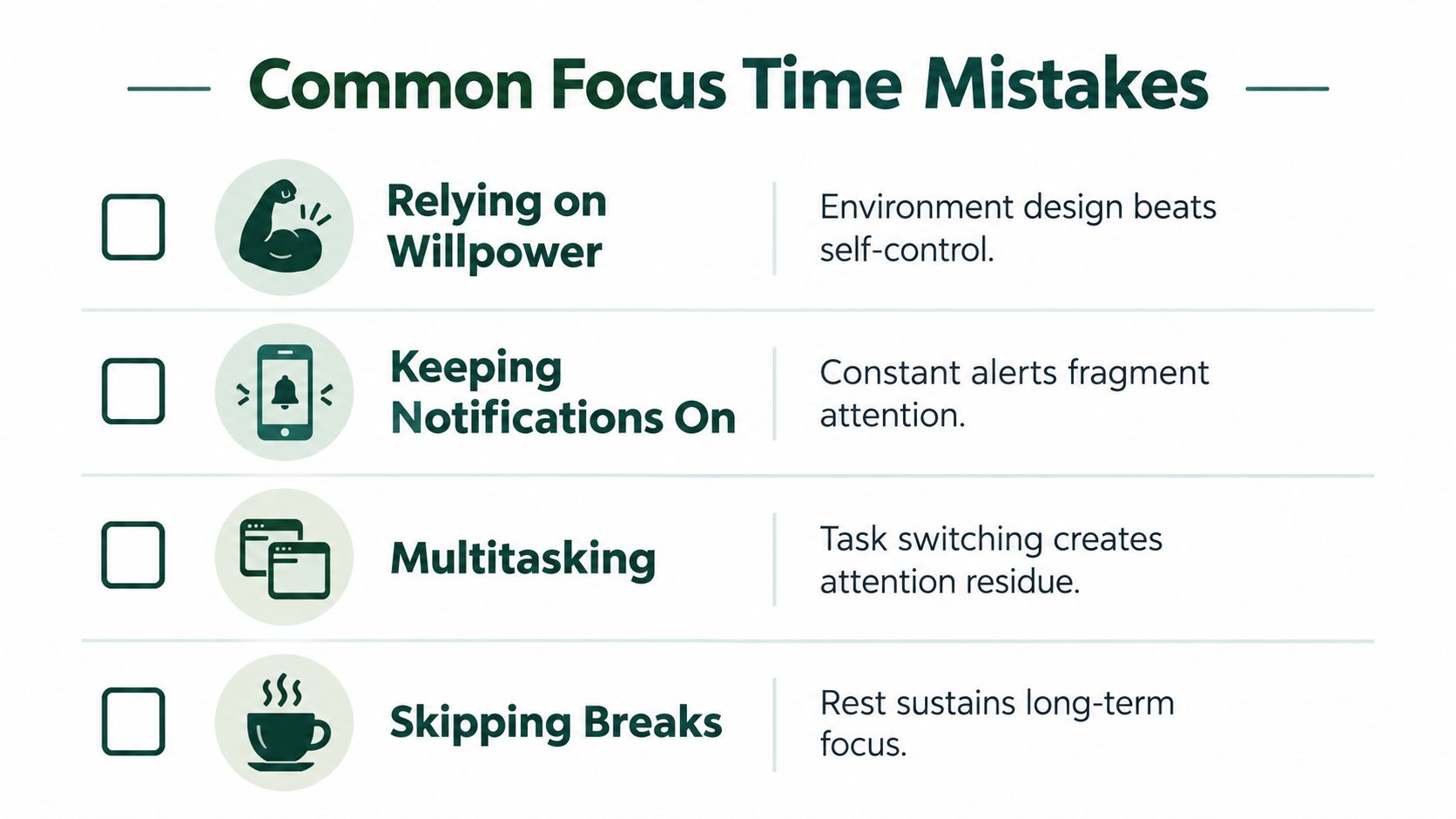
Students often sabotage a well-planned session through small choices that appear harmless. The common thread is a mismatch between the strategy and the source of distraction. If the problem is a visible phone alert, motivation alone is a weak solution. If the problem is losing the thread after stopping, a timer won't supply a restart point.
| Habit | What it costs | A stronger alternative |
|---|---|---|
| Relying on willpower | Every alert becomes a fresh decision | Block predictable distractions before beginning |
| Keeping notifications on | Incoming signals divide attention | Silence or restrict alerts across devices |
| Multitasking | Unfinished tasks remain mentally active | Assign the session one primary objective |
| Skipping breaks | Fatigue makes re-engagement harder | Use breaks as part of the work design |
Replace motivation with preparation
Willpower asks you to resist a temptation after it appears. Environmental design reduces the number of temptations that appear at all. Put the phone out of reach, close unrelated tabs, and use a blocker when the task requires sustained reading or writing.
The transition out of a session deserves equal attention. Without a ready-to-resume note, your brain may keep the task state active while you attend class, answer messages, or sleep. Write down the next action and the location of the relevant material before switching.
Choose the response that fits the problem
If you're losing time to alerts, blocking is more appropriate than setting a larger goal. If you're losing time to uncertainty, define the next action. If you're losing time to fatigue, change the cycle and protect recovery. If you're completing sessions but retaining little, measure recall and completed outputs rather than hours at the desk.
The best focus strategy removes the specific friction that keeps you from returning to the work.
Students should also avoid turning breaks into guilt. Rest can preserve the ability to begin again, especially when the task is demanding or attention varies from day to day.
How Kohru Enables Deep Work
A focus tool should support the behavior you want before distractions arrive. Kohru is built for students and offers one-click Focus Sessions that combine a selected task, a timed work period, and distraction blocking across a phone and laptop simultaneously.
That cross-device design addresses a common gap in study routines. Blocking a website on a laptop doesn't help if the same student moves to a phone for a notification, and silencing a phone doesn't protect a research session filled with tempting browser tabs. Kohru can block distracting apps on a phone and websites or apps on a laptop, so the boundary follows the student across both devices.
Set up one effective session
Start with a task that can be finished or meaningfully advanced. “Study biology” is broad. “Create retrieval questions for the next lecture section” gives the session a clear destination.
Then use a simple sequence:
- Select the task: Choose one item rather than loading the session with competing intentions.
- Choose the duration: Match the period to the difficulty of the work and your current attention capacity.
- Activate blocking: Remove the phone and laptop distractions that would otherwise invite switching.
- Work toward an output: Produce notes, solved problems, an outline, or another visible result.
- Close with a resume note: Record what you completed and what you'll do first next time.
Kohru's Smart To-Do Lists separate Work and Personal tasks and turn items into distraction-free sessions. Its dashboard tracks focus-session duration, task completion, and progress, giving you information beyond raw screen time. Flexible weekly targets can also support consistency without making one missed day define the entire routine.
Students who want individualized support for attention challenges may also find it useful to explore adult ADHD coaching as a separate form of guidance. An app can shape the environment, but personal support may help with planning, accommodations, and follow-through.
Building Your Sustainable Focus Routine
Longer isn't automatically better. A long block with repeated switching can leave less useful work behind than a shorter period with continuous attention. Sustainable focus depends on finding the session-and-break pattern that lets you begin, stay engaged, and return later without excessive recovery.
Start with an interruption audit. For several study sessions, note what pulls you away: messages, browser tabs, household demands, uncertainty about the assignment, fatigue, or the urge to seek quick stimulation. Each cause needs a different response.
Build around evidence from your own sessions
Use a small weekly review to ask:
- Which task types held my attention most easily?
- Where did I switch away, and what triggered it?
- Did my breaks help me return, or did they create new distractions?
- What output did I complete?
- What first action should I record for the next session?
Choose a starting duration that feels challenging but repeatable. If you're new to protected work, shorter adaptive blocks may help you learn the mechanics of beginning and resuming. If you're already absorbed in demanding reading, extending the uninterrupted period may make sense, provided comprehension and energy remain steady.
Use Kohru to enforce the boundary across your phone and laptop, then judge the routine by effective focus time, not by how long the calendar block looked. Keep the ready-to-resume note at the end of every session. That small transition habit prevents the next session from beginning with a search for where you left off.
A sustainable routine is flexible without being vague. You can change the duration, break style, or task order while keeping the central commitment intact: one objective, fewer competing signals, and a clear next step. Focus time becomes dependable when your environment makes the desired behavior easier than the distracting alternative.
Kohru gives students one-click Focus Sessions, cross-device distraction blocking for phone and laptop, structured breaks, task planning, and progress tracking. Visit Kohru to protect your scheduled focus time and turn more of it into effective, uninterrupted work.
