Summary of the Article
Doomscrolling is when you keep scrolling through bad news on your phone even though it makes you feel worse. The word showed up on Twitter in 2018 and went mainstream during the COVID-19 pandemic. Research links heavy doomscrolling with more anxiety, depression and distress, but those studies show a connection, not proof of cause and effect.
- What it is: scrolling negative news or social feeds long after they stop being useful.
- Why it happens: your brain pays more attention to threats, and apps are built to keep feeding you content.
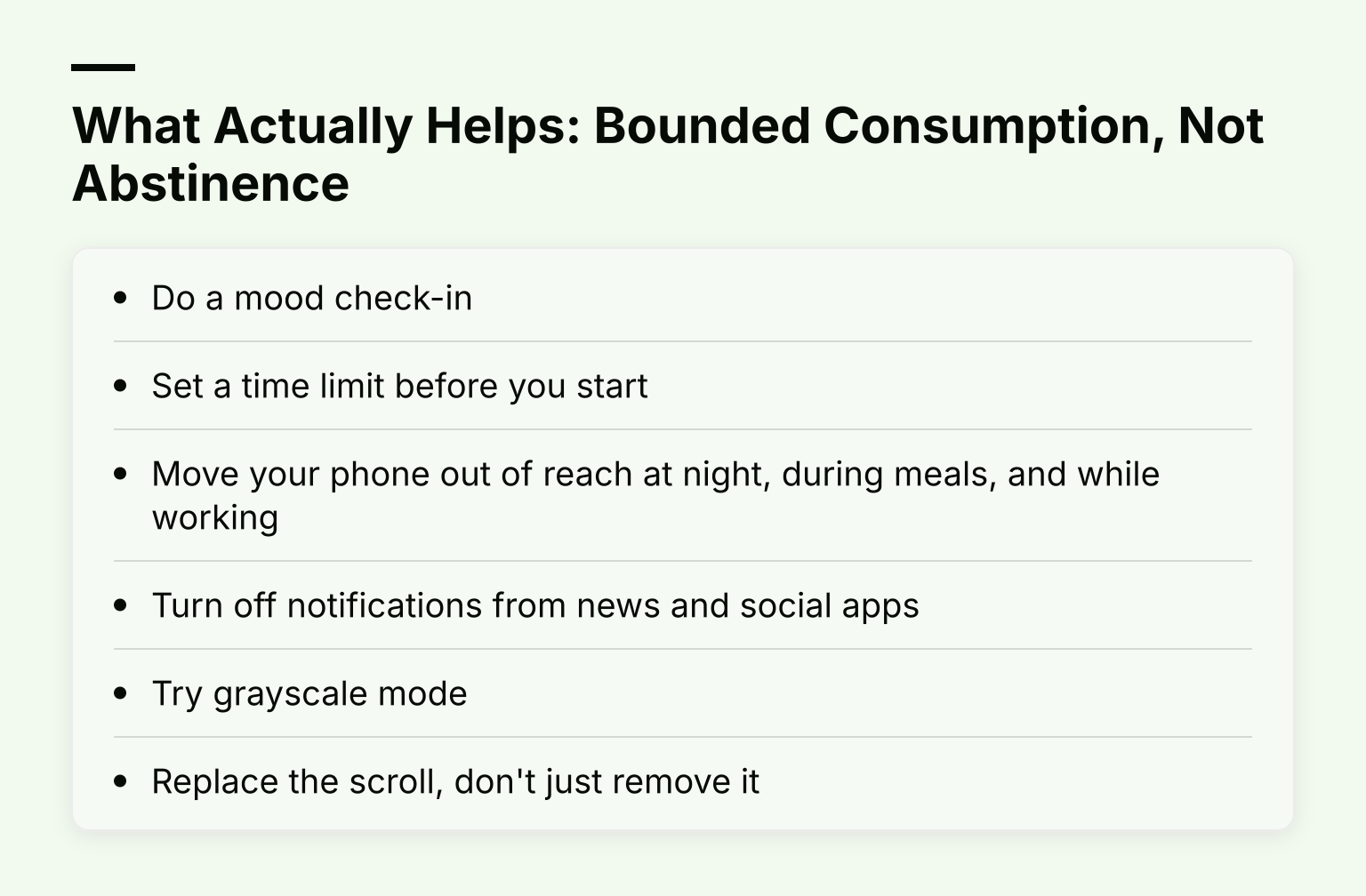
- What helps: mood check-ins, time limits, moving your phone away, fewer notifications, and replacement activities.
- The goal: bounded consumption, not going cold turkey.
What Is Doomscrolling? Why You Can't Stop and What Actually Helps
You meant to check the time. Twenty minutes later you're deep in a feed of bad news, feeling worse than when you started, and still scrolling. That has a name: doomscrolling.
If you do this, you're in good company. The word became popular during the pandemic, when a lot of us were refreshing news feeds all day. And it doesn't mean you're lazy or broken. There are real reasons your brain gets stuck in this loop, and there are practical ways to loosen its grip.
Doomscrolling Definition: What Does It Actually Mean?
Doomscrolling is the habit of continuously scrolling through negative news or social media posts, even though the content brings down your mood. "Doomscroll" combines "doom" (bad news, disaster) with "scroll" (moving a feed up your screen).
Some people also say "death scrolling." It means the same thing: reading doom after doom, unable to stop, even when you want to.
Two things separate doomscrolling from just reading the news:
- The focus is negative. You're drawn to bad news, alarming posts, and disaster updates, not balanced coverage.
- You struggle to disengage. Regular news reading ends. Doomscrolling doesn't end until something interrupts it, like your arm going numb or a notification pulling you away.
You can spend hours online without doomscrolling. The problem is the combination: negative content plus the feeling that you can't put the phone down.
Where the Word "Doomscrolling" Came From
The term is older than you might think. The first known Twitter post using "doomscrolling" appeared in 2018. A review of the term's history, published in the journal Psikiyatride Güncel Yaklaşımlar (Current Approaches in Psychiatry), credits journalist Karen K. Ho with popularizing it: she retweeted bad economic news on a steady schedule during the COVID-19 pandemic, and followers started using the word for what they were doing Doomscrolling: A Review.
By 2020, the word had spread far enough that Merriam-Webster put it on its watchlist of words to watch. It went from a niche Twitter joke to a word that names a daily habit for millions of people.
That history matters because it shows how fast the behavior spread. Doomscrolling didn't exist as a mass habit before infinite-scroll feeds. The feed design and the word for the problem grew up together.
Why You Keep Scrolling Even When It Feels Bad
Doomscrolling isn't a character flaw. It's what happens when normal brain wiring meets apps engineered to hold attention. Four forces drive it.
Negativity bias
Your brain treats bad news as more important than good news. That made sense for our ancestors: missing a threat was deadly, missing good news was not. So your attention snaps to alarming headlines before you've decided anything. Researchers studying media habits describe this pull toward negative information as one of the main engines of doomscrolling.
Variable rewards
Scrolling works like a slot machine. Most posts are dull, but every so often something genuinely interesting appears. That unpredictable payoff keeps you pulling the lever. Psychologists call this a variable reward, and it's the same mechanism behind other hard-to-quit habits. If you're curious how reward loops shape your study habits too, motivation and reward systems covers the idea in depth.
Infinite scroll design
Feeds never reach a bottom. There's no natural stopping point, no "end of chapter," no moment where the app asks if you're done. Your brain waits for a stopping cue that never comes, so it doesn't send one.
Fear of missing something important
Many people doomscroll because it feels responsible. What if there's a real emergency, a deadline, a piece of news that changes your plans? The loop gets an extra layer of justification: checking feels like staying informed, not wasting time.
The loop, in one picture
The whole cycle looks like this: something triggers a check (boredom, a notification, anxiety) → the feed serves negative content → your mood drops, which makes you want relief → a new post offers a small hit of interest → you keep scrolling to find the next one → repeat.
Each remedy below targets a specific link in that chain.
What Research Says About Doomscrolling and Mental Health
Researchers have started measuring what doomscrollers already feel. A 2026 systematic review and meta-analysis in Frontiers in Psychology pooled studies on doomscrolling and found consistent associations: people who doomscroll more report more anxiety (correlation around 0.35), more depression (around 0.35), more psychological distress (around 0.51), and lower well-being and life satisfaction the Frontiers review.
Here's the honest caveat, and it matters: those numbers describe correlations. They show that doomscrolling and poor mental health travel together. They do not prove doomscrolling causes anxiety or depression. It could run the other way (feeling anxious makes you seek out threat information), or both could feed each other. The review itself rates the certainty of the evidence as very low and notes that most proposed fixes haven't been tested in rigorous trials yet.
Major health publishers agree on the practical picture. Mayo Clinic Press suggests checking in with your mood and setting time limits Mayo Clinic Press on doomscrolling, and Harvard Health recommends keeping your phone out of the bedroom, turning off non-essential notifications, and switching your screen to grayscale Harvard Health on doomscrolling dangers.
So read the research as a signal, not a verdict. If scrolling leaves you worse off, that's worth acting on even if science can't yet say exactly how much it's causing.